
Best USB Audio Interfaces for Low Latency and Clear Recordings
Answering the need for near-zero lag and pristine sound, this guide highlights five USB audio interfaces suited for fast, responsive recording, streaming, and podcasting. Each pick targets different user types—home studio singers, podcasters, guitarists, or streamers—helping you choose based on latency, input options, and ease of use. The table below summarizes the five options to compare at a glance.
| Product | Best for | Key Benefit |
|---|---|---|
| Focusrite Scarlett Solo 3rd Gen | Vocalists and guitarists seeking pro-grade preamps | Air mode and high-quality converters |
| iCON USoloLive | Podcasters and streamers needing virtual routing | Ultra-low latency with ProDriver4 routing |
| XTUGA Q-12 | Portable setups and mobile creators | Zero latency monitoring with USB power |
| Cubilux CB5 | Multi-purpose setups and beginners | 5-in-1 hub with multiple jacks and 96 kHz/24-bit |
| M-Audio M-Track Duo | Versatile home studios and podcasts | Two inputs, easy monitoring, 48 kHz baseline |
Focusrite Scarlett Solo 3rd Gen USB-C Audio Interface

Best for: Vocalists and singer-songwriters who want studio-grade preamps and clear guitar feeds. The Scarlett Solo 3rd Gen uses high-headroom mic pre-amps and an Air mode that adds brightness to acoustic instruments, helping vocals retain presence in a mix. Its two inputs simplify simultaneous guitar and vocal recording, with Gain Halos to visually monitor levels. Latency remains low through 24-bit/192 kHz conversion, providing professional-sounding results in desktop DAWs. A limitation: it has a single instrument input, so if you need two guitars at once, you’ll need a different model or an external splitter.
iCON USoloLive USB Audio Interface with 48V Phantom Power for Podcast

Best for: Podcasters and streamers who value advanced routing and low-latency monitoring. The USoloLive leverages Ultra-Low Latency ASIO 2.0 with ProDriver4 virtual routing, enabling flexible mixing and live plugin use without distracting delay. It supports 48V phantom power for condenser mics, making it suitable for studio-quality voice work. One caveat: as a compact unit, it may offer fewer built-in monitoring options than larger interfaces, which could matter for complex live setups.
XTUGA USB Audio Interface Q-12

Best for: On-the-go creators needing plug-and-play simplicity with low latency. The Q-12 provides reliable dual inputs, 48V phantom power, and an emphasis on zero-latency monitoring suitable for quick vocal and instrument capture. The trade-off: at 16/48kHz, it prioritizes latency and mobility over the highest possible sample rate, which is fine for streaming and casual production. It’s a strong choice for travelers and laptop DJs who want immediate results.
M-AUDIO M-Track Duo USB Audio Interface
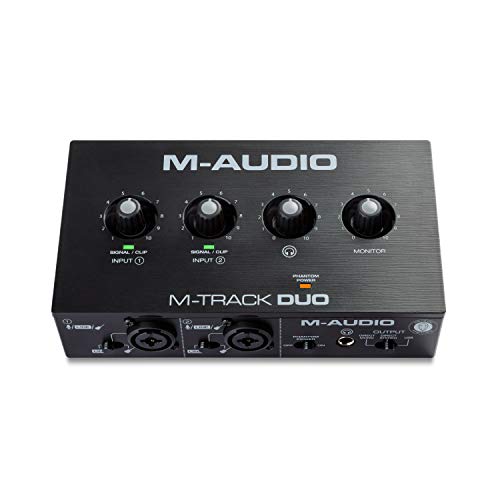
Best for: Multi-purpose home studios needing flexible inputs and straightforward monitoring. The M-Track Duo offers two combo XLR/Line/Instrument inputs, 48 kHz fixed resolution, and a direct/USB monitoring switch for nearly zero-latency listening. The dual-input design helps sessions with two microphones or a mic plus instrument, though it does not specify higher-than-48 kHz performance, which could matter for high-resolution projects. It suits podcasters and small bands seeking reliability and easy setup.
Cubilux CB5 USB Audio Interface

Best for: Beginners and creators who need a compact multi-purpose hub. The CB5 converts a laptop’s USB into multiple ports: two stereo mic jacks, line-in, line-out, and headphone jack, enabling flexible monitoring and input options. It supports multi-track recording by naming independent device streams and can capture fairly crisp sound at up to 96 kHz/24-bit with its built-in chip. A caution: the line-out and output jacks can’t be used while line-in is active, which can limit certain live monitoring setups.
Buying Guide: Key Purchase Considerations
- Latency requirements: Seek interfaces with direct monitoring and low-latency drivers (ASIO, DirectSound) for near-zero delay during recording and playback.
- Input options: Choose based on how many mics or instruments you need to connect simultaneously. Combo XLR/1/4″ inputs simplify setups.
- Sample rate and bit depth: Higher values (24-bit/192 kHz) provide more detail but require more CPU and disk space; use 24-bit/96 kHz for general use and 24-bit/192 kHz for critical tracks.
- Phantom power: If you plan to use condenser mics, ensure the interface provides 48V phantom power.
- Software routing: For streamers and podcasters, virtual routing and loopback features help mix inputs and computer audio without external mixers.
- Portability vs. expandability: Smaller units are portable; larger interfaces may offer more inputs, outs, and DSP features for complex projects.
Frequently Asked Questions
- What does “low latency” mean in an audio interface?
It refers to minimal delay between input (your performance) and output (monitoring or playback) during recording and monitoring in a DAW or streaming setup. - Do I need external drivers for latency?
Yes. Interfaces that provide ASIO drivers or dedicated Windows/macOS drivers typically deliver the most reliable, lowest latency performance. - Is 24-bit/192 kHz worth it for home use?
It provides the best possible fidelity in theory, but many listeners may not perceive the difference in casual listening; it is more beneficial in professional recording and mixing. - Can I use a USB-C interface with older laptops?
Many USB-C interfaces are backward compatible via adapters; ensure your computer supports the device’s driver requirements and power needs. - What is direct monitoring?
Direct monitoring lets you hear your input signal directly, bypassing the computer to reduce latency during recording. - Should I prioritize one with multiple inputs or better preamps?
It depends on your workflow: multiple inputs suit bands and podcasts, while high-quality preamps benefit vocal clarity and dynamic mics for solo work.
All five options emphasize low-latency paths for real-time performance, streaming comfort, and straightforward recording workflows. Each is chosen to align with typical buyer needs—vocalists, podcasters, guitar players, and multi-input setups—while providing clear reasons to opt for one model over another. Use the buying guide and FAQ to refine your choice to the interface that fits your setup and skill level.