
Best USB Audio Interface Microphone Setups for Clear Home Studio Recordings
Answer: For clean, professional-sounding recordings, a USB audio interface with robust pre-amps and versatile inputs is essential. The top picks below are best for podcasters, musicians, streamers, and remote workers who want low latency, good gain, and straightforward setup. Each product is evaluated for who it’s best for, plus any practical trade-offs. A quick comparison is provided in the intro table to help you choose at a glance.
| Product | Best For | Key Benefit |
|---|---|---|
| Focusrite Scarlett Solo 3rd Gen | Home studios, vocalists, solo musicians | Air mode, high-headroom pre-amps |
| XTUGA Q-12 | On-the-go recording, PC users | Low latency, plug-and-play |
| Cubilux CB5 | Streamers and podcasters | 5-in-1 hub with multiple outputs |
| M-AUDIO M-Track Duo | Guitarists and vocalists with monitoring needs | Two combo inputs, zero-latency monitoring options |
| MAONO PS22 Lite | Budget-conscious creators | High-resolution 24-bit/192kHz with strong pre-amps |
Focusrite Scarlett Solo 3rd Gen USB-C Audio Interface

The Focusrite Scarlett Solo 3rd Gen is best for solo artists and podcasters who need studio-grade vocal quality with simple two-input design. Its mic pre-amps deliver brightness and clarity, with an Air mode to add presence for acoustic instruments. The two high-headroom instrument inputs are ideal for guitar or bass tracking without clipping. Recording at up to 24-bit/192kHz preserves sonic detail, making it a solid choice for home studios pursuing pro-sounding results. A caution: this model focuses on single-mic input—if you need dual mics, consider a multi-input option.
Who it’s best for: solo vocalists, vloggers, and creators who want a compact interface with professional pre-amps. Why selected: its Air mode, top-tier converters, and reliable performance make it a standout for single-minger setups while maintaining a clear, bright voice.
Key notes from features: Pro pre-amps with an airy character, switchable Air mode for extra vocal clarity, high-headroom instrument inputs, and 24-bit/192kHz conversion for crisp recordings.
XTUGA USB Audio Interface for PC

XTUGA Q-12 is best for budget-conscious setups that still require reliable, low-latency recording. It provides professional-sounding 16-Bit/48kHz resolution with crystal-clear XLR and 3.5mm inputs, and it ships with phantom power capable for condenser mics. The unit powers directly from the computer, making it a strong plug-and-play option for on-the-go recording or streaming. A caution: the 16-bit/48kHz spec is lower than higher-end interfaces, so it’s best for entry-level projects or voice work rather than high-resolution music production.
Who it’s best for: mobile creators, students, and first-time buyers who want reliable USB audio with no extra gear. Why selected: straightforward setup, phantom power for mics, and zero-latency potential when paired with compatible software.
Cubilux CB5 USB Audio Interface

The Cubilux CB5 stands out for multi-input versatility in a compact chassis. It offers 5-in-1 functionality with two microphones, line-in, line-out, and a dedicated headphone jack for monitoring. This makes it a smart choice for streamers and podcasters who need flexible routing. The included 96 KHz/24-bit performance ensures clear vocal capture and reasonable instrument playback. A caution: the line-out and audio output jacks cannot be used simultaneously, which may affect some monitoring setups.
Who it’s best for: streamers and podcasters who want easy multi-source management in a single device. Why selected: strong input variety, clear monitoring options, and practical routing for spoken-word and music segments.
M-AUDIO M-Track Duo USB Audio Interface
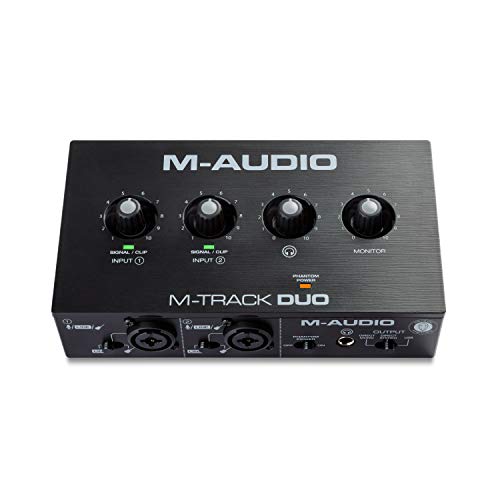
The M-AUDIO M-Track Duo is best for versatile recording sessions that involve guitar, vocals, and live streaming. It provides two combo inputs with phantom power for both mic and instrument use, plus comprehensive monitoring options including a dedicated headphone output and stereo main outs. Its USB/Direct switch enables zero-latency monitoring, helping performers stay in time with the track. A caution: overall build and driver support can vary by system, so ensure compatibility with your OS and DAW before purchase.
Who it’s best for: producers who need two channels with flexible input types and tight monitoring. Why selected: strong input flexibility, good monitoring options, and portable design for home studios or small projects.
PIYONE Audio Interface 2×2

The PIYONE 2×2 interface is best for Mac and PC users who want a modern USB-C connection with driver-free ease. It offers 24-bit/192kHz fidelity and XLR/TRS combo inputs for flexible mic or instrument setups. The illuminated gain controls add visibility in dim studios, enhancing usability during fast recording sessions. A caution: as a two-channel device, it lacks additional independent outputs that some multi-mic setups demand.
Who it’s best for: creators who prefer USB-C, plug-and-play operation, and studio-grade fidelity on a compact footprint. Why selected: driver-free setup, high-resolution conversion, and stylish, functional design.
BOMGE Mini 2 Channel USB Audio Interface

The BOMGE Mini is best for beginners and small studios needing a compact, 2-channel interface with phantom power. It delivers 48 kHz audio resolution and provides two combo XLR/mic/LINE inputs plus independent RCA outputs for monitors or speakers. Its portability makes it suitable for travel or mobile podcasts. A caution: 48 kHz sampling rate is adequate for most voice work, but higher-rate music production may benefit from a more advanced unit.
MAONO PS22 Lite USB Audio Interface

The MAONO PS22 Lite is best for entry-level guitarists and vocalists seeking high-resolution recording with simple operation. It supports 24-bit/192kHz and provides solid pre-amps suitable for podcasts and streaming. It’s a practical choice for beginners who want reliable sound without complexity. A caution: while excellent for voice and basic guitar work, heavier music production may benefit from more channels and advanced monitoring features.
Buying Guide
- Input needs: decide how many mic/instrument channels you require. If you only need one mic, a Solo or compact two-channel unit may suffice. For two mics or more, consider a two-channel interface with multiple inputs.
- Resolution and latency: aim for interfaces offering at least 24-bit/96kHz, with low-latency monitoring. Higher sample rates benefit music production more than spoken word.
- Monitoring options: look for direct monitoring, zero-latency switching, and headphone/line-out versatility to tailor monitoring to your workflow.
- Power and portability: USB-powered devices are convenient for laptops and mobile setups; USB-C support is increasingly common and future-proof.
- Compatibility: verify driver availability for your OS and DAW; class-compliant devices offer easier plug-and-play on many systems.
- Budget vs. features: balance the number of inputs, phantom power, and monitoring features against price to match your use case.
FAQ
- What is a USB audio interface?
It converts microphone and instrument signals into digital data for a computer, enabling recording and playback with low latency. - Do I need phantom power?
Condenser microphones typically require 48V phantom power; dynamic mics usually do not. - What is zero-latency monitoring?
Direct routing that lets you hear inputs without the computer’s processing delay, useful for real-time recording. - Is higher sampling rate always better?
Higher rates can improve fidelity, but for voice and streaming, 48kHz–96kHz are often sufficient. - Which interface is best for beginners?
A compact two-channel unit with USB power and easy setup, such as the Focusrite Solo or MAONO PS22 Lite, is typically ideal. - Can I use a USB-C only interface with older laptops?
Many USB-C interfaces are backward compatible with USB-A via adapters, but verify connection options on your device.