
Best USB Car Chargers: Straightforward Picks for Fast, Safe in-Car Charging
When you’re on the road, you want reliable, fast, and safe charging for all your devices. This guide highlights five top USB car chargers that balance high power, multiple ports, and practical safety features. It’s ideal for drivers who need to power phones, tablets, GPS, and accessories without clutter. Below, you’ll find quick buy-ready insights and a concise product comparison to help you choose the right option for your vehicle and devices.
| Product | Best For | Key Benefit | Limitations |
|---|---|---|---|
| JUNVANG 90W 4-Port USB C Car Charger | Heavy device households, frequent travelers | Highest total output with 4 ports | Some devices may not need 90W |
| LISEN 69W Mini USB-C Car Charger | Clean dashboard, few cables | Dual ports with balanced power | One port at max for fastest charging |
| Anker 320 24W Dual-USB | Compact spaces, budget-friendly | Small footprint, reliable dual ports | No USB-C PD |
| KENHAO 67W 3-Port USB-C & USB-A | USB-C and USB-A mix, MacBooks/tablets | Strong PD and QC support across ports | Aluminum may be warmer under load |
| Anker 323 52.5W Car Charger | Two high-speed devices at once | Power IQ 3.0 for broad compatibility | USB-C port only 30W |
JUNVANG 90W 4-Port USB C Car Charger

This 4-port car charger delivers up to 90W total output with two USB-C and two USB-A ports. It supports PD and QC fast charging and is capable of charging iPhone, iPad, Samsung Galaxy, Google Pixel, and other USB devices rapidly. Best for households with multiple devices or frequent travelers who need to power several gadgets at once. Choose this if you regularly charge two high-demand devices while using a laptop or tablet in the car. Caution: high output can heat the adapter in hot environments, so ensure good ventilation and avoid long idle charging on hot days.
LISEN Car Charger USB C, 69W Dual-Port
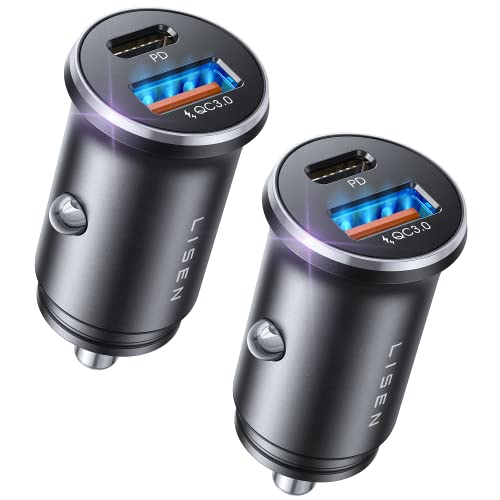
Two ports (USB-C PD and USB-A) deliver balanced power to multiple devices. It’s ideal for drivers who want a tidy setup with fewer cables and reliable charging on the go. Best for: users who need one fast USB-C port and one versatile USB-A port without overheating. Limitation: the fastest charging is concentrated on one port at a time to prevent heat buildup during peak use.
Anker 320 24W Dual-USB Mini

The Anker 320 car charger packs 24W across two USB-A ports in a compact form factor. It’s best for drivers who want a small, unobtrusive charger that still delivers solid dual-port performance. Better for everyday charging rather than demanding PD devices because it lacks USB-C PD capability. Caution: no USB-C output, which limits compatibility with newer devices relying on USB-C fast charging.
AILKIN Car Charger [2Pack/3.4A] Dual Port

Dual USB-A ports deliver up to 3.4A combined, suitable for quick, simultaneous charging of two devices. It’s best for users who want a simple, budget-friendly solution with automatic safety shutoff. Better for everyday phones and small tablets. Limitation: does not support USB-C PD, so newer devices may charge slower or not at peak speeds.
KENHAO 67W 3-Port USB-C & USB-A

Three ports — PD USB-C plus QC USB-A — support simultaneous charging for multiple devices, including iPhone and MacBook Air or iPad. Best for travelers who need strong performance on both USB-C and USB-A devices. Limitation: all-metal housing improves heat dissipation but may feel warmer under sustained high output; ensure ventilation and monitor heat during longer charging sessions.
Anker 323 52.5W USB C Car Charger

Two ports include a USB-C up to 30W and a USB-A up to 22.5W, powered by PowerIQ 3.0. Best for users needing fast USB-C charging with a capable second port for a second device. Limitations: USB-C max 30W may be insufficient for high-demand laptops or power-hungry tablets beyond a few hundred grams of battery drain.
Buying Guide: Key Considerations for In-Vehicle Charging
- Power needs: Determine how many devices you typically charge at once and whether you need USB-C PD, USB-A QC, or both.
- Port configuration: Choose a model with the right mix of USB-C and USB-A ports to match your devices.
- Size and heat management: Smaller, well-ventilated chargers reduce dashboard clutter and heat buildup.
- Compatibility: Look for chargers that support PD 3.0/PD 4.0, PPS, QC, and common fast-charging protocols for your devices.
- Durability and build: Aluminum housings can improve heat dissipation and longevity, but check for fit in your vehicle’s 12V socket.
Frequently Asked Questions
- What’s the difference between USB-C PD and USB-A QC in car chargers?
USB-C PD provides faster, more flexible power delivery for newer devices, while USB-A QC also speeds up charging but may be slower for some devices. - Can I charge a laptop in a car charger?
Some models with higher total wattage (like 90W) can power certain laptops, but always verify max output per port and device requirements. - Is it safe to use car chargers with multiple devices?
Yes, when using certified chargers with built-in protections against over-current, over-voltage, and short-circuit. - Do these chargers heat up in hot climates?
Any high-output car charger can heat up; modern designs include heat management, but avoid covering vents and monitor if the car becomes very warm. - Which charger is best for a dash cam and phone together?
Chargers with at least one high-output USB-C PD port and a capable USB-A port usually fit, but confirm dash cam power requirements before purchase.
Choosing the right USB car charger depends on how you use your devices. If you need maximum total power and multi-device charging in one unit, the JUNVANG 90W 4-Port stands out. For a minimal, tidy setup with dependable dual ports, the LISEN 69W Mini provides a balanced approach. If you prioritize compact size and broad compatibility without USB-C PD, the Anker 320 or Anker 323 models deliver reliable, everyday performance. For mixed USB-C and USB-A needs with PD and QC support, the KENHAO 67W model covers a wide range of devices while maintaining solid safety features.