
Best USB Interfaces for Mac: Stay Portable, Flexible, and Studio-Ready
Crystal-clear, low-latency USB audio interfaces are essential for Mac users who record vocals, instruments, or podcasts. This guide highlights five solid options and explains who each is best for, so you can pick a model that fits your workflow without overpaying. Whether you’re podcasting from a laptop, producing music at home, or streaming live, these interfaces deliver dependable Mac compatibility and straightforward setup.
| Product | Best For |
|---|---|
| M-AUDIO M-Track Duo USB Audio Interface | Dual-input versatility for voice and guitar |
| Mackie Onyx Artist 1X2 USB Audio Interface | High-fidelity preamps and compact setup |
| PIYONE Audio Interface, 2X2 | Bus-powered, driver-free plug-and-play |
| Jolgoo 2×2 USB Audio Interface | Zero-latency monitoring on the go |
| BOMGE mini 2 Channel USB Audio Interface | 2-in/2-out with flexible I/O |
M-AUDIO M-Track Duo USB Audio Interface

The M-Track Duo is designed for Mac and PC users who want a portable, adaptable recording setup. It delivers 48kHz audio resolution for clean recordings and supports both vocal and instrument inputs with two combo XLR/Line/Instrument inputs, plus phantom power. This interface targets podcasters, solo musicians, and livestreamers who need flexible input options and straightforward monitoring. A key advantage is the USB/Direct switch for zero-latency monitoring, reducing delay during real-time performances. A potential limitation is that it supports a compact configuration, which may feel limiting for multi-mic setups.
Who it’s best for
- Podcasters and solo artists seeking two versatile input channels.
- Mac users who want easy, portable recording for on-the-go sessions.
Mackie Audio Interface, Onyx Artist 1X2 USB Audio Interface

The Mackie Onyx Artist 1X2 offers high-quality mic preamps and a robust, compact design. Its 24-bit/192kHz recording capability supports professional-sounding tracks, while the Onyx preamps are known for wide dynamic range and clarity. The 1/4″ Hi-Z input enables direct guitar or bass connections. This model suits Mac users who need studio-grade input fidelity in a portable package and who may incorporate a small keyboard or guitar into their workflow. A caveat is that it’s a step up in price and feature set, which may exceed what casual hobbyists require.
Who it’s best for
- Musicians and producers wanting premium preamps in a compact interface.
- Mac users building a small home studio with real-time monitoring needs.
PIYONE Audio Interface, 2X2 24-bit/192kHz

PIYONE emphasizes driver-free, plug-and-play operation, especially for Mac users who want a quick setup without installing software. It supports 24-bit/192kHz fidelity and two inputs, with a USB-C connection that handles data and power. The illuminated gain controls provide visibility in dim studios, which helps during late-night sessions. The main limitation is that the feature set focuses on essential two-channel use, which may not satisfy users needing more inputs or advanced DSP features.
Who it’s best for
- Casual home studios that value easy setup and clean A/D conversion.
- Mac or PC users who want a stylish, simple interface with onboard monitoring.
Jolgoo 2×2 USB Audio Interface
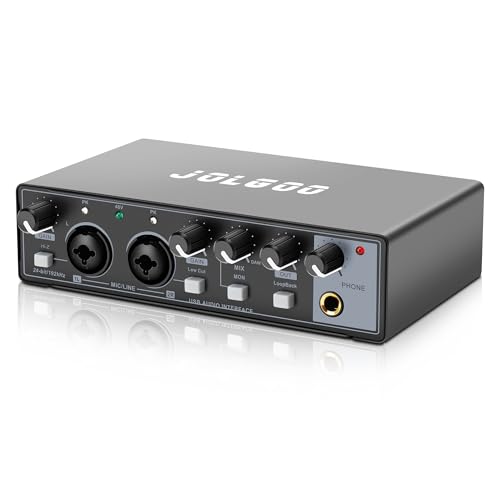
Jolgoo’s 2×2 interface targets performers who need studio-grade 24-bit/192kHz fidelity with reliable phantom-powered XLR inputs. It offers zero-latency direct monitoring and USB-powered portability, making it suitable for mobile recording and small home studios. The dual inputs and LED peak indicators help prevent clipping during vocal or instrument tracking. A potential drawback is that as a compact unit, it may lack some of the advanced routing options found on larger interfaces.
Who it’s best for
- On-the-go musicians and podcasters who value real-time monitoring.
- Users seeking professional-sounding recordings without external power supplies.
BOMGE mini 2 Channel USB Audio Interface

The BOMGE mini is a compact two-input, two-output interface suitable for beginners and intermediate users. It provides 48V phantom power for condenser mics and has flexible output options, including RCA stereo connections for connecting powered monitors or PA systems. This model is a practical choice for small setups that require straightforward connectivity and reliable power in a compact footprint. A limitation is that its feature set focuses on essential I/O, which may not support heavier multi-mic projects.
Buying Guide: Key Purchase Considerations
- Inputs and outputs: Consider how many mics or instruments you’ll record at once. If you plan to track multiple sources, prioritize interfaces with multiple combo XLR/Line inputs and proper phantom power.
- Resolution and latency: Look for 24-bit/192kHz support if you need high-fidelity recordings. Zero-latency monitoring helps with real-time performance without delay.
- Mac compatibility and driver model: Driver-free or class-compliant interfaces simplify setup on macOS. USB-C connectivity generally offers broad compatibility and power.
- Monitoring options: Headphone and line outputs with direct monitoring can improve your ability to hear tracks in real time. Consider whether you need independent control over headphone and monitor mix.
- Portability vs. expandability: Portable units are ideal for mobile recording and streaming, while larger boxes may offer more routing options and DSP features for advanced users.
FAQ
- Do these interfaces require drivers on Mac?
- Most modern Mac-compatible interfaces are class-compliant and driver-free, offering plug-and-play functionality. Some may still benefit from manufacturer drivers for advanced features; check product specs.
- What is latency, and how can I minimize it?
- Latency is the delay between input and output. Enable direct monitoring when possible and ensure your buffer size is appropriately set in your recording software.
- Is phantom power necessary for my microphone?
- Condenser microphones typically require 48V phantom power. Dynamic mics do not.
- What if I need more inputs later?
- Choose an interface with additional input channels or plan to upgrade to a model with more I/O as your setup grows.
- Can I use these interfaces for live streaming?
- Yes. Many interfaces provide clean mic/line inputs and monitoring, which are suitable for podcasting and streaming from a Mac.
Notes on Selection
When choosing, consider your typical use—podcasting, guitar recording, or multi-mic performances. For simple one- or two-source sessions, a compact 2-in model with solid preamps often provides the best balance of cost and capability. For more demanding recording with multiple tracks, pick a unit with higher channel count and robust monitoring options. Always verify compatibility with your macOS version and your DAW for the smoothest workflow.