Best USB Microphone for Singing: Top Picks for Home Studios
Answering the buyer’s search for the best USB microphone for singing, this guide highlights five reliable options that suit different setups—from casual karaoke to semi-professional home studios. The top picks are best for solo vocalists, streamers, podcasters, and small-band enthusiasts who want plug‑and‑play simplicity, clear recording, and good noise control. Below, you’ll find quick-start notes on who each product is best for, plus a buyer’s table to compare key features at a glance.
| Product | Best For | Key Benefit |
|---|---|---|
| TPFOON 4M USB Microphone | Casual singers and family fun | Long cord; plug-and-play; broad compatibility |
| FIFINE Studio Condenser USB Microphone (T669) | Home studios and vocal demos | Broad frequency response; included boom arm and pop filter |
| ZealSound K66 USB Podcast Microphone | Podcasters and content creators | Noise reduction modes; USB-C/Lightning adapters |
| MAONO HD300T USB/XLR Dynamic Mic | Live streaming and singing with mixers | Dual USB/XLR outputs; real-time monitoring |
| MAONO AU-A04 USB Condenser Microphone | YouTube, gaming, voiceovers | High-resolution 192kHz/24bit; plug-and-play |
TPFOON 4M USB Microphone For Gaming And Singing

Best for: Casual singers and family fun. This wired USB mic is designed for PC and various gaming consoles, with a long 13-foot cord for movement during performances. It offers plug‑and‑play setup without drivers and emphasizes accurate voice reproduction for rock-band style games and karaoke apps. A potential limitation is its broad compatibility noted in the listing; users should confirm system compatibility before purchase.
FIFINE Studio Condenser USB Microphone Kit
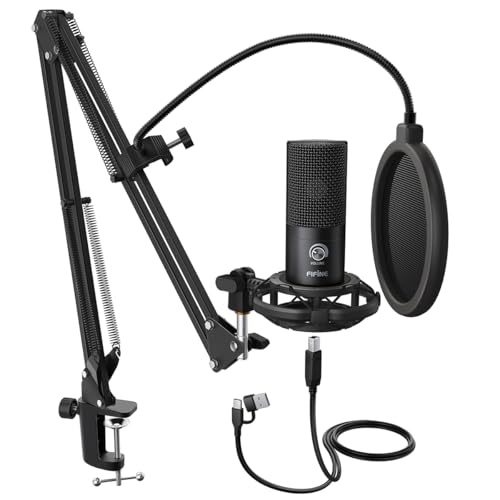
Best for: Home studios and vocal demos. The T669 kit provides a wide frequency response and a cardioid capsule to focus on voice while reducing background noise. It comes with a desktop boom arm, 8.2-foot USB cable, and a double pop filter, which is ideal for singing and voiceovers in untreated spaces. Caution: The listing notes incompatibility with Xbox, so check your setup if you plan to record while gaming on consoles.
ZealSound K66 USB Podcast Microphone

Best for: Podcasters and content creators seeking clean vocal capture. The K66 emphasizes studio-like sound with a wide 40Hz–18kHz response and a 46kHz sampling rate, plus built-in noise reduction modes. It’s plug-and-play across Windows, Mac, PS4/PS5, and tablets, with USB-C and Lightning adapters for mobile use. Caution: Some users may prefer dedicated audio interfaces for complex multi-mic setups.
MAONO HD300T USB/XLR Dynamic Microphone Kit

Best for: Live streaming and singing with a mixer. The HD300T provides both USB and XLR outputs, enabling direct computer use or connects to mixers and audio interfaces for better vocal control. Its dynamic capsule helps reduce room noise, which is advantageous in non-studio spaces. Limitation: Dynamic mics typically require higher gain; ensure your audio interface or mixer can supply adequate gain for optimal vocal loudness.
MAONO AU-A04 USB Condenser Microphone

Best for: YouTube, gaming, voiceovers, and casual singing. The AU-A04 offers a high-resolution 192kHz/24-bit USB connection with a cardioid pickup pattern to minimize side noise. It’s plug‑and‑play across most PCs and Macs, making it a straightforward option for beginners. Limitation: Condenser mics can pick up room reflections; consider a small amount of acoustic treatment or placement adjustments to improve vocal clarity.
Buying Guide
What to consider when choosing a USB microphone for singing:
- Recording environment: If you record in a noisy or untreated room, a mic with good noise rejection (dynamic mics or cardioid condensers with pop filters) helps reduce background noise.
- Connectivity: USB mics are plug‑and‑play. If you plan to integrate with mixers or audio interfaces, look for USB/XLR dual outputs like the MAONO HD300T.
- Voice tone and genre: For bright vocal tones and singing, a condenser mic captures detail; for live singing with room noise, a dynamic mic can be more forgiving.
- Accessories: Boom arms, pop filters, and shock mounts improve sound quality and convenience, as seen with the FIFINE kit.
- Compatibility: Check device compatibility with gaming consoles, tablets, and mobile devices if you plan to switch between platforms.
FAQ
- What USB mic is best for singing at home?
Generally, condensers with cardioid patterns like the FIFINE T669 or MAONO AU-A04 provide clear vocal detail for singing at home. - Do I need an audio interface for USB mics?
Not for USB mics. USB mics are plug-and-play, but an audio interface is needed if you choose an XLR connection or want higher control over gain and latency. - Can USB mics reduce background noise?
Some mics offer built‑in noise rejection or come with accessories (pop filters, boom arms) to reduce noise; environment treatment also helps. - Is a dynamic mic better than condenser for singing?
Dynamics handle louder sources and noisy rooms better, but condensers capture more high-frequency detail; your room and style determine the best choice. - Do I need drivers for USB mics?
Most USB mics are driver-free; you can plug them in and start recording. Some professional setups may benefit from driver or software customization. - Should I choose USB-C or USB-A?
USB-C can offer broader compatibility with newer devices; many mics include USB-C adapters for versatility.