
Best USB Powered Audio Mixers for Home Studios and Live Streaming
If you need a compact, USB-powered mixer to record, stream, or broadcast, these five models are strong options for different setups. The best fit depends on input count, built-in recording capability, wireless features, and budget. This guide highlights who each product is best for and why it stands out, with a clear, practical comparison to aid quick decisions.
Summary table of selected products:
| Product | Best For | Key Benefit | Notable Limitation |
| Aveek 5 Channel | Podcasters and live streamers needing built-in PC recording | Built-in recording chip; USB direct recording | Not compatible with Bluetooth output |
| Depusheng M4 4-Channel | Small home studios needing Bluetooth plus USB audio interface | Bluetooth streaming; USB audio interface | Fewer mic inputs than larger mixers |
| FIFINE Ampligame SC3 | Streamers wanting dedicated muting/monitoring | Indi-Fader, independent channel control | Not suitable for USB mic input |
| Pyle PMXU43BT.5 | DJ/performers needing MP3/USB playback | MP3/USB playback; 4 channels; Phantom power | Bluetooth output limitations |
| Behringer XENYX 802S | Entry-level analog with USB streaming | Pure analog warmth with USB streaming | Fewer features vs digital models |
Aveek 5 Channel Audio Mixer

Best for podcasters and streamers who want quick, direct PC integration. The Aveek mixer includes 3 XLR inputs, line inputs, and both RCA and 6.35mm outputs to connect speakers or a recording setup. It features a built-in recording chip for plug-and-play PC recording via USB-B, removing the need for extra software. USB drive playback and recording support adds quick MP3 playback and the ability to save mixes to a USB stick. A limitation is that it cannot connect output devices via Bluetooth, so wired speakers are required.
Depusheng 4 Channel USB Interface Mixer
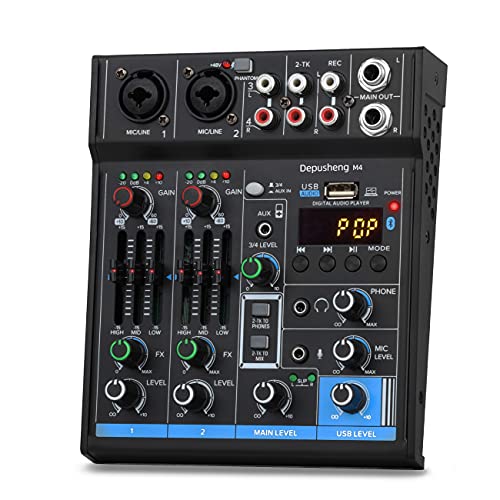
Best for small home studios needing wireless streaming and USB recording. The 4-channel design supports two mic/line inputs plus multiple line connections, and includes built-in USB audio interface compatibility for direct PC recording with various software. Bluetooth streaming is available, but Bluetooth works within a short range and is primarily for music streaming rather than reliable studio monitoring. If you prefer a compact, flexible setup with Bluetooth and USB recording, this is a strong contender.
Cooidea 3 Channel Mini Audio Mixer

Best for light setups and casual routing. This 3-channel mixer emphasizes pure analog routing with a zero-latency design and separate outputs for monitoring and recording. It supports dual output paths and direct-coupled circuitry to minimize signal loss and phase issues. It does not provide phantom power or microphone support, so it’s better for line-level devices or gaming/monitoring tasks rather than microphone-heavy pod setups.
Hohean 2 Channel Stereo Audio Mixer

Best for quick, on-the-go audio blending where two sources must be balanced. The Hohean model offers independent volume controls for each input and a standard 3.5mm output, making it ideal for mobile setups, classrooms, or small presentations. It’s simple to operate with no software requirements. The main limitation is the limited input count, which may not satisfy multi-mic or complex routing needs.
Pyle PMXU43BT.5 USB Bluetooth Mixer

Best for performers needing MP3 playback and wireless streaming. This mixer includes USB/flash reader MP3 compatibility and Bluetooth streaming for music from mobile devices. It supports 48V phantom power for compatible mics and provides mic and line inputs with a straightforward control layout. A consideration is that Bluetooth is primarily input-focused, which may limit wireless output options for some setups.
Behringer XENYX 802S

Best for those seeking pure analog warmth with USB streaming. The Behringer XENYX 802S offers eight input channels and a USB streaming interface, combining classic analog tone with modern connectivity. It’s a straightforward option for podcasting and streaming that prioritizes ease of use over advanced routing features. The trade-off is a smaller feature set compared to larger digital mixers.
Buying Guide
What should you consider when choosing a USB powered audio mixer?
- Input count and type: Do you need multiple XLR mic inputs, line-level inputs, or a combination? Ensure the model supports phantom power if you use condenser mics.
- USB audio interface: A direct USB connection simplifies PC recording and streaming. Check compatibility with your DAW or streaming software.
- Bluetooth capabilities: If wireless streaming from phones or tablets is important, verify Bluetooth range and whether it supports input only or output as well.
- Built-in playback/recording: Some models include USB drive playback or MP3 playback, which can simplify quick broadcasts or karaoke setups.
- Portability vs. feature set: Small, simple mixers are portable and easy to use, but may lack advanced routing found in larger units.
Which type is right for you?
- For podcasting and streaming on a budget: Look for a mixer with USB recording, at least 2–3 mic inputs, and good headphone monitoring.
- For mobile or on-the-go use: A compact 2–4 channel mixer with lightweight design and USB/BT capabilities is ideal.
- For music production and home studios: Prioritize models with multiple line-level inputs, phantom power, and robust USB audio interfaces that work with your preferred software.
What are common limitations to watch for?
- Bluetooth output is rarely robust for studio monitoring; expect wired speakers for best monitoring accuracy.
- Lower-channel mixers may lack advanced EQ, effects, or direct recording to multiple devices.
- Some USB interfaces require drivers on certain systems; verify driver support for your computer and OS.
Frequently Asked Questions
- What does USB-powered mean for a mixer? It means the mixer can be powered or connected via USB, providing a convenient way to route audio to a computer or stream online without a separate power supply.
- Do I need phantom power for all mics? No. Only condenser mics typically require phantom power; dynamic mics usually do not.
- Can I use Bluetooth with a USB mixer for monitoring? Some models offer Bluetooth input, but Bluetooth monitoring is often laggy. Prefer wired headphones for real-time monitoring.
- Is an external audio interface necessary if a mixer has USB? Not always. A USB-enabled mixer can act as an audio interface, but compatibility with your software should be checked.
- Which mixer is best for beginners? A simple 2–4 channel USB mixer with clear controls and USB recording is usually easiest to learn and use.
- Can I play USB MP3s directly from some mixers? Yes, several models support USB drive playback, which is useful for karaoke or quick broadcasts.