
Best USB Step-Down Converters From 12V to 5V for Electronics
When selecting a USB step-down converter, accuracy, protection, and current capacity are key. This guide highlights five reliable options for converting 12V or higher DC input to a stable 5V USB output. Best for projects requiring portable power, car electronics, or Raspberry Pi setups. The top picks cater to DIY enthusiasts, hobbyists, and professionals who need clear protection features and dependable performance.
Summary table of chosen products:
| Product | Best For | Key Benefit | Max Output |
|---|---|---|---|
| Acridine 12V-32V to 5V USB Buck | General use, compact builds | Strong protection suite | 3A |
| DROK 6-32V to 5V Buck (4-pack) | DIY projects, multi-device charging | Multiple units, versatile input | 4 x 5V 3-4A zones |
| YIPIN HEXHA 12V-32V to 5V 6A Dual USB | Dual-device charging | High total current | 6A total |
| Klnuoxj 12V/24V to 5V USB-C 5A | Raspberry Pi and USB-C devices | USB-C output, rugged | 5A |
| PlusRoc 12V/24V to 5V 3A USB-C | Compact USB-C power | Efficient, 96%+ | 3A |
Acridine 12V-32V DC to 5V USB Buck Module

The Acridine module accepts 10-32V input and outputs DC 5V up to 3A (15W). It includes input reverse connection protection, overload and overcurrent safeguards, overheat protection, and short circuit protection. This makes it well suited for general-purpose vehicle, robotics, and microcontroller projects requiring a reliable 5V rail.
Best for: Hobbyists and small projects needing solid protection without extra features. This unit is straightforward to wire and use in environments with potential power surges.
Limitation: The 3A max output may limit use with power-hungry devices; ensure your load stays under 15W.
DROK USB Buck Converter (4-Pack)
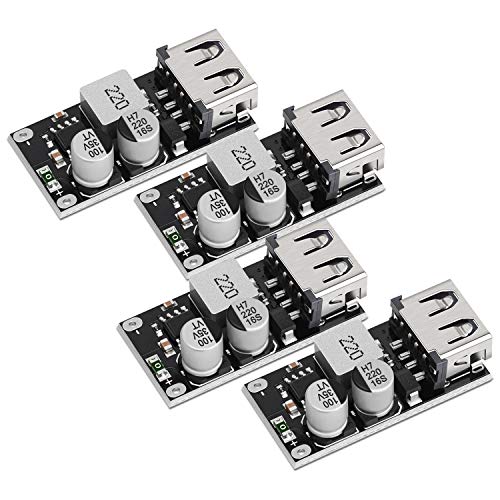
This kit provides a DC-DC step-down module with input range 6-32V and default output 5V, with automatic adjustment to 3-12V after triggering quick charging. It offers up to 24W total output and comprehensive protection: input/output over-current, over-voltage, short-circuit, and over-temperature protections. The product is ideal for solar charging projects, DIY car power, and other multi-device setups.
Best for: Projects requiring multiple independent 5V outputs across different subsystems, especially when experimenting with charging or power distribution from a higher-voltage source.
Limitation: Automatic voltage shift during quick charging may require monitoring in critical applications to avoid unexpected voltage changes.
DC Converter 12V-24V to 5V 6A Dual USB

This module supports a total of 6A, with each USB port offering up to 3A (15W per port). It includes protections against reverse polarity, overvoltage, undervoltage, overcurrent, and short circuits, plus overheat protection. It is well-suited for charging two devices concurrently or powering two Raspberry Pi-like boards from a 12V-24V source.
Best for: Dual-port needs where simultaneous high-current charging is required, such as multi-device microcontroller projects or dual-device USB hubs on a single supply.
Limitation: Some users may experience heat with continuous high-load operation; ensure adequate cooling in enclosure layouts.
YIPIN HEXHA DC Converter 12V-24V to 5V 3A USB-C

This module outputs 5V at up to 3A with input range 10-32V. It features a dust cover to protect against dust and moisture, plus standard protections: reverse polarity, overvoltage, overcurrent, and overheating. The USB-C output makes it compatible with many modern devices that rely on USB-C power.
Best for: Projects requiring a USB-C downstream port and resilience to dusty environments, such as outdoor installations or rugged enclosures.
Limitation: Max 15W total on this variant, so high-power devices near or above 3A should be avoided for longer runs.
PlusRoc Waterproof USB-C 5V 3A Buck Converter

The PlusRoc module is designed for waterproof operation with a 8-32V input and a 5V, 3A USB-C output. It emphasizes high efficiency, claiming up to 96% conversion. This makes it suitable for marine, automotive, or outdoor uses where exposure to elements is a concern.
Best for: Environments where moisture resistance matters and where a stable 5V/3A USB-C output is needed for a single device or small cluster of peripherals.
Limitation: Waterproofing and rugged design may come at a higher price point; verify enclosure compatibility for tight spaces.
Buying Guide: Key Considerations For USB 12V- to 5V Converters
- Output current needs: Choose a unit that can comfortably supply your expected load. If you anticipate spikes, select a model with headroom above your typical draw.
- Input voltage range: Ensure the converter can accept your source voltage (common ranges include 6-32V or 8-32V).
- Protections: Look for reverse polarity, overvoltage/undervoltage, overcurrent, short circuit, and overheat protections to safeguard connected devices.
- Port type: USB-A vs USB-C matters depending on device compatibility. USB-C can provide newer devices with better compatibility and power efficiency.
- Thermal management: Consider heat sinking or enclosure ventilation if operating near max current for extended periods.
- Durability and environment: Waterproof or dust-resistant variants are beneficial for outdoor or rugged applications.
- Size and wiring: Smaller modules suit compact builds; check cable length and connector types to ensure a clean integration.
Frequently Asked Questions
- What is a USB step-down converter? A device that reduces higher DC input voltage to a stable 5V USB output for powering USB devices.
- Can these converters power Raspberry Pi? Yes, provided the model can supply at least 2.5A to 3A depending on the Pi model and peripherals.
- Do all converters support USB-C output? Some models include USB-C outputs with higher efficiency; others provide USB-A ports.
- Is protection against short circuits reliable? Reputable models typically include short circuit protection and overheat protection for safety.
- Should I choose a dual-port model? If you need to charge two devices simultaneously at 5V, a dual-port unit with adequate total current is ideal.
- Are waterproof variants necessary for indoor use? Not usually, but they’re advantageous in outdoor or moisture-prone environments.