Best USB to AES Converter Options for Clean Digital Audio and Data Transfer
The best USB to AES converter picks translate digital audio or data signals from a computer or device into AES/EBU or equivalent digital formats with minimal latency and high reliability. This guide targets audiophiles, studio technicians, and IT professionals who need dependable signal integrity and straightforward setup. Below you’ll find five strong candidates, each with a clear use case and practical limitations. A quick summary table follows to help you compare at a glance.
| Product | Best For | Key Benefit |
|---|---|---|
| Fit for Mini USB to AES Signal Audio Adapter Converter Cable | Budget audio projects and hobbyists | Compact USB-to-AES signal path |
| Arklove USB A To AES Cable – 5ft | Home studios needing longer reaches | Solid conductor quality and 110Ω signal integrity |
| IHNIERAEM 16Bit USB To AES Converter | General purpose digital interface | Versatile USB to AES with broad compatibility |
| Arklove USB A To AES Cable – 20ft | Long cable runs in setups | Extended distance with strong signal path |
| XTPTFABS USB To Keyboard/USB Converter | Advanced keyboard remapping and macro use | Remapping, macros, and NKRO features |
Fit for Mini USB to AES Signal Audio Adapter Converter Cable

The device is designed for users who need a compact USB-to-AES signal path, featuring 16/24/32-bit support across 44.1kHz to 192kHz sample rates. Best for small workflows and field setups where budget and size matter. It may suit podcasters, hobbyist studios, or on-the-go sound tests where space is at a premium. A potential limitation is that longer-term reliability and wide-range performance can vary with non-standard DACs.
Arklove 5ft USB A To AES Cable

Best for small to mid-sized studio setups that require a dependable 110Ω AES/EBU signal path. The front section uses OCC silver-plated conductors with a 24K gold-plated connector over 3μ, aimed at smoother signal transmission and low jitter. It’s particularly suitable for DACs, sound preamps, and amps needing a robust USB-to-AES link. Limitation: at 5 feet, it may not cover longer-distance needs without an extender.
IHNIERAEM 16Bit USB To AES Converter

This option targets general-purpose digital interfaces with broad compatibility and user-friendly installation. It emphasizes versatile applications across industrial, automotive, and home electronics. Best for buyers who want a flexible USB-to-AES bridge without specialized requirements. A potential caveat is that the description focuses on versatility over niche performance guarantees.
Arklove 20ft USB A To AES Cable
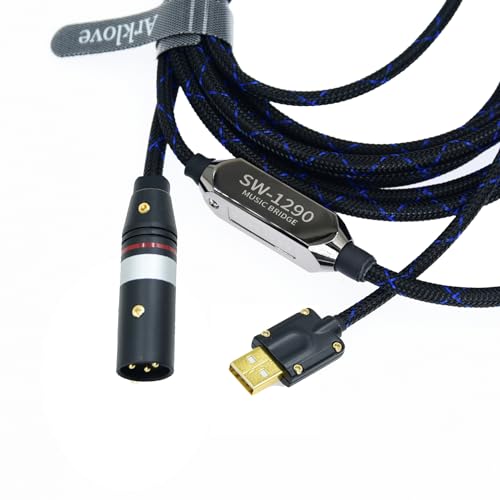
Best for installations requiring longer runs in studios or live venues. The 110Ω AES/EBU signal path combined with OCC silver-plated front and 110Ω back path supports stable signal integrity over distance. It’s a strong choice when you need to bridge DACs, preamps, or sound cards across a room. Limitation: cable length can introduce more potential for interference in untreated environments; shielding should be considered.
XTPTFABS USB To Keyboard And Audio Converter

Best for advanced users who want remapping, macros, and NKRO on keyboards, combined with USB interfaces. This product blends USB-to-aes-like conversion capabilities with keyboard control flexibility, making it suitable for studio setups that require quick access to macro-enabled audio control or workflow shortcuts. Caution: its primary feature set focuses on keyboard remapping, which may not be essential for all AES conversion tasks and could complicate simple audio-only use cases.
Buying Guide: Key Considerations For USB To AES Converters
- Signal integrity: Look for 110Ω AES/EBU design and high-quality conductors (OCC silver-plated or gold-plated connectors) to minimize jitter and preserve audio clarity.
- Cable length vs. latency: Shorter runs typically minimize latency and signal degradation. If longer runs are needed, ensure adequate shielding and quality construction.
- Sample rate and bit depth support: Verify compatibility with your DACs or audio interfaces, especially if you work with high-resolution formats (e.g., 96kHz, 192kHz).
- Ease of setup: Prioritize devices with clear installation steps and plug-and-play operation to reduce setup time in busy studios or field work.
- Durability and build: OCC copper, robust connectors, and well-insulated cables help with long-term reliability in studio, live, or field environments.
- Use-case alignment: Decide whether you need pure audio conversion, or if additional features like macros, NKRO, or USB expansion are valuable for your workflow.
Frequently Asked Questions
- What is a USB to AES converter used for?
It translates USB digital audio data into AES/EBU digital audio, enabling compatibility between USB sources and AES-enabled DACs, preamps, or audio interfaces.
- Do I need a specific sample rate for AES conversion?
Yes. Ensure the converter supports the sample rates you use (e.g., 44.1kHz, 48kHz, up to 192kHz) to avoid downsampling or quality loss.
- Are longer USB to AES cables reliable?
They can be, if the cable uses high-quality shielding and conductors. Longer runs may introduce more potential for interference; choose cables designed for low jitter and strong shielding.
- Can USB to AES adapters be used with any DAC?
Compatibility depends on the DAC’s AES/EBU input specifications and driver support. Always verify the device’s input standard and supported formats.
- Is remapping or macros relevant for AES conversion?
Only if you require keyboard-side control integrated with your audio workflow. For pure audio conversion, this feature is not necessary.
- What should I consider for field use?
Choose compact, durable units with reliable cabling and clear indications of input/output status to withstand travel and varied environments.