
Best USB to Audio in Adapters for Clear Computer Sound in 2026
Looking for a simple USB to audio in solution? This guide highlights five reliable USB sound adapters that add or improve headphone output and microphone input on desktops, laptops, or tablets. Ideal buyers: students needing a quiet, portable audio upgrade; remote workers seeking clearer mic input; gamers wanting low-latency voice chat; and creatives needing better separation of sound input and output without installing drivers.
| Product | Best For | Key Benefit |
|---|---|---|
| SABRENT AU-MMSA | Windows/Mac/Linux users | Driverless setup with two jacks for stereo out and mono mic |
| MOSWAG USB To 3.5mm | Headset lovers with TRRS | Wide compatibility and 16-bit/48kHz sound |
| UGREEN USB Sound Card | Desktop upgrades | High-resolution DAC for clearer audio |
| SABRENT AU-UCMA (USB-C) | USB-C devices | 24-bit/96kHz audio with separate 3.5mm jacks |
All five options support straightforward, driver-free use on most common systems, though some require USB-C connections or may have limitations on headset types. The summaries above can help you compare compatibility, jack configurations, and audio quality at a glance.
SABRENT USB External Stereo Sound Card Adapter

The SABRENT AU-MMSA is a compact USB sound card that adds a dedicated stereo output and mono microphone input via two 3.5mm jacks. It is recognized as a standard USB audio device without drivers and is plug-and-play across Windows, Mac, and Linux. Best for users who need a simple, no-fuss upgrade to improve headphone listening and mic pickup without software installation. Limitations include that it does not support 4-pole headsets on a single plug and does not power passive speakers.
MOSWAG USB To 3.5mm Jack Audio Adapter

The MOSWAG USB sound card adds a 3.5mm TRRS port for combined headphone and mic use and supports a wide range of devices, including Windows, macOS, Linux, Chromebook, and even Raspberry Pi. It delivers stable 16-bit/48kHz output with noise reduction for clearer audio. It is best for users who need TRRS compatibility and universal cross-platform support, especially when using headsets with integrated microphones. A caveat: the 3.5mm microphone jack does not support TS or TRS alone.
UGREEN USB Sound Card Adapter
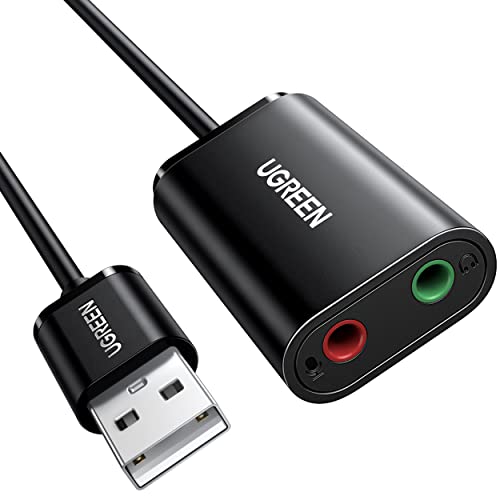
UGREEN’s USB sound card emphasizes high-resolution output with a built-in DAC and offers a 16bit/48kHz capability aimed at better-than-average listening and gaming audio. It is plug-and-play with no external power. This model is best for those seeking enhanced fidelity on a desktop or laptop without complex setup, but it’s advisable to verify that your mic and headphone jacks are compatible with the TRS/TS standards present on the device.
SABRENT USB-C to 3.5mm Audio Adapter, AU-UCMA

The USB-C version, AU-UCMA, connects to USB-C devices and provides two separate 3.5mm jacks: one stereo for headphones/speakers and one mono for microphones. It supports up to 24-bit/96kHz audio, offering higher sample rates than many entry-level adapters. Best for USB-C laptops, tablets, or desktops that require higher-resolution audio. A limitation: it does not fit USB-A ports; for those devices, choose the AU-MMSA model instead.
Buying Guide: Practical Considerations For USB Audio Adapters
- Port Type: Check whether your device has USB-A or USB-C. Choose the matching adapter, or use a USB-C to USB-A hub if needed.
- Jacks And Channel Config: Decide if you need separate stereo output and mono mic input. Some models offer TRRS compatibility for headsets; others use independent jacks.
- Audio Quality: Look for DAC/bit depth and sampling rate specs. Higher figures (e.g., 24-bit/96kHz) generally yield clearer audio, especially for music and gaming.
- Driver Requirement: Most of these are driverless, but some features may vary on older systems. Driverless setup is ideal for quick use on multiple OSs.
- Compatibility: Verify compatibility with your OS, headset plug type, and any special devices like Raspberry Pi or PS4/PS5 where applicable.
- Limitations: Note that some adapters do not provide power for passive speakers or do not support single-3.5mm combo jacks for headsets.
Frequently Asked Questions
- What is a USB sound card adapter best used for?
It adds or upgrades audio input and output on devices that lack built-in high-quality sound hardware or when you need more reliable mic input or headphone output.
- Do I need drivers for these adapters?
No driver installation is typically required; they’re plug-and-play and recognized as standard USB audio devices.
- Can these adapters work with gaming headsets?
Yes, especially models with separate mic and headphone jacks or TRRS compatibility; ensure your headset connector matches the adapter.
- Is USB-C or USB-A better for audio adapters?
USB-C is needed for devices without USB-A ports. Both can support high-quality audio; choose based on your device’s port type.
- Will these adapters power speakers?
Most are designed for output to headphones or powered speakers and do not power passive speakers without external amplification.
- What should I consider if I use a microphone with a USB adapter?
Consider mono versus stereo mic input and whether your microphone requires specific impedance or plug type. Check compatibility with your mic.