
Compact Guide: This article compares five reliable wired vocal microphones suited for speakers, karaoke, presentations, and live voice reinforcement. Below is a quick summary table of the selected models to help you scan options before reading full reviews.
| Product | Brand | Key Feature |
|---|---|---|
| Fifine K6 Wired Handheld Mic | FIFINE TECHNOLOGY | Cardioid dynamic, 1/4″ plug, 14.8 ft cable |
| JBL PartyBox Mic 100 | JBL | Cardioid polar pattern, plug-and-play with PartyBox |
| YIOWNER Wired Karaoke Microphone | YIOWNER | Oxygen-free copper shielded cable, vocal-focused |
| Marengo Handheld Wired Microphone | Marengo | Cardioid dynamic, ON/OFF switch, 13 ft cable |
| Shinco Handheld Mic | Shinco | Cardioid dynamic, durable build, 13 ft cable |
Fifine Karaoke Microphone, Dynamic Vocal Microphone for Speaker

This Fifine K6 is a cardioid dynamic microphone built for live vocal use and speech. It offers a flat, wide frequency response from 50 Hz to 18 kHz, making it suitable for both spoken word and singing. The design minimizes feedback via its cardioid pickup pattern, which helps when used with loudspeakers or PA systems.
The mic uses a 1/4″ (6.35mm) plug and includes a 14.8 ft detachable cable, which makes quick connections to many karaoke units and amplifiers straightforward. No external power is required. The manufacturer highlights low distortion for clear speech intelligibility and reliable handling of high SPL (sound pressure levels).
JBL PartyBox Mic 100: Wired Dynamic Vocal Mic

The JBL PartyBox Mic 100 is a plug-and-play cardioid microphone designed to pair effortlessly with JBL PartyBox speakers. The cardioid polar pattern prioritizes on-axis vocals while reducing ambient noise, which is useful for live speaker applications and karaoke.
JBL emphasizes durable industrial design and easy use: connect and sing. The construction and internal voicing focus on capturing vocals clearly in party and live settings, providing compatibility with common speaker inputs and a robust wired connection for reliable performance.
YIOWNER Wired Karaoke Microphone, Handheld For Singing
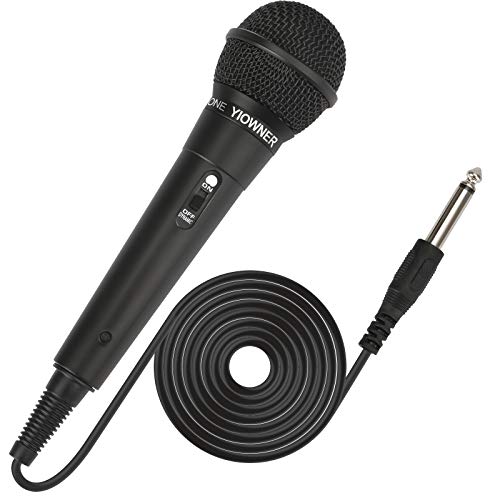
The YIOWNER vocal microphone focuses on clear voice reproduction and background noise reduction. The cable is built from oxygen-free copper with shielding to reduce hum and noise, which benefits clarity when connected to mixers, amplifiers, or speakers.
Its compatibility notes include power amplifiers, mixers, KTV systems, and portable speakers. The mic claims to prioritize the singer’s voice while filtering ambient sound, making it appropriate for presentations and karaoke sessions.
Marengo Handheld Wired Microphone, Cardioid Dynamic Mic

This Marengo microphone emphasizes a cardioid pickup pattern to reject unwanted sound and focus on the user’s voice, useful for speeches and live vocal use. It requires no batteries and includes an external on/off switch for quick control.
The build is described as rugged and comfortable for handheld use, with a 13 ft cable for stage mobility. The mic is positioned as suitable for indoor and outdoor use where simple, reliable wired connectivity is preferred.
Shinco Handheld Mic, Cardioid Vocal Dynamic Microphone
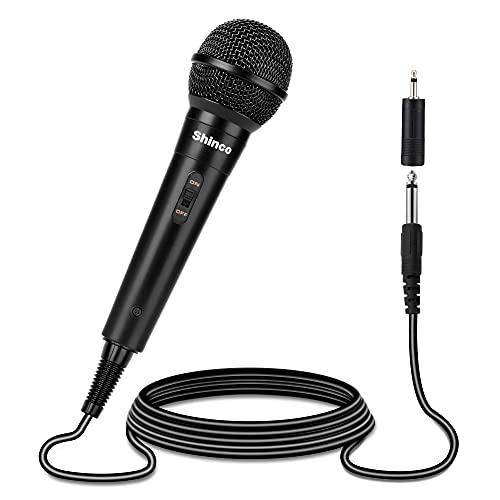
The Shinco handheld mic offers a cardioid pattern and a similar set of practical features: no battery requirement, external on/off switch, and a roughly 13 ft cable. The construction focuses on durability and comfortable handling.
The product messaging highlights stable performance for live singing and speaking in varied settings. The cardioid design reduces feedback and ambient pickup, aligning with typical requirements for microphones used with speakers and small PA systems.
Buying Guide: Choosing The Best Wired Microphone For Speaker
When selecting a wired microphone to use with a speaker or PA, consider these key factors:
- Pickup Pattern: Cardioid is preferred for speakers because it captures forward-facing sound while rejecting rear and side noise, reducing feedback and ambient pickup.
- Connector Type: Confirm the microphone’s plug matches your speaker or mixer input (6.35mm TS/TRS, XLR, or other). Some listed mics use 1/4″ plugs while others may require adapters.
- Cable Quality and Length: Shielded cable with oxygen-free copper can reduce hum and interference. Choose adequate length (10–15 ft common) to allow movement without signal loss.
- Durability and Comfort: Metal construction and a comfortable grip matter for handheld use during speeches or performances. An integrated on/off switch adds convenience for presenters.
- Frequency Response: For clear speech and vocals, look for a broad midrange response (roughly 50 Hz to 15–18 kHz) and low distortion at higher SPLs.
- Power Requirements: Dynamic mics don’t need phantom power and are simpler for plug-and-play setups with standard speakers and karaoke machines.
- Compatibility: Verify compatibility with your speaker system, mixer, or karaoke unit—some microphones are optimized for specific brand ecosystems (e.g., JBL PartyBox).
- Feedback Control: Cardioid dynamic mics and proper mic placement (keep mic behind the speaker plane when possible) help minimize feedback risk.
- Use Case: For speeches, prioritize intelligibility and feedback rejection. For singing, prioritize a wider frequency response and handling of high SPLs.
- Value Considerations: Multipacks or mics with detachable cables and durable connectors can improve long-term value for events or repeated use.
Comparison perspectives:
- Live Speech — Favor cardioid dynamic mics with clear midrange and minimal handling noise.
- Karaoke/Home Parties — Plug-and-play compatibility and durable cabling are beneficial; JBL PartyBox integration may simplify setup with PartyBox speakers.
- Small Venues/Outdoors — Choose mics with robust build, longer cables, and strong feedback rejection for uncontrolled environments.
- Installation With Mixers — Check connector types and cable shielding if routing audio through mixers or PA systems to reduce interference.