Best Wireless Delegate Microphone System for Meetings and Conferences
The best wireless delegate microphone system for meetings and conferences provides reliable wireless connectivity, clear voice transmission, and simple multi-user management. This guide highlights five top options, tailored for boardrooms, large seminars, and public speaking events. Each pick prioritizes ease of use, scalability, and dependable performance in dense attendee environments. Read on to see which system fits your room size, number of delegates, and setup preferences.
| Product | Key Strength | Best For |
|---|---|---|
| Digital Discussion System UHF Wireless Conference Microphone 25 Delegate | Large delegate support, dedicated outputs | Medium to large conference rooms |
| Professional Wireless Conference Microphone DDS6800 | Flexible expansion, up to 255 attendees | Total room coverage, scalable setups |
| TONOR Wireless Microphones System 4×10 Channel | Four-channel versatility, long range | Churches, schools, events with mixed mic types |
| Phenyx Pro 8-Channel UHF System (PTC-8) | Auto scan, 8×25 frequencies | Public speaking and classrooms needing low interference |
| Phenyx Pro Dual UHF Wireless System (PTU-71-2B) | Dual channels, flexible microphone pairings | Duet presentations and small panels |
Digital Discussion System UHF Wireless Conference Microphone 25 Delegate

This system supports up to 25 delegate microphones with a chairman unit, offering dedicated XLR outputs and volume controls per channel. It uses a 500MHz band to reduce interference and features multiple speaking modes (alternate and chairperson modes) for orderly conferences. Best for: mid-sized to large meetings that require structured speaker control and a centralized main unit. Caution: setup may require careful frequency planning to avoid cross-channel interference in very dense environments.
Bolymic 8800S Wireless Microphone System

Best for: venues using Shure-compatible systems or needing a robust 8-channel setup with auto-synchronization. This model offers 8 selectable frequencies per channel and supports up to 30 simultaneous units. It emphasizes automatic transmitter setup and easy synchronization between transmitter and receiver. Limitation: despite strong range claims, performance will depend on room layout and furnishings that can cause RF reflections.
Professional Wireless Conference Microphone DDS6800
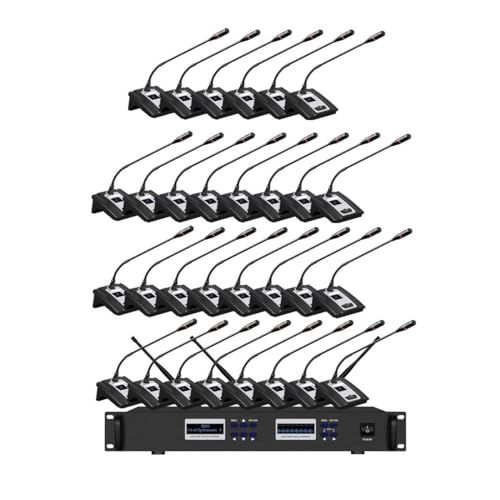
Best for: larger conferences needing high-capacity attendee support and a durable all-metal main unit. This kit supports up to 255 attendees (including 1 chairman) and uses a digital-analog hybrid approach to minimize delay and maximize fidelity. Caution: data sheet notes flexible attendance changes, but real-world performance depends on room acoustics and interference management.
TONOR Wireless Microphones System (4×10 Channels)

Best for: churches or conferences needing long-range wireless with multiple microphone options. It features a 295ft (90m) range and four channels with 10 frequencies per mic, enabling up to 40 channels without interference. Choose this if you want hands-free flexibility with reliable coverage across larger rooms. Limitation: setup may require careful interference checking in RF-dense environments.
TONOR Wireless Microphone System UHF 4×10 Channels

Best for: versatile event settings requiring reliable 4×10 channel performance with 60m range. It supports up to four simultaneous sets and is compatible with mixers and PA systems via standard outputs. Caution: like all UHF systems, performance can vary with building materials and nearby RF devices.
Phenyx Pro Dual UHF Wireless System (PTU-71-2B)

Best for: small panel discussions or duet presentations needing two reliable, independently tunable channels. It features auto-scan to identify the least-interference frequencies and includes both wireless headsets and lapels. Limitation: dual-channel design means total mic count is limited compared to larger multi-mic systems.
Buying Guide
- Room size and attendee count: For up to 25–30 participants, prioritize systems with scalable channel counts (DDS6800, Phenyx Pro PTU-71-2B) or large-capacity kits (DDS6800 family). For smaller or duplex talks, two-channel or four-channel kits may suffice.
- Interference management: Look for auto-scan or frequency synchronization features to minimize channel dropouts. UHF systems generally perform better in crowded RF environments.
- Available outputs and integration: Ensure the system provides XLR, 1/4″ outputs or direct mixer compatibility for your venue’s audio chain.
- Expandability: If you anticipate growth, choose systems with optional add-on mics or higher-capacity kits (e.g., 8×25 frequency configurations or 255-attendee defaults).
- Ease of setup: IR synchronization, quick pairing, and clear control interfaces reduce setup time before events.
FAQ
- What is the main difference between UHF and other wireless bands? UHF typically offers better range and less interference in crowded RF environments, but requires careful channel planning.
- How many mics can I run at once with these systems? It varies by model; some kits support 8, 16, or up to 255 attendees including chairman, depending on the configuration.
- Do these systems require calibration before each event? Many include auto-scan or synchronization features to simplify setup, though a quick check of channels is recommended.
- Can I mix handheld mics with lavalier or headset mics in the same system? Some models support mixed microphone types; check each kit’s compatibility notes for channel assignments.
- Is IR synchronization necessary? IR pairing is common for fast, reliable pairing of mics to their receivers, reducing setup time.
- Are there any common limitations I should expect? RF environments, room materials, and nearby wireless devices can affect range and reliability; plan accordingly with a spare channel or two.