
Best Wireless Guitar System for Active Pickups: Clear, Low-Latency 5.8GHz Options
Choosing a wireless guitar system that works seamlessly with active pickups means focusing on low latency, strong range, and reliable compatibility. This guide highlights five 5.8GHz models that support active and passive pickups, with notes on who benefits most from each. If you perform live, practice at home, or record, these options help you keep your signal clean and consistent. Below, you’ll find concise profiles, key strengths, and practical buying tips to compare quickly.
Buyer’s quick-reference table
| Product | Best For | Notable Benefit |
|---|---|---|
| Xvive AC58 Wireless System (Bundle) | Active or Passive guitars; onstage use | Charging case with up to 2 full charges |
| Xvive A58 Wireless System | Active pickups; versatile setups | Active/Passive modes; wide compatibility |
| NUX C-5RC | Studio and stage; auto matching | 24-bit audio; up to 100 ft range |
| Xvive A58 (Transmitter/Receiver) | Live performers needing long range | 5.8GHz, high-resolution audio |
| JOYO JW-06 | Budget-friendly reliability | 18-hour battery life; multi-channel |
Xvive AC58 Wireless Guitar System Bundle

The AC58 bundle includes the A58 system and a BCA58 charging case, offering up to two full charges or multiple top-ups for the transmitter and receiver. It uses a 5.8 GHz true diversity wireless approach and supports high-resolution 24-bit/48 kHz audio, ensuring minimal interference with other wireless devices. This setup is best for players who value mobility on stage and want a reliable charging solution for long gigs. A note for buyers: the system supports both active and passive modes, but keep an eye on battery life during extended performances.
Who it’s best for: Musicians who perform regularly and need a ready-to-go charging solution without swapping batteries, plus compatibility with both active and passive pickups. Why selected: bundled charging case improves on-stage practicality and reduces downtime between sets.
Limitation: While the claim is reliable, actual battery life depends on usage and power management during shows.
Xvive A58 Wireless Guitar System
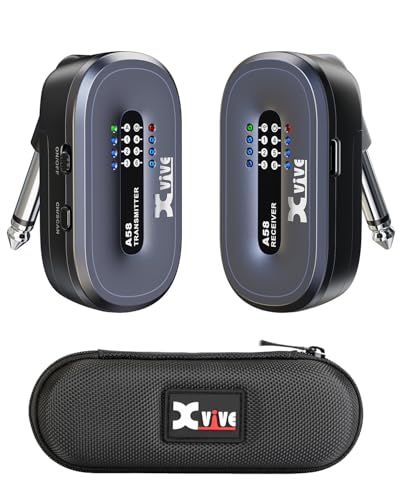
This A58 unit emphasizes versatility with active and passive modes, addressing compatibility with high-output active pickups. It’s designed for both stage and home use, delivering 24-bit/48 kHz audio and a stable 5.8 GHz transmission that minimizes interference. The manual notes how to activate Active mode by holding the Channel button for three seconds, ensuring players with different pickups can quickly set up.
Who it’s best for: Players with a mix of active and passive instruments who need a straightforward switch between modes. Why chosen: explicit support for high-output active pickups makes it a natural pick for modern guitars and basses.
Caution: If you encounter distortion in passive mode with very high input power, switch to Active mode as suggested by the manufacturer guidance.
NUX C-5RC 5.8GHz Wireless System

NUX’s C-5RC is pitched as ultra-compact and ultra-simple, with pristine 24-bit audio and ultra-low latency. It offers up to 100 feet of operation in line-of-sight, and it is compatible with electric, acoustic-electric, bass guitars, and other instruments, regardless of pickup type. This model emphasizes digital transmission quality and simplicity, making it appealing for players who want dependable wireless performance without fiddling with complex settings.
Who it’s best for: Entertainers and session players who need dependable, long-range wireless with minimal setup. Why chosen: auto-match capability and broad compatibility make it a flexible choice for diverse rigs.
Limitation: Real-world range can vary with lighting, obstacles, and RF interference; test in your space before critical gigs.
Xvive A58 Wireless System (Transmitter & Receiver) – Rosewood Variant

This variant centers on the same A58 family’s reliability with 5.8 GHz true diversity and 24-bit/48 kHz audio. It emphasizes onstage reliability and broad compatibility with active and passive pickups. The Rosewood label is cosmetic; the core performance remains centered on clean signal transmission and minimal interference. Best for players who want consistent performance across multiple guitars and tones in live settings.
Who it’s best for: Stage players who value consistent tone across guitars and quick setup. Why chosen: proven A58 performance with a familiar form factor for ongoing live use.
LEKATO 5.8GHz Wireless Guitar System
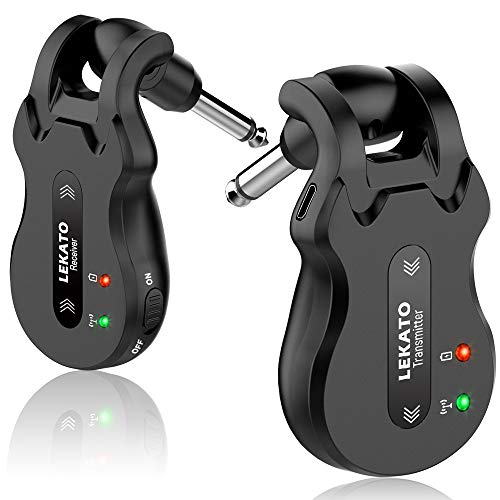
LEKATO’s system highlights higher anti-interference performance and an effective range around 100 feet, along with a 24-bit/48 kHz audio path and a rechargeable battery that lasts up to five hours per charge. A dual USB charging setup is included, and the unit supports both electric and bass applications. This option is suitable for players who want longer performance without frequent recharging and solid signal integrity across a wide space.
Who it’s best for: Guitarists who need a robust, long-range solution with built-in recharging and clear audio. Why chosen: rechargeable design and strong range with clear signal transmission.
New Bee Wireless Guitar System with Charging Box

New Bee offers a 5.8GHz wireless system with 30 meters transmission distance and a USB-C fast charging mindset. The setup supports 6.35mm and 3.5mm jacks and is suitable for active and passive pickups across guitars and other instruments. It includes a charging case with a 2000mAh battery, providing up to 10 hours of operation after full charge. The 4-bar battery indicator helps monitor power for performances.
Who it’s best for: Players seeking multi-jack compatibility and a long-running battery in a compact charging case. Why chosen: practical 30-meter range, dual jack support, and visible battery status aid on-stage decisions.
Buying Guide: Key Considerations For 5.8GHz Wireless Systems
- Active vs. passive pickup compatibility: Confirm whether you need true diversity, and whether the system explicitly supports high-output active pickups. If your guitar uses active pickups, prioritize models with an easy mode toggle or clear guidance for activating active mode.
- Latency and audio quality: Look for 24-bit/48 kHz audio and sub-6 ms latency. This combination preserves nuance in tone and attack while reducing perceptible delay.
- Range and reliability: Consider open-space range (often up to 100 feet) and how shielding or interference from other devices could affect performance on stage or in rehearsal spaces.
- Battery life and charging options: A charging cradle or case that can supply multiple charges is advantageous for long shows. Check estimated playtime per charge and whether a case is included.
- Channel management and interference: Systems with multiple channels or auto-match features help avoid dropouts in busy RF environments. Verify how many pairs can operate simultaneously in the same venue without crosstalk.
- Portability and compatibility: Look for compact transmitters/receivers, easy pairing, and compatibility with standard guitar jacks (6.35mm) and auxiliary devices (3.5mm) for recording or direct monitoring.
Frequently Asked Questions
- Do 5.8GHz wireless guitar systems work with active pickups? Yes. Many models support both active and passive modes, with explicit steps to switch modes for best performance.
- What latency should I expect from a good system? High-quality 5.8GHz systems typically deliver under 6 ms, with many around 4–5 ms, which is generally inaudible to players and audiences.
- Is a charging case important? A charging case is highly beneficial for gig-heavy schedules, extending the number of charges between power sources and reducing downtime between sets.
- Can I use multiple wireless systems in the same space? Yes, but it’s best to choose units with multiple channels or auto-matching features and test in your space to avoid interference.
- What should I test before a live show? Check battery levels, confirm the transmitter/receiver pair is on the correct channel, and verify the system remains free of dropouts across stages and rehearsal rooms.
- Are these systems suitable for bass guitars? Most models advertise compatibility with electric guitars, acoustic-electric guitars, and bass guitars, provided the instrument’s output matches the system’s inputs.