Best Wireless Headphones for Guitarists: Amp-Quality Practice and Play
When selecting wireless headphones for guitar practice, look for low latency, clear instrument response, and comfortable wear for long sessions. This guide highlights five top options, each suited to different guitar setups—from silent practice and direct amp emulation to studio monitoring and live performance. The picks cover AI-powered headphones, dedicated wireless IEM systems, and compact headphone amps designed for guitarists.
Summary table of selected products
| Product | Best For | Why It Stands Out |
|---|---|---|
| Positive Grid Spark NEO Wireless Guitar Headphone Amp | Amp-quality practice with AI tones | AI-driven presets, built-in 1/4″ input, low-latency wireless |
| JOYO JW-07 Wireless IEM System | Quiet studio practice, stage monitoring | Low latency, 48kHz/16bit clarity, independent receiver |
| LEKATO Guitar Headphone Amp | Silent practice with Bluetooth and effects | Built-in Bluetooth, multiple effects, compact |
| syndesmos 2.4GHz Wireless Headphones For Guitar Amp | Hybrid wired/wireless studio use | Dedicated wireless instrument bridge, 20ms latency |
| BOSS Waza-Air | Immersive wireless guitar experience | Spatial tech, multiple amps/effects via app |
Positive Grid Spark NEO Wireless Guitar Headphone Amp

Best for players seeking AI-powered tone shaping directly from wireless headphones. The Spark NEO uses custom audio drivers and ultra-soft ear cups for noise-isolating sound, with a built-in wireless transmitter that provides seamless connection and ultra-low latency for electric, acoustic, and bass guitars. The included Spark app offers AI-driven tools and gear collections to craft custom tones and learn chords.
Who it’s best for: players who want studio-like tone options and instant access to a collection of guitar rigs without extra hardware. Why selected: the integrated 1/4″ input and AI features make this ideal for at-home practice with quick tone recall.
Caution: setup relies on the Spark app ecosystem; if you don’t plan to use the app features, you may not utilize the full capability of the hardware.
JOYO JW-07 Wireless In-Ear Monitor System

Best for quiet practice and real-time monitoring. The JW-07 is a 2.4GHz wireless IEM system offering 48kHz/16bit clarity and low latency under 5 ms, making it suitable for guitarists who need immediate feedback while practicing. It uses frequency hopping to minimize interference and maintain a stable signal.
Who it’s best for: players who practice in shared spaces or who need precise timing without dragging cables. Why selected: its low-latency design and monitoring focus help sharpen technique with minimal distraction.
Caution: as an IEM system, it may require additional stage gear for full live performance use and can be less comfortable for extended wear on longer sessions.
OneOdio A70 Bluetooth Over-Ear Headphones

Best for versatile wireless or wired practice and studio work. The A70 supports up to 72 hours in wireless mode, with a wired option via 3.5 mm and 6.35 mm jacks for uninterrupted sessions. Its dual mode makes it a flexible choice for guitarists who also need solid monitoring for other instruments.
Who it’s best for: players who want long battery life and a robust wired option for studio work. Why selected: long playtime and a comfortable design make it suitable for long practice blocks and mixing sessions.
Caution: sound profile emphasizes bass; if you need ultra-flat monitoring for critical mixing, this may skew low-end perception compared with studio monitors.
LEKATO Guitar Headphone Amp
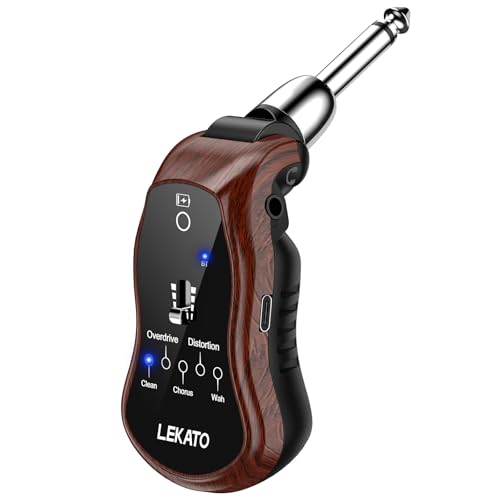
Best for silent practice with built-in Bluetooth and multiple effects. This pocket amp supports Bluetooth input from a phone or other devices and offers classic guitar effects: Clean, Overdrive, Chorus, Distortion, and Wah. It’s a compact solution for late-night sessions without disturbing others.
Who it’s best for: players seeking a compact, all-in-one practice gear with a set of classic effects. Why selected: the built-in effects and Bluetooth input make it easy to improvise and jam anywhere.
Caution: the device is designed for practice with headphones; it may not replace a full amp for live guitar tones in a band setting.
syndesmos 2.4GHz Wireless Headphones For Guitar Amp

Best for modern studios needing flexible connectivity. The Wireless Bridge links directly to your guitar via 2.4GHz transmission for a latency of about 20 ms, delivering a “wired feel” while moving around the studio. It supports switching to Bluetooth 5.3 for casual listening and includes 3.5 mm and 6.35 mm cables for compatibility with traditional interfaces.
Who it’s best for: players who require low-latency instrument monitoring and easy transition between wired and wireless modes. Why selected: the hybrid approach is ideal for both practice and studio sessions without changing gear setups.
Caution: latency is still higher than ultra-low-latency systems, which may be noticeable to highly timing-sensitive players.
BOSS Waza-Air: Over-Ear Wireless Guitar System

Best for immersive, app-driven guitar tones with spatial processing. The Waza-Air is an over-ear system that uses advanced spatial technology and a gyro sensor for 3D ambience and precise tone localization. It provides access to multiple amp types and over 50 customizable effects via the BOSS Tone Studio app.
Who it’s best for: players who want a portable, high-fidelity wireless rig with extensive tone shaping and live-play feel. Why selected: its immersive sound stage and extensive effects make it a strong stand-alone practice or performance option.
Caution: the feature set relies heavily on the companion app; some users may prefer a hardware-forward approach with fewer app dependencies.
Buying Guide: Key Purchase Considerations
Latency and reliability matter most for guitar practice. Look for low-latency wireless solutions and clear instrument transmission to ensure real-time feedback. If you play live, consider IEM systems or wireless headsets with stable channels to avoid dropouts.
Design and comfort influence how long you’ll practice. Prioritize soft ear pads, adjustable headbands, and lightweight builds for extended sessions.
Sound tuning should match your goals. Some devices emphasize bass and immersive ambience, while others focus on accurate guitar tone and clean mids. If you rely on pedals or amp sims, the ability to route a direct guitar signal through the device (1/4″ input or direct monitoring) is essential.
Connectivity flexibility matters. Bluetooth is convenient for casual listening, but dedicated instrument wireless bridges or low-latency dongles are preferable for precise practice timing. Ensure compatibility with your guitar’s output jack and your preferred devices (smartphones, laptops, or microphones).
Portability vs. performance: compact headphone amps are great for travel and late-night practice, whereas immersive systems like Waza-Air are designed for studio-like experiences away from the desk.
FAQ
- What is the best option for ultra-low latency guitar practice? A dedicated wireless instrument bridge or IEM system with reported sub-5 ms latency is ideal for real-time feedback.
- Can I use Bluetooth headphones for guitar tones? Yes, but for timing-critical practice, rely on wired or proprietary low-latency wireless options to minimize delay.
- Are there built-in guitar effects in wireless headphone amps? Some models include a set of classic effects (overdrive, chorus, distortion, Wah) and amp models, suitable for silent practice.
- Is it better to choose hybrid wired/wireless systems? Hybrid setups offer flexibility, letting you switch to wired for reliability or Bluetooth for casual listening.
- Do these devices affect battery life significantly? Wireless practice gear typically balances battery life with performance; check playtime specs to match your practice regimen.
- Which option is best for studio monitoring? Headphones and IEMs with accurate midrange and clean highs are preferred; consider models with a flat or reference-like response for mixing tasks.