
Best Wireless Headphones That Look Like Hearing Aids for Everyday Use
Answering the need for discreet, console-like hearing support, these wireless devices resemble familiar earbuds while offering hearing-enhancement features. They’re best for seniors, frequent conversational settings, or anyone seeking a discreet listening aid that doubles as wireless headphones. This guide highlights five top options, explains who each is best for, and compares their key strengths and limitations.
| Product | Best For | Why It Stands Out |
|---|---|---|
| Ceretone OTC Hearing Aids Seniors Rechargeable Looks Like Regular Earbuds | Seniors who want a premium in-ear aid with long-life charge | Advanced DSP, rechargeable case with 100 hours total use |
| Flaygo Hearing Aids for Seniors (Audien) | Lightweight, nearly invisible wearers | 16-channel digital chip, compact, fast USB-C charging |
| Edifier OTC Bluetooth Hearing Aids & Neckband | Users who want 2-in-1 with neckband/earbuds | Dual-mode chip for hearing aid and Bluetooth headphones |
| SIAIME Hearing Aids for Seniors | Those needing strong DSP noise reduction | Significant noise reduction and nearly invisible design |
| Hearing Aids for Seniors and Adults (Calmaur) | Budget-conscious buyers needing Bluetooth and amplification | 2-in-1 Bluetooth and hearing aid with multiple environment modes |
Ceretone OTC Hearing Aids Seniors Rechargeable Looks Like Regular Earbuds

Best for seniors who want a premium in-ear hearing aid with long battery life. This device uses a digital sound processing chip (Intricon) and a Knowles-branded speaker, delivering crystal-clear conversations and balanced sound across daily activities and media consumption. It includes an upgraded charging case that doubles as a portable power bank, totaling up to 100 hours of use. The ergonomic, in-ear design offers comfort with multiple ear tip sizes and IP54 dust and sweat resistance. Consider this option if long life and strong environmental noise reduction are priorities, but be aware it is an in-ear device that looks like a standard earbud rather than a classic behind-the-ear model.
- Best for: Seniors needing clear speech in varied environments and long battery life.
- Why selected: High-quality processing with durable, travel-friendly charging case.
- Caution: Full charging time is about 2 hours; weights and fit vary by ear size.
Flaygo Hearing Aids for Seniors (Audien)

Best for wearers who want a lightweight, nearly invisible in-ear experience with strong noise reduction. This model uses a 16-channel digital chip and intelligent noise reduction to filter background sounds while preserving voices, plus a whistling suppression system to reduce feedback. It weighs about 3.5 g and comes with USB-C fast charging, offering up to 80 hours of use per cycle and a compact charging case that supports multiple recharges. Choose this if you value low-profile wear and straightforward operation, but note that it emphasizes discreet design over large acoustic adjustments for severe hearing loss.
- Best for: Individuals prioritizing discretion and comfortable daily wear.
- Why selected: Compact, lightweight, with robust battery life and smart noise handling.
- Caution: Designed for mild to moderate hearing loss; performance may vary with more intensive hearing needs.
Edifier OTC Bluetooth Hearing Aids & Neckband Headphones

Best for users who want a 2-in-1 solution: hearing aids and neckband Bluetooth headphones in one device. Built with a dual-mode chip to switch between hearing aid functionality and wireless audio streaming, it remains compatible with iOS and Android for calls and media. It features a 16-channel DSP for noise reduction and anti-feedback technology to reduce whistling. The neckband design supports all-day wear with an IP54 rating for sweat and light rain. Choose this if you want seamless transitions between conversations and media, and be mindful that the form factor is neckband-centric, which may feel bulkier to some users.
- Best for: People who want both hearing support and wireless headphones in one device.
- Why selected: Flexible 2-in-1 capability with cross-platform compatibility.
- Caution: Neckband may feel bulkier compared with pure in-ear models for some users.
SIAIME Hearing Aids for Seniors
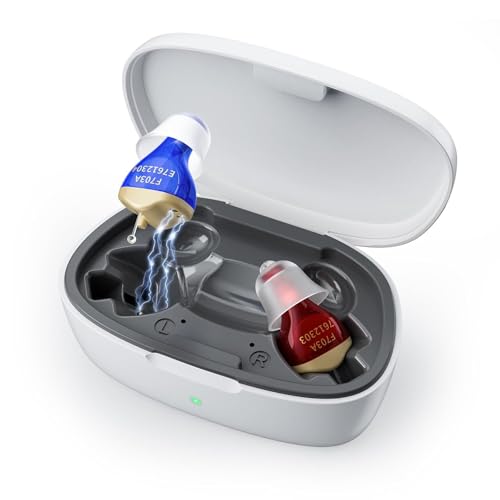
Best for seekers of strong DSP-based noise reduction in a nearly invisible form. SIAIME emphasizes a discreet in-the-ear design and senior-friendly operation, including large volume controls and multiple earbud sizes for a tailored fit. The device promises substantial speech clarity through 15-20 dB noise filtering and improved intelligibility in restaurants and gatherings. Consider this if you value significant noise suppression and a simple user interface; however, the design is focused on comfort and subtle appearance, which may limit some advanced customization options for power users.
- Best for: Seniors needing pronounced noise reduction and easy handling.
- Why selected: Strong DSP performance in a nearly invisible form.
- Caution: Fewer advanced customization options than some premium models.
Hearing Aids for Seniors and Adults (Calmaur)

Best for budget-conscious buyers who want a practical Bluetooth-enabled hearing aid and streaming capability. Calmaur delivers a 2-in-1 experience with Bluetooth connectivity and diverse environment modes, aiming to balance amplification with ambient awareness. The device emphasizes comfortable wear and a straightforward interface, making it suitable for users new to hearing aids. A potential limitation is that it may offer fewer premium features than higher-priced counterparts, so expectations should align with real-world needs rather than spec-heavy claims.
- Best for: Buyers seeking a cost-effective Bluetooth-enabled solution.
- Why selected: Combines basic hearing aid functions with Bluetooth streaming in a compact package.
- Caution: May lack some advanced features found in more expensive models.
Buying Guide
What to consider when choosing
Discretion and design: If the appearance matters most, prioritize discreet, in-the-ear designs that resemble standard earbuds. If you prefer less visibility, look for models advertised as nearly invisible or compact.
Sound quality and noise management
Look for devices with DSP (digital signal processing) technology and multiple noise-reduction modes. Strong noise suppression helps with conversations in noisy environments, while good voice clarity ensures you hear speech clearly.
Battery life and charging
Consider total usage time per charge and charging options. Some products offer long runtimes with rechargeable cases, while others rely on fast charging or USB-C power delivery. Travel-friendly cases are a plus for frequent travelers.
Fit and comfort
Ear tip or earbud sizing matters for comfort and seal. A secure fit reduces feedback and improves sound quality. IP ratings indicate resistance to sweat and light rain, which matters for outdoor use.
Compatibility and controls
Ensure compatibility with your devices (iOS/Android) and verify whether the device supports hands-free calls, streaming, or on-device controls. Some models provide simple, button-based operation suitable for seniors.
Best use scenarios
Clinical settings aside, these devices suit daily conversations, watching TV, commuting, and casual listening. Choose a model that aligns with your primary use—quiet, discreet listening or frequent media streaming with phone calls.
FAQ
- Are these devices true hearing aids or just amplifiers?
Most listed options are designed as OTC hearing aids or hearing-aid-like devices with amplification and noise management, not generic amplifiers. - Will they look obvious when worn?
Several options are designed to be discreet or nearly invisible, featuring compact in-the-ear designs and soft ear caps. - Can I use these for calls and music?
Many models support Bluetooth streaming for calls and media, but 2-in-1 devices may prioritize hearing support over pure audio quality. - What should I look for if I have mild hearing loss?
Focus on models with strong speech enhancement, lightweight fit, and manageable controls for easy daily use. - Do these require professional fitting?
OTC devices are designed for self-selection, but fit, comfort, and settings can be adjusted by the user or with manufacturer guidance. - How long do the batteries last?
Battery life varies; some units provide 60–100 hours per charge with a rechargeable case, while others offer shorter cycles depending on usage.