Best Wireless Headset Microphone System for Clear Voices and Flexible Performances
Whether you’re hosting a church service, delivering a keynote, or doing live karaoke, a wireless headset microphone system can keep you moving while preserving sound quality. This guide highlights five top options, focusing on reliable range, clear voice capture, and easy setup. Each pick is best for different user needs—from multiple-mic classrooms to single-performer shows—so you can choose the right fit for your space and audience.
| Product | Best For | Key Advantage |
|---|---|---|
| Mid-size events | 40 simultaneous sets without interference | |
| Phenyx Pro PDP-1-1B | Solo performers, churches | 15 tunable frequencies in 902–928 MHz |
| Bietrun Wireless Headset System | Portable venues | 160 ft range; 2-in-1 headset/handheld |
| Shure BLX14/P31 | Professional events | Up to 300 ft range; proven reliability |
| TONOR UHF Wireless System with Headset/Lavalier (B0CKNY9R1N) | Churches and conferences | Two mic options; 60 m range |
TONOR 4-Channel UHF Wireless System

Key features include a professional cardioid dynamic capsule for clear sound and a wide 200ft/60m operating range. The system supports up to 40 simultaneous sets across 4 microphones, reducing interference in larger spaces. It connects to mixers, karaoke machines, and powered speakers via a standard 1/4″ (6.35mm) output. This setup is best for venues that need multiple wireless mics without sacrificing sound quality.
Best for: mid-size venues with multiple speakers or performers. This option is particularly suitable for church gatherings, weddings, gym classes, and conferences where reliability and easy multi-mic management matter.
Caution: While the 200ft range is impressive, actual distance depends on line-of-sight and obstacles like walls or metal fixtures. Position the receiver to maximize signal paths.
Phenyx Pro Single Digital Wireless System

This single-system kit is designed for performers who need high-quality digital transmission. It uses 48kHz/24Bit UHF digital circuitry with 15 tunable frequencies (902–928MHz) to minimize interference. The bodypack and mini receiver support long battery life through USB-C charging, and an auto-tune frequency selection simplifies setup. It offers an estimated 160–200ft line-of-sight range, making it suitable for small studios, churches, and live stages.
Best for: solo performers or small groups who require clear, low-latency sound and straightforward operation. Choose this if you prioritize digital transmission with flexible frequency options.
Caution: Range can vary with obstructions and antenna placement; ensure the line-of-sight path remains clear for best performance.
Bietrun Wireless Headset System
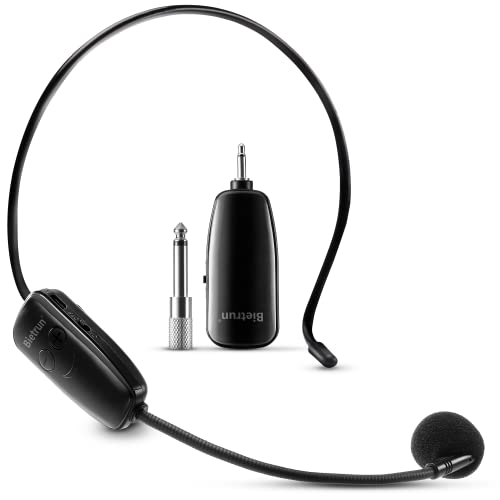
The Bietrun system offers a 160ft (50m) range with a built-in high-sensitivity condenser microphone for clearer sound. It supports headset and handheld modes, making it flexible for both singing and speaking engagements. The plug-in design connects to 3.5mm outputs, with an optional 6.35mm adapter for larger PA systems. Batteries provide several hours of operation, and the setup is generally straightforward for quick deployments.
Best for: mobile or small-to-medium venues where flexibility and quick setup are priorities. Not ideal for users requiring Bluetooth or AUX passthrough from devices.
Caution: The system is designed for mic jack use; it may not work with AUX inputs or some modern Bluetooth speakers without adapters.
Shure BLX14/P31 Headset System

The Shure BLX14/P31 package includes a BLX4 receiver, BLX1 bodypack, and a PGA31 cardioid headset mic. This system uses the H11 UHF band (572–596 MHz) and offers a generous line-of-sight range of up to about 300 ft (100 m). It is built for all-day reliability, with straightforward operation and a familiar Shure durability. The headset mic is designed to stay in place during movement, making it a strong choice for presenters and performers who need hands-free operation.
Best for: professional events or venues where consistent performance and brand reliability are priorities. It’s suitable for hosts, teachers, and performers who require dependable uptime and simple control.
Caution: Always verify local spectrum regulations before ordering to ensure compliance in your area, as UHF bands can vary by region.
TONOR 4-Channel UHF System With Headset/Lavalier

This Tonor kit pairs a wireless receiver with both headset and lavalier microphones and a bodypack transmitter, delivering a 60 m/200 ft range. It uses 4 channels to support multiple performers without signal interference. The system connects to standard mic inputs on mixers and powered speakers via a 1/4″ output. It’s designed for church conferences, performances, and karaoke settings where hands-free operation is beneficial for multiple speakers.
Best for: churches, conferences, and small-stage performances that require simultaneous wireless mics with easy setup. Choose this if you want versatile mic options and a robust 60 m range.
Caution: Users should avoid close proximity to metal surfaces or glass to maintain optimal range and minimize potential interference.
Buying Guide: Key Purchase Considerations
How to choose among wireless headset microphone systems depends on space, number of speakers, and performance needs. Consider these practical questions and notes:
- What is the room size and seating layout? Larger spaces benefit from longer range and multiple channels.
- Do you need headset, lavalier, or both? Systems that include both give you flexibility for movement and hands-free speaking.
- What is the wireless band and local regulations? UHF bands offer reliable range, but availability varies by region; ensure compliance.
- Is battery life important? Look for systems with long battery life or USB-C charging for easy recharging during events.
- How many channels are needed simultaneously? More channels reduce the chance of interference in multi-speaker settings.
- What devices will you connect to? Check output types (1/4″ or XLR) and compatibility with mixers, amps, and speakers.
- What’s the typical usage scenario? For church services or teaching, reliability and ease of use are critical; for performances, sound quality and feedback rejection matter more.
FAQ
- What is the typical range of these wireless systems? Most models offer 160–300 ft line-of-sight ranges, though walls and furniture can reduce this.
- Do these systems require special receivers? Yes, a dedicated receiver is needed; most kits include a 1/4″ output for mixers or powered speakers.
- Are headset mics better than lavalier mics? Headset mics stay in place during movement and can offer consistent gain, but lavaliers can be less obtrusive and more discreet.
- Can I use multiple wireless mics with one mixer? Many kits support multiple channels; check the number of channels and potential interference handling.
- What should I avoid to prevent noise or feedback? Maintain line-of-sight between transmitter and receiver, avoid pointing a mic directly at speakers, and keep at least several feet of separation from reflective surfaces when possible.
- Is it necessary to verify regional frequency compliance? Yes. UHF bands differ by country; confirm local regulations before purchasing.