Best Wireless in-Ear Monitors for Musicians on Stage
Discover reliable wireless in-ear monitor systems that suit different performance needs. This guide highlights top options for singers, bands, church teams, and solo performers. Each pick emphasizes low latency, clear sound, and ease of use. Ideal buyers include: touring musicians needing stable multi-channel setups, church tech teams seeking simple mono/stereo switching, and small- to mid-sized bands needing cost-effective IEM solutions.
| Product | Best For | Key Benefit |
|---|---|---|
| LEKATO MS-02 | Small to mid-size bands | Ultra-low latency, One-to-Many coverage |
| Xvive U45 | Live performers | 5.8 GHz, channel scan for quick setup |
| Xvive U4 | Budget setups | 6-channel, long range, low latency |
| POGOLAB | Stage and touring | UHF, 7 channels, 1 ms latency |
| Phenyx Pro PTM-10 | Speakers and classrooms | Stereo/mono, flexible EQ |
LEKATO MS-02 Wireless In-Ear Monitor System

The LEKATO MS-02 offers an upgraded low-latency wireless path with mono mode under 4.5 ms. Its 24-bit/48 kHz sampling rate preserves detail for on-stage monitoring. Best for small to mid-sized bands needing reliable multi-receiver support from a single transmitter, up to four receivers.
- Best for: small to mid-sized ensembles needing a simple one-to-many arrangement.
- Why selected: notably low latency and clear, realistic sound reproduction.
- Caution: pairing procedure requires both transmitter and first receiver to be in pairing mode; ensure all units are within range during setup.
Xvive U45 Wireless In Ear Monitor System

U45 uses 5.8 GHz true diversity for stable RF connections over long distances (up to about 100 feet). Its Channel Scan Mode automatically finds the best channel, then the transmitter and receiver are synced. The system delivers 24-bit/48 kHz audio with a broad 20 Hz–20 kHz response for clean on-stage monitoring.
- Best for: performers who need quick setup and reliable channel selection in crowded venues.
- Why selected: strong RF stability and an automatic channel scan streamline live sound checks.
- Caution: ensure no conflicting devices operate on nearby 5.8 GHz channels during setup.
Xvive U4 Wireless In-Ear Monitor System Set
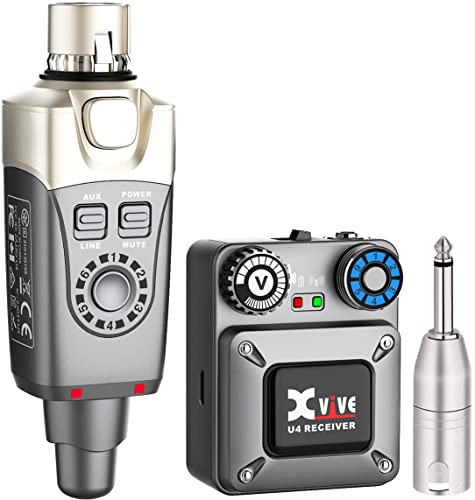
The U4 set emphasizes broad coverage with up to 90 feet of range and six available channels, offering flexibility for multiple performers on stage. Latency is kept below 5 ms, making it suitable for live performances where timing matters.
- Best for: bands or worship teams that need multi-channel capability without complex setup.
- Why selected: long range with multiple channels supports larger stage layouts.
- Caution: the system relies on clear line-of-sight; obstacles can affect range.
JOYO JW-07 Wireless In-Ear Monitor System

JOYO JW-07 targets entry-level users with low latency under 5 ms and 48 kHz/16-bit audio. It emphasizes ease of use for beginners learning monitoring and practice setups.
- Best for: new performers or practice-focused setups needing straightforward pairing.
- Why selected: simple controls and reliable basic performance for learning the IEM workflow.
- Caution: audio clarity may not match higher-end models in loud, complex environments.
POGOLAB Wireless In-Ear Monitor System

POGOLAB offers a UHF system with seven selectable channels and a quoted 1 ms latency in a professional package. Its XLR input on the transmitter supports balanced sources, while the receiver includes a 3.5 mm output for easy monitoring with standard in-ears.
- Best for: stage performances and touring where channel flexibility and low latency are priorities.
- Why selected: robust channel count and professional input options support diverse audio sources.
- Caution: UHF performance can vary by venue; verify channel availability ahead of time.
Phenyx Pro PTM-10 UHF Stereo Wireless IEM

Phenyx Pro PTM-10 provides stereo or mono monitoring with 900 MHz operation and 89 selectable frequencies for multi-system reuse. It includes a balanced XLR input and a dedicated EQ/tone shaping, offering more control over monitor mixes.
- Best for: venues or events needing stereo monitoring with flexible channel use.
- Why selected: strong feature set for a mid-range price point, including EQ and mono/stereo options.
- Caution: 900 MHz performance can vary; verify local channel availability before use.
Buying Guide: Key Considerations For Selecting Wireless IEMs
- Latency: Critical for musicians; many systems advertise sub-5 ms latency, useful for real-time monitoring.
- Frequency band: 2.4 GHz systems are common and affordable; UHF systems often offer more stable performance in crowded venues but may require channel checks.
- Channel count: If you have multiple performers, choose “one transmitter to many receivers” or multi-channel sets to prevent crowding on a single channel.
- Input options: Transmitter inputs (XLR, 1/4″ AUX) influence how you connect from mixers or audio sources.
- Range: Consider stage size and environment; longer range helps in large venues or outdoor spaces.
- Ease of pairing: Auto-pairing or channel-scan features save setup time between performances.
- Durability and battery life: Look for robust hardware and long battery life to match show length and rehearsal time.
- Compatibility: Ensure the system works with your current receiver/beltpack and in-ear headphones or earphones.
FAQ
- What is a typical latency range for wireless IEMs?
Most systems advertise sub-5 ms latency, with some models under 4.5 ms, which is usually sufficient for live performance timing.
- Is 5.8 GHz better than 2.4 GHz for IEMs?
5.8 GHz (and some UHF bands) can offer more stable performance in crowded airspace, but availability and regulations vary by region. 2.4 GHz is common and budget-friendly.
- How many receivers can a single transmitter support?
Many systems support multiple receivers (from 2 up to 4 or more) in a one-to-many arrangement; check the product specs for exact limits.
- What should I consider when choosing between stereo and mono IEM modes?
Stereo provides a wider image and is beneficial for groups with multiple monitor feeds; mono can be more intelligible for single-channel cues and simpler mixes.
- Do these systems require professional setup?
Some models offer auto-pairing and channel scanning for quick setup, while others may require manual channel matching and basic mixing knowledge.