
Looking For A Wireless Subwoofer Kit? This guide compares leading kits that remove the need for long speaker cables while preserving bass quality and synchronization. Below is a quick summary table of the selected products to help you scan options fast.
| Product | Brand | Key Feature |
|---|---|---|
| DYNASTY PROAUDIO WSA-5TR-V2 | DYNASTY PROAUDIO | 5.2/5.8GHz Dual-Band, 106 RF Channels |
| Klipsch WA-2 Wireless Subwoofer Kit | Klipsch | Proprietary Klipsch/Jamo Compatibility |
| Audioengine S8 With W3 Wireless Adapter | Audioengine | Built-In Amplifier, Low Latency W3 Adapter |
| OSD Wireless 5.8GHz WSK-SUB | OSD Audio | 5.8GHz, 45-Channel Selection, 100ft Range |
| KEF KW1TXRX Wireless Adapter Kit | KEF | High-Bandwidth 5GHz, 24bit/48kHz Support |
DYNASTY PROAUDIO WSA-5TR-V2 Wireless Subwoofer Kit

This kit Uses 5.2 & 5.8GHz Dual-Band selectable wireless technology and a total of 106 RF channels with auto selection to reduce interference. The manufacturer emphasizes near-lossless audio transmission and improved stability for low interference environments. Installation is described as quick and cable-free—connect the transmitter to the audio source and place a powered subwoofer near a power outlet. Reported operating ranges reach up to 100 feet line-of-sight and roughly 50 feet through typical walls, ceilings, or floors. The product claims reduced latency suitable for home theater sync.
Klipsch WA-2 Wireless Subwoofer Kit With Easy Installation

The Klipsch WA-2 is a proprietary adapter designed for Klipsch (and select Jamo, Energy, Mirage) subwoofers that include the WA-2 port. It provides a manufacturer-matched wireless connection intended to preserve factory tuning and integration. Setup is framed as straightforward, and compatibility is limited to systems with the appropriate port—this makes it a focused solution for owners of compatible subwoofers seeking a plug-and-play wireless link without additional adapters.
Audioengine S8 250W Wireless Subwoofer Kit (W3 Adapter)
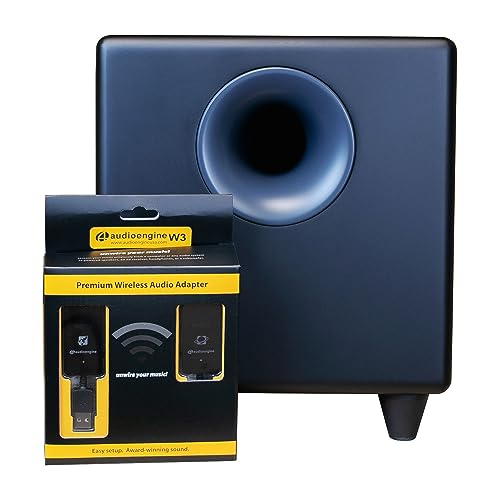
The Audioengine S8 is an integrated powered subwoofer (250W) paired with the W3 wireless adapter to provide low-latency placement flexibility. The S8 features a front-ported MDF cabinet and auto-sleep power saving. The W3 adapter offers extended range and can expand to additional zones with extra receivers. It works with Audioengine powered speakers and with AV receivers or preamps that have variable line-level outputs, making it a versatile option for systems where a powered subwoofer and manufacturer-matched wireless adapter are preferred.
OSD Wireless 5.8GHz Subwoofer Kit WSK-SUB

The OSD WSK-SUB focuses on a 5.8GHz digital link with a 45-channel selection to help find the cleanest frequency in congested RF environments. It advertises up to 100 feet line-of-sight range for low-frequency transmission and aims to provide a reliable wireless bass solution without running cables. The 45-channel tuning can be useful in multi-device households where Wi-Fi and other RF sources are present.
KEF KW1TXRX Wireless Subwoofer Adapter Kit
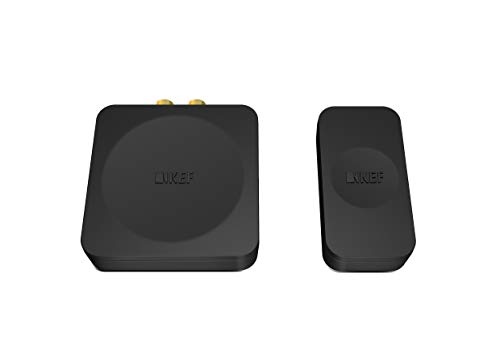
The KEF KW1 operates in the high-bandwidth 5GHz band and supports audio up to 24bit/48kHz. It is specified to work with KEF Kube subwoofers (Kube8b, Kube10b, Kube12b) and KF92, delivering a wireless transmission meant to retain detail and impact for both film and music. The adapter addresses connectivity for compatible KEF subwoofers while aiming to maintain high-resolution audio fidelity for users seeking a branded wireless pairing.
Buying Guide: How To Choose A Wireless Subwoofer Kit
Selecting the right wireless kit involves matching technical capability to your room, equipment, and listening priorities. Below are the major factors to weigh.
Compatibility
- Proprietary vs Universal: Some kits (Klipsch, KEF) are designed for specific subwoofer models and offer direct plug-and-play compatibility. Universal kits (DYNASTY, OSD, Audioengine W3) work with a wider range of powered subwoofers and receivers via line-level connections.
- Inputs/Outputs: Confirm the transmitter and receiver have the required RCA, 3.5mm, optical or proprietary port for your system.
Frequency Band And Channel Options
- 2.4GHz vs 5GHz/5.8GHz: 2.4GHz tends to have longer range but more congestion from Wi‑Fi and other devices. 5GHz/5.8GHz often allows cleaner, higher-bandwidth links with less interference at typical home distances.
- Channel Selection: More RF channels (45–106) can help avoid interference in crowded RF environments.
Latency And Sync
- Low Latency: Look for manufacturers specifying low-latency operation if you plan to use the subwoofer for home theater to keep audio synchronized with video.
- Phase/Delay Controls: Some wireless subwoofer systems provide adjustable delay or phase controls on the subwoofer or receiver to fine-tune integration.
Range And Obstructions
- Line-Of-Sight Range: Many kits specify 100 feet line-of-sight; actual performance through walls or floors will be reduced.
- Placement Flexibility: If the sub must be placed through multiple rooms or with many obstructions, prioritize kits with stronger transmission specs or higher-gain antennas.
Audio Quality
- Bandwidth & Bit Depth: High-bandwidth 5GHz solutions and kits that support higher sample rates (e.g., 24bit/48kHz) will better preserve low-frequency detail.
- Lossless/HiFi Claims: “Near-lossless” or HiFi claims can vary—confirm whether the kit supports uncompressed or high-quality codec transmission and check manufacturer specs.
Ease Of Installation
- Plug-And-Play: Proprietary kits for specific brands often offer the simplest installation.
- Universal Kits: Universal adapters usually require connecting to a line-level output on the AVR/preamp or using an included cable to the subwoofer input.
Environment And Interference
- Household RF Density: In homes with many Wi‑Fi devices, cordless phones, or smart devices, choose kits with broader channel selection or higher-frequency operation to avoid interference.
- Other RF Sources: Garage door openers, R/C devices, and neighboring Wi‑Fi routers can affect 2.4GHz performance more than 5GHz/5.8GHz solutions.
Expansion And Multi-Zone Use
- Expandable Systems: If you plan to add receivers or multiple subwoofers, look for systems that support multi-zone or additional receivers (Audioengine W3 expands with more receivers).
Manufacturer Match Vs Flexibility
- Brand-Matched Kits: Tend To Preserve Factory Tuning But Limit Cross-Brand Use.
- Universal Kits: Provide broader compatibility But May Require Manual Level/Phase Adjustment.
Use these comparison perspectives—compatibility, frequency band, latency, range, audio fidelity, installation ease, environment, and expansion needs—to narrow your choice. Check your subwoofer’s available inputs and the wireless kit’s supported bands and channels to ensure a suitable match for your room and home-theater or music priorities.