
Quick Overview: Below are five wireless microphone and portable speaker systems selected for clear voice projection, wireless mic options, battery life, and connectivity for presentations, classrooms, meetings, and tour guiding.
| Product | Type | Key Features |
|---|---|---|
| ResponseBridge 100W Voice Amplifier S99 | Portable PA With Dual Wireless Mics | 100W, Bluetooth, USB/TF, dual wireless mics, Type-C |
| WinBridge 60W S97 | Portable PA With Handheld & Headset | 60W, Bluetooth, instrument port, multiple volume controls |
| ResponseBridge B002 15W Megaphone Speaker | Clip-On Headset Amplifier | Portable headset mic, up to 9+ hrs, Bluetooth, USB |
| SANMIC S98 Pro | Portable PA With Handheld Mic | Bluetooth 5.3, LED display, 4 sound modes, USB/AUX/TF |
| Bietrun UHF Headset Mic System | UHF Wireless Headset Transmitter/Receiver | 160ft range, condenser mic, 6 hrs battery, 3.5mm/6.35mm adapter |
100W Powerful Voice Amplifier With 2 Wireless Microphones

Brand: ResponseBridge. This portable PA system emphasizes high output (100W) using a 6.5-inch woofer and 2-inch tweeter for fuller bass and crisp treble. It supports Bluetooth, USB, TF card, Aux, and guitar input, plus Type-C fast charging.
The unit ships with two wireless microphones that can operate simultaneously and allow independent volume control. Sound effect modes (Acoustic, Profession, Popular, Hip-hop) and an echo function offer adaptable voice profiling for presentations or small events. Battery claims indicate up to about 5 hours of playback per charge, suitable for medium-length sessions.
WinBridge 60W Wireless Voice Amplifier With Handheld And Headset

Brand: W WINBRIDGE. A 60W portable PA built for teachers and presenters with both handheld and headset microphone support. The system offers Bluetooth playback, USB/TF/AUX inputs, and a dedicated instrument port for guitar use.
Controls include an LED display and separate knobs for instrument, reverb, microphone, and master volume, providing precise sound balancing during presentations. This model targets versatility for educators and small events where both speech and occasional music are needed.
Voice Amplifier Wireless Microphone Headset B002

Brand: ResponseBridge. This compact clip-on unit and headset mic focus on portability and simplicity. The B002 highlights instant auto-pairing and a light form factor for hands-free delivering of lectures or tours.
Rated for clear, distortion-free voice projection and a claimed coverage up to large rooms, it offers Bluetooth streaming, USB playback, and up to 9+ hours battery life. The instant mute function and minimal setup make it suitable for presenters prioritizing ease-of-use.
Wireless Voice Amplifier With Handheld Microphone S98 Pro

Brand: SANMIC. The S98 Pro features Bluetooth 5.3 for improved wireless stability, an LED display for battery/volume readouts, and physical buttons for instant control. It supports USB/AUX/TF playback and professional wired mic/instrument connections.
Four sound modes (Acoustic, Professional, Pop, Hip-hop) let presenters adapt tonal balance to spoken-word clarity or livelier events. The interface and quick operation aim to reduce setup time for classroom or meeting-room use.
Bietrun UHF Wireless Headset Mic System
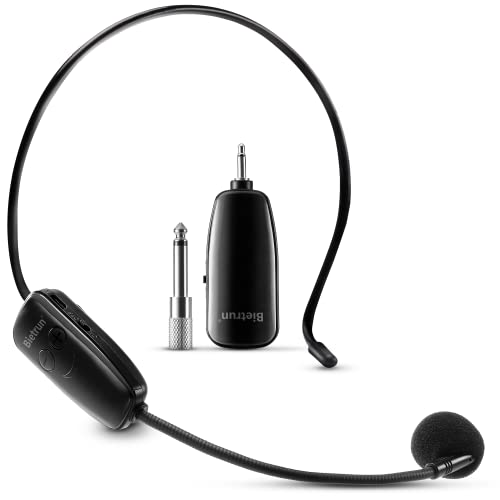
Brand: Bietrun. This UHF wireless transmitter/receiver set focuses on headset mic performance and long-range transmission (up to ~160 ft). The built-in condenser mic and signal stability features address reliable pick-up across medium-sized venues.
The kit is primarily for mic jacks (3.5mm) and includes a 6.35mm adapter for amplifiers. It offers about 6 hours of operation per charge with quick pairing and an anti-howling design, making it a good match for presenters who need a dedicated wireless mic to feed an external PA.
Buying Guide: Choosing The Right Wireless Mic And Speaker For Presentations
Coverage And Output: Match speaker wattage and speaker size to your venue. Higher wattage and larger drivers (e.g., 6.5″) generally provide better projection for larger rooms. For classrooms or small meeting rooms, 10–60W systems or compact 15W clip-on amplifiers are often sufficient.
Microphone Type: Headset/lapel (lav) mics enable hands-free presentations and maintain consistent mic-to-mouth distance. Handheld mics can be better for Q&A or shared use. Systems with both options offer flexibility.
Wireless Technology & Range: Bluetooth is convenient for audio playback but not ideal as the sole mic link for low-latency voice. Dedicated UHF/2.4GHz wireless mic systems provide longer range and lower latency for the presenter’s voice. Check the stated operating range and interference protections.
Battery Life & Charging: Consider session duration. Look for products that advertise continuous talk time that exceeds your longest event and convenient charging (Type-C preferred). Some systems separate mic and speaker batteries—check both.
Connectivity & Inputs: Ensure the unit supports the inputs you need: 3.5mm/6.35mm mic jacks, AUX, USB, TF card, and instrument inputs if you’ll add music or a guitar. Separate volume controls for mic and master output help balance voice vs. audio playback.
Sound Controls And Modes: Reverb, echo, EQ presets, and multiple sound modes can improve perceived clarity. For presentations, clarity-focused modes and a straightforward interface are generally most useful.
Portability And Mounting: Clip-on and belt-clip units or small carry cases improve mobility for teachers, tour guides, and presenters on the move. Larger PA units are better when mobility is less critical.
Compatibility With Existing Gear: If you already have a PA or mixer, choose a mic system with compatible outputs (3.5mm, 6.35mm, XLR via adapters). For feeding into existing speakers, confirm the receiver’s output type.
Reliability In The Field: Look for units with quick-pairing or auto-pairing and proven wireless stability. UHF/2.4GHz systems with anti-jamming or DSP noise reduction can reduce dropouts in crowded RF environments.
Multiple User Scenarios: If you need multi-presenter support, consider systems that include two mics or allow multiple wireless mic inputs. Independent mic volume controls are helpful for moderator/panel situations.
Final Comparison Perspectives: Evaluate systems by categories—compact clip-on/headset amplifiers for personal use, mid-size portable PAs with multiple input types for classrooms or meetings, and larger 60–100W units for bigger rooms or mixed speech/music events. Prioritize clarity, battery life, and connectivity to fit your primary use case.