Best Wireless Microphones for Singing: Top Picks for Any Event
Looking for a wireless microphone system that delivers clear vocals for singing? This guide highlights reliable options across home karaoke, church, weddings, parties, and stage performances. Each pick prioritizes range, battery life, and ease of use to fit different buyers—from casual hobbyists to event professionals. The following table compares five well-rounded choices to help you decide quickly.
| Product | Best For | Key Benefit |
|---|---|---|
| HUACAM Wireless Microphone (2 Versions) | Casual home and small venues | Long 200 ft range with rechargeable batteries |
| JBL Wireless Two Microphone System | Two-person performances | Dual-channel receiver, simple setup |
| ECHOMUSSY Wireless Metal Mic | Durable outdoor gigs | All-metal build, stable 200 ft range |
| JBL PartyBox Wireless Mic | Party environments | Offers two mics with solid sound |
| BONAOK Karaoke Microphone | Compact, portable karaoke | Bluetooth and cable options |
HUACAM Wireless Microphone System

Best for: Home karaoke and small church or classroom use. This system offers a 200-foot range (line of sight), minimizing dropouts during performances. The rechargeable 1200 mAh batteries eliminate frequent battery swaps, and a green/red LED display signals operation and charging status. It’s ideal for solo or small-group singing where mobility improves performance.
Why chosen: Its plug-and-play pairing is straightforward, and it supports 6.35 mm (1/4″) and 3.5 mm (1/8″) interfaces, making it compatible with many common PA systems and speakers. A caution: the AUX interface is not applicable, so ensure your setup uses a compatible input.
JBL Wireless Two Microphone System
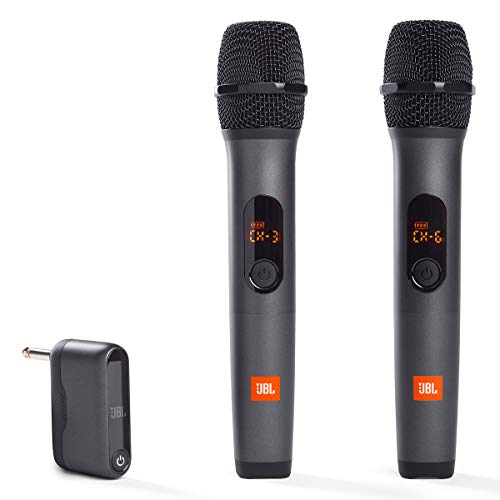
Best for: Duet performances or two-person hosting. The system provides a dual-channel receiver and JBL Original Pro Sound, ensuring clear vocals without distortion. It’s noted for easy plug-and-play setup and up to six hours of playback, suitable for small events or practice sessions.
Why chosen: The two-mic design supports balanced harmonies and quick, straightforward operation. A potential limitation is that performance quality hinges on proper antenna placement and receiver proximity to the mics.
ECHOMUSSY Wireless Metal Dynamic Mics

Best for: Outdoor parties and larger venues where durability matters. The all-metal build adds ruggedness, and the system delivers a 200-foot range with a dual-chip processing design for a stable connection and minimal dropouts.
Why chosen: Strong emphasis on reliability and connection stability makes it a solid choice for events where mobility is key. Caution: metal construction can add weight; ensure comfortable handling during long performances.
JBL PartyBox Wireless Mic

Best for: Party environments and social gatherings with built-in speaker features. This system provides two digital wireless microphones and a long battery life suitable for extended events. It’s designed to deliver clear voice reproduction with a focus on ease of use.
Why chosen: The cardioid mics minimize ambient noise, and the integrated design simplifies setup for casual users. Limitation: performance depends on the PartyBox’s overall system capabilities and space acoustics.
BONAOK Bluetooth Karaoke Microphone

Best for: Portable, smartphone-based karaoke and casual singing on the go. This 3-in-1 device acts as a Bluetooth microphone, speaker, and recorder, compatible with many singing apps. It’s a compact option for travel or quick setups.
Why chosen: Dual connection options (Bluetooth and cable) offer flexibility, and simple operation suits beginners. Caution: built-in speaker and mic quality are serviceable for fun, but not ideal for high-fidelity performances.
Buying Guide: Key Considerations For Wireless Singing Mics
What range do I need?
Choose a system with a usable range that fits your venue size. Larger spaces may benefit from 200 ft or more line-of-sight ranges to avoid dropouts. Indoors, walls and furniture can reduce effective range, so consider a model with a robust receiver and good antenna design.
What about battery life and charging?
Look for rechargeable mics with battery life that covers your typical event length. Systems with 6–8 hours or more of playback are safer for longer gigs. Charging time is a practical factor; some units require several hours to full power, so plan charging accordingly.
Fixed frequency vs. dual-channel or auto scan?
Fixed-frequency systems provide reliable performance in stable setups. Auto-scan or multi-channel options help avoid interference in environments with many wireless devices. If you host large events or multiple mics, multi-channel or auto-scan capabilities can reduce signal dropouts.
Build quality and durability
All-metal or rugged housings offer longer life in frequent-use scenarios, especially outdoors or on busy stages. Weight and grip comfort matter for performers who move around a lot during songs.
Compatibility and ease of use
Ensure the microphone and receiver support common input types (6.35 mm and 3.5 mm). Plug-and-play setups save time, particularly for beginners. Consider whether you need extra mics for duets or panel discussions.
Sound quality and voice fidelity
Dynamic cardioid mics generally provide solid vocal warmth and feedback rejection. Systems with smart processing or dual-channel mixing can help balance voices in group performances. If you require studio-like clarity, prioritize brands with known consistent performance in vocals.
Portability and setup time
For travel or quick events, lighter, simpler kits with fast pairing and minimal cables are advantageous. A compact transmitter-receiver setup reduces setup time and clutter on stage.
Frequently Asked Questions
- What is the typical range of wireless mics for singing?
Most systems offer 200 feet or more in line-of-sight conditions, but walls, interference, and other factors can reduce effective range. - Do I need two mics for a duet?
Yes, if you want each singer to have an independent mic and control, a dual-mic system or two units is recommended. - Can wireless mics work with a home karaoke setup?
Yes, many systems connect to common 6.35 mm or 3.5 mm inputs on home speakers, karaoke machines, or PA gear. - Which feature helps in noisy environments?
Cardioid pickup patterns and built-in noise reduction help minimize feedback and ambient sounds, improving vocal clarity. - Are rechargeable mics better than battery-powered?
Rechargeable mics reduce ongoing costs and downtime, but ensure the battery life meets your event duration and consider charging logistics. - What should I consider for outdoor performances?
Durability, weather protection, and reliable range are key. All-metal builds and robust receivers tend to perform better in less controlled environments.