
Best Wireless Optical Audio Cable Options for Clean TV Sound
Looking for a reliable wireless optical audio setup to send TV or device audio to speakers or a soundbar? This guide highlights five top Amazon picks, detailing who they’re best for and why. Whether you’re wiring a home theater, gaming setup, or streaming corner, these options cover 2.4 GHz wireless transmission, optical Toslink compatibility, and Bluetooth-enabled adapters. The top picks vary from long-range wireless kits to simple optical cables for direct connections. This overview targets buyers seeking low-latency, clear audio, and compatibility with common TV and audio systems.
Summary of chosen products
| Product | Best For | Key Benefit | Limitations |
|---|---|---|---|
| 1Mii 3-in-1 Wireless Audio Kit | TVs, PCs, and home theater setups needing multiple outputs | Three input/output options and dual receivers | 2.4 GHz may be affected by heavy wireless interference |
| KabelDirekt Optical Cable 6ft | Direct, wired Toslink connections to soundbars | High-quality optical, immune to electrical interference | Requires a compatible optical input on devices |
| HomeSpot Bluetooth Transmitter for TV | Bluetooth headphones or speakers with dual streaming | Bluetooth audio with dual-device sharing | Bluetooth latency may vary with non-Latency codecs |
| YGiTK ARC/eARC Optical Extractor | Televisions with eARC/ARC needing optical output | Supports eARC and ARC with high sampling rate output | Dependent on TV HDMI port labeling for eARC/ARC |
| Amazon Basics Toslink Cables | Simple, reliable optical cables | Gold-plated connectors and multi-channel support | Basic cables without wireless features |
1Mii 3-in-1 2.4Ghz Wireless Audio Transmitter Receiver

Best for: TV-connected setups or media centers needing flexible wireless output. This kit includes one transmitter and two receivers with a metal shell for durability and reduced signal interference. It supports optical, coaxial, and 3.5mm (RCA) inputs and outputs, enabling connections to TVs, PCs, AV receivers, soundbars, and powered speakers. The dual-receiver capability lets you run two powered speakers simultaneously, which is ideal for stereo or multi-room audio without noticeable latency.
Why selected: The 3-in-1 design consolidates multiple input/output paths into a single kit, reducing cable clutter and enabling room-to-room audio expansion. Its long-range capability claims up to 320 feet outdoors and 30–50 meters indoors, with under-20ms latency to preserve lip-sync during video playback.
Limitations: Wireless performance may vary with home layout and Wi‑Fi interference. Pairing and stability can depend on power connections and line-of-sight between transmitters and receivers.
KabelDirekt – Optical Audio TOSLINK Cable – 6ft

Best for: Users who want a high-quality wired optical connection between a TV and a soundbar or receiver. This TOSLINK to TOSLINK cable is designed to deliver clear, digitally transmitted audio and is fully immune to electrical interference due to its optical design.
Why selected: It provides a dependable, interference-free link for crystal-clear sound and supports a range of devices, including TVs, game consoles, Blu-ray players, and streaming boxes. The metal-free fiber optic design emphasizes flexibility and durability in common living-room setups.
Limitations: Requires compatible optical input/output on both ends. Not a wireless solution for those seeking wireless audio transfer.
HomeSpot Bluetooth Transmitter for TV Audio
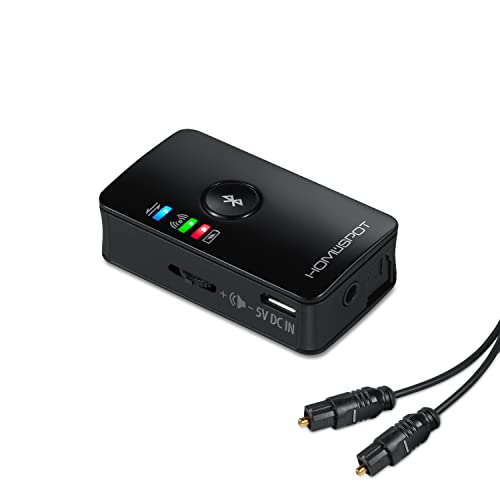
Best for: Viewers who want to add Bluetooth headphones or speakers to a non-Bluetooth TV. This dual-stream adapter enables two devices to receive audio simultaneously, making it suitable for shared viewing or late-night listening without disturbing others.
Why selected: The device emphasizes low-latency streaming when paired with aptX Low Latency-compatible devices, helping keep audio synchronized with video. It’s a straightforward option for enhancing existing TVs with wireless audio capabilities.
Limitations: Latency performance depends on the Bluetooth codecs used by the connected headphones or speakers. Some setups may experience slight delays if aptX Low Latency is not available on the receiving devices.
YGiTK eARC Audio Extractor
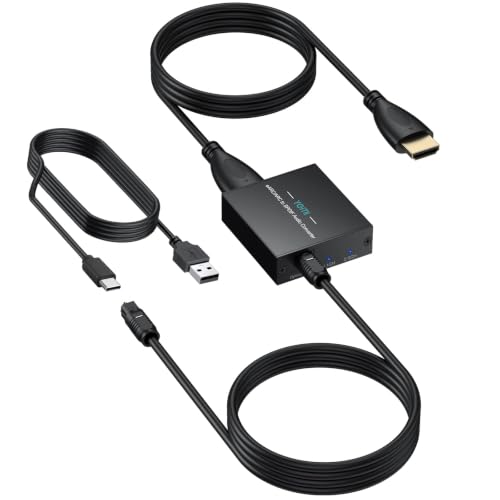
Best for: TVs with HDMI eARC/ARC outputs needing an optical audio path to soundbars or wireless headphones. This extractor converts HDMI ARC/eARC audio to optical output, broadening compatibility for sound systems that rely on Toslink input.
Why selected: It supports both eARC and ARC connections, accommodating newer and traditional TV models. The optical output can deliver up to 24Bit/192kHz PCM and multi-channel formats like Dolby Digital 5.1 and DTS 5.1, improving compatibility with home theater configurations.
Limitations: The effectiveness depends on TV settings and source formats. Some TV platforms may require specific configuration to enable eARC or ARC audio output properly.
Amazon Basics Toslink Digital Optical Audio Cable – 6 Feet

Best for: Users seeking a reliable, budget-friendly optical cable for multi-channel audio between a TV and a sound system. The 6-foot length provides flexible placement in many living spaces.
Why selected: The cable includes gold-plated connectors and buffer tubing to help maintain signal integrity for multi-channel audio. It’s straightforward and widely compatible with Toslink-enabled devices.
Limitations: As a basic optic link, it does not offer wireless features or advanced shielding beyond standard Toslink cable design.
Amazon Basics Toslink Digital Optical Audio Cable – 3.3 Feet
Best for: Compact setups where shorter optical runs are needed, such as small entertainment niches or desktop systems. The 3.3-foot length provides a neat option for tight spaces.
Why selected: Similar to the 6-foot version, this cable emphasizes clear, multi-channel audio with durable construction and gold-plated connectors for reliable signal transfer.
Limitations: Limited reach means less flexibility in larger rooms or distant audio components.
Buying Guide
What kind of audio setup do you have? If you need wireless flexibility across multiple rooms or speakers, consider a kit like the 1Mii system for its dual receivers and broad input/output support. For a straightforward wired link, optical Toslink cables from KabelDirekt or Amazon Basics offer robust, interference-free connections. If you already have Bluetooth headphones or want dual-device streaming from your TV, HomeSpot’s transmitter could be the better fit. For TVs with ARC/eARC, YGiTK’s extractor helps route audio to optical devices when direct HDMI outputs aren’t convenient. Consider the length of cables you need and whether you require long-range wireless options or a simple, wired path to your soundbar or receiver.
Key considerations by buyer type
- Casual home theater users: Prioritize a plug-and-play wireless kit with minimal setup and clear audio, such as the 1Mii system or HomeSpot transmitter depending on whether you need Bluetooth or 2.4 GHz wireless.
- Soundbar or speaker hackers: An optical Toslink cable like KabelDirekt or Amazon Basics can deliver crisp, stable digital audio with minimal latency.
- TV owners with ARC/eARC: An extractor like YGiTK provides a way to extract optical audio from HDMI eARC/ARC, broadening compatibility with existing sound systems.
- Small room setups: Shorter cables (3.3 ft or 6 ft) from Amazon Basics are sufficient for compact spaces and reduce clutter.
Quick FAQs
- What is the main difference between wireless and wired optical audio?
Answer: Wireless options transmit audio over radio frequencies, reducing cords, while wired optical cables send digital audio via Toslink for a stable, interference-free connection. - Can all TVs support ARC or eARC?
Answer: Most newer TVs support ARC, and some support eARC. Check your TV’s HDMI port labeling and settings to enable ARC/eARC output. - Is low latency important for TV audio?
Answer: Yes, especially for gaming or fast-action video. Look for devices explicitly supporting low-latency codecs or under-20ms delay where possible. - Do optical cables carry surround sound formats?
Answer: Many optical cables support multi-channel formats like Dolby Digital and DTS, but verify compatibility with your specific receiver or soundbar. - Can I reuse a Bluetooth transmitter for different TVs?
Answer: Yes, as long as the devices you pair with are compatible and the transmitter supports the required codecs. - What should I consider when choosing a long-range wireless kit?
Answer: Look at the claimed range, number of receivers, latency, and whether the system can handle interference from Wi‑Fi or other 2.4 GHz devices.