
Quick Overview: This guide compares top wireless speaker adapters designed to add Bluetooth or long-range wireless audio to a stereo receiver, powered speakers, or soundbar. Below is a compact summary of the five selected adapters covered in detail.
| Product | Key Feature | Ideal For |
|---|---|---|
| esinkin Bluetooth Audio Adapter | Simple Bluetooth pairing, 3.5mm/RCA | Basic home stereo upgrades |
| 1Mii 2.4GHz Wireless Transmitter/Receiver Set | 2.4GHz long-range kit (260 ft), TX/RX pair | TV-to-speaker wireless transmission |
| KAIY Bluetooth 5.3 Receiver | Bluetooth 5.3, Optical + RCA/AUX + USB | Legacy stereos needing optical/USB support |
| UGREEN Bluetooth 6.0 Receiver | LDAC Hi-Res support, Bluetooth 6.0, dual pairing | Hi‑res streaming to wired systems |
| 1Mii B06 Plus Bluetooth Receiver | Long range Class 1 Bluetooth, aptX HD/Adaptive | High-fidelity wireless to home stereo |
esinkin Bluetooth Audio Adapter For Music Streaming Sound System
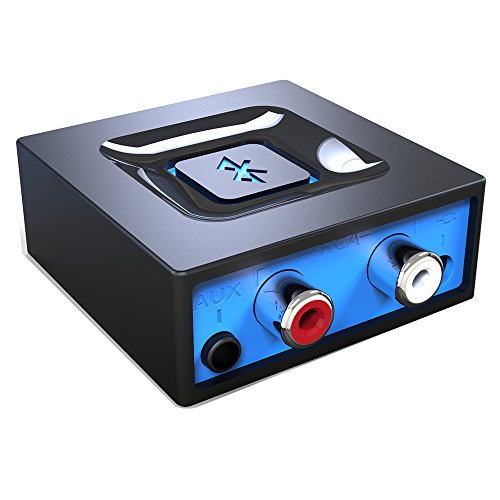
Brand: esinkin
- Compatibility: Connects to computer speakers, home stereos or other systems via 3.5mm or RCA cables.
- Setup: Single-button pairing with automatic reconnect to previously paired device; press for play/pause, hold to power on/off.
- Range: Indoor connection range around 30–40 ft (10–12 m) without obstacles.
This compact adapter focuses on straightforward Bluetooth streaming for legacy receivers and powered speakers. It uses common analog jacks so it fits many basic setups and emphasizes easy pairing and automatic reconnection.
1Mii 2.4GHz Wireless Audio Transmitter Receiver Set

Brand: 1Mii
- Included Kit: Transmitter and receiver pair with AUX/RCA in/out and included cable adapters.
- Connection Behavior: Auto power-on/pairing when powered, blue ring light indicates status.
- Wireless Tech: 2.4GHz true wireless transmission with up to 260 ft/80 m line-of-sight range; 25 ms low latency specified.
This set is tailored for sending TV or PC audio wirelessly to a remote amplifier, soundbar, or powered speakers. The dual AUX/RCA outputs allow connecting two speakers or stereo channels directly at the receiver end.
KAIY Bluetooth 5.3 Receiver For Home Stereo

Brand: KAIY
- Outputs: RCA, AUX and optical ports for broad compatibility with modern and vintage gear.
- Extras: USB flash drive playback support to play files without Bluetooth.
- Bluetooth Version: Bluetooth 5.3 with up to ~33 ft (10 m) stable connectivity and low-latency claim.
The KAIY adapter is positioned as a versatile option for owners of older receivers who also want optical input compatibility or occasional USB playback. The multiple output options make it suitable for varied systems without sacrificing connection flexibility.
UGREEN Bluetooth 6.0 Receiver With LDAC Hi-Res

Brand: UGREEN
- Codec Support: LDAC decoding up to 24-bit/96kHz and Hi-Res Audio certification (device compatibility required).
- Bluetooth Tech: Latest Bluetooth 6.0 chip for stability, lower latency, and reduced interruptions.
- Features: Dual pairing supports two phones simultaneously (only one can play at a time).
This receiver targets listeners who prioritize higher-resolution wireless audio. LDAC can provide superior bandwidth when both source and receiver support it. Dual-pairing helps households sharing multiple devices.
1Mii B06 Plus Bluetooth Receiver HiFi Wireless Adapter
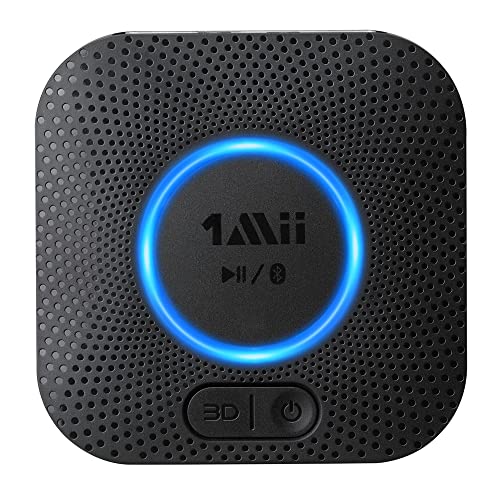
Brand: 1Mii
- Range: Class 1 Bluetooth with up to 164 ft (50 m) line-of-sight and 50–70 ft (20–30 m) typical indoor range.
- Audio Quality: Supports aptX HD and aptX Adaptive plus a switchable 3D surround mode.
- Power/Convenience: Auto power and reconnect when plugged into power outlet.
The B06 Plus is built for delivering higher-fidelity Bluetooth streaming over longer distances in a home. It focuses on aptX variants for improved bandwidth and lower latency with compatible source devices.
Buying Guide: Choosing A Wireless Speaker Adapter For A Receiver
Connection Type: Identify the inputs on your receiver. If you need optical (TOSLINK) or USB playback choose adapters like the KAIY. For basic analog receivers, RCA or 3.5mm outputs such as esinkin models are sufficient.
Wireless Technology: Bluetooth adapters (versions 5.0–6.0) are common and easy to use. For longer range or fixed one-to-one links, 2.4GHz transmitter/receiver kits (like 1Mii’s set) can offer extended distance and lower latency over open spaces.
Audio Quality & Codecs: For better-than-CD streaming, choose devices that support aptX, aptX HD/Adaptive, or LDAC (UGREEN) and ensure your source device supports the same codec. Note: codec benefits require compatible phones/tablets.
Latency: If you’ll sync audio with TV video, prioritize low-latency solutions (aptX Low Latency or specified low-latency 2.4GHz kits). Check manufacturer latency figures and whether the source supports low-latency codecs.
Range & Placement: Consider room layout and obstacles. Class 1 Bluetooth and dedicated 2.4GHz kits provide farther reach. Expect reduced range through walls or floors.
Multi-Device Pairing: If multiple household members need to connect, look for dual-pairing support. Remember only one device can usually stream at a time.
Power & Convenience: Some adapters auto-power and auto-reconnect when plugged in; others run on battery. For permanently attached receivers, a powered adapter that reconnects automatically is often more convenient.
Compatibility With Pro/PA Gear: For live sound or pro audio inputs (XLR), choose specialty receivers like the Xvive series rather than consumer Bluetooth dongles.
Additional Features: USB playback, switchable 3D modes, or dual outputs (AUX and RCA) can add utility depending on your setup. Prioritize features that match how you listen.
Comparison Perspectives: Evaluate adapters by (1) codec and sound quality, (2) latency for A/V sync, (3) range and stability for your room size, (4) physical I/O compatibility with your receiver, and (5) ease of use such as auto-reconnect and one-button pairing.
Final Consideration: Match the adapter’s strengths to your main use case—simple smartphone streaming, long-distance TV audio, high-resolution music, or multi-source household sharing—to select the device that best integrates with your receiver.