Best Wireless Surround Speaker Adapter for Home Theater
Quick Guide: This article compares popular wireless surround speaker adapters and kits that let you add rear speakers, subwoofers, or wireless inputs to existing home theater systems. Below is a summary table of the five selected options covered in detail.
| Product | Brand | Main Use |
|---|---|---|
| 1Mii 2.4GHz Wireless Audio Transmitter Receiver Set | 1Mii | Wireless rear speakers / powered speaker connection via AUX/RCA |
| DYNASTY PROAUDIO WSA-5RP Wireless Surround Sound Rear Speakers Kit | DYNASTY PROAUDIO | Wireless kit for passive rear speakers with built-in amplifiers |
| 1Mii B06 Plus Bluetooth Receiver (Upgraded) | 1Mii | Bluetooth-to-line-level receiver with aptX formats and 3D surround toggle |
| SVS SPWADAPT Soundpath Wireless Audio Adapter | SVS | Wireless adapter for subwoofer placement flexibility |
| Nodelay S-AIR100-PRO Wireless Rear Speaker Kit | Nodelay | Low-latency wireless rear speaker transmitter/receiver with high power |
1Mii 2.4GHz Wireless Audio Transmitter Receiver Set

The 1Mii wireless audio kit uses 2.4GHz transmission to send Hi‑Fi audio between a transmitter and receiver. It supports AUX and RCA in/out, making it suitable for connecting TVs, PCs, powered speakers, amplifiers, or soundbars without running speaker wire.
- Connectivity: 3.5mm plus RCA cable included; plug-and-play setup.
- Automatic pairing: Units auto power on and enter pairing mode with indicator light.
- Range/Latency: Long-range design (advertised up to 260 ft / 80 m) and low latency for reduced lip-sync delay.
- Limitations: Not designed for subwoofer use; avoid simultaneous dual AUX/RCA inputs to prevent audio mixing.
DYNASTY PROAUDIO WSA-5RP Wireless Surround Sound Rear Kit
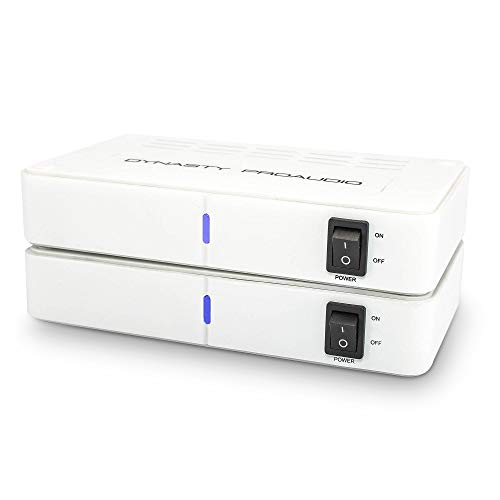
This DYNASTY PROAUDIO kit provides a wireless link specifically for rear surround speakers, with built-in Class D amplifiers so it can drive passive bookshelf or in-room surround speakers directly.
- Wireless Tech: Dual-band selectable 5.2 / 5.8 GHz with 106 RF channels to reduce interference from Wi‑Fi and 5G devices.
- Amplification: Built-in 2 x 25W RMS (8Ω) or 2 x 50W RMS (4Ω) outputs for direct passive speaker connection.
- Inputs: Speaker line level and stereo RCA inputs allow integration with A/V receivers or preamps.
- Use Case: Best for users adding wireless rears to a system that uses passive speakers and wants integrated amplification in the wireless module.
[Upgraded] 1Mii B06 Plus Bluetooth Receiver

The 1Mii B06 Plus is a Bluetooth receiver designed to add wireless streaming capability to existing amplifiers or powered speakers. It emphasizes codec support and distance for flexible placement.
- Bluetooth Version & Codecs: Bluetooth 5.3 with aptX HD and aptX Adaptive, supporting higher-resolution Bluetooth audio.
- Range: Class 1 performance with line-of-sight up to ~164 ft (50 m) and practical indoor range of 50–70 ft (20–30 m).
- Extras: 3D surround toggle and automatic reconnect on power-up simplify repeated use.
- Best For: Users who want a high-quality Bluetooth input for a receiver or powered speakers where latency tolerance is moderate (music more than tight A/V lip sync).
SVS SPWADAPT Soundpath Wireless Audio Adapter

The SVS Soundpath adapter is tailored mainly for subwoofer placement freedom, removing the need for a long subwoofer cable by delivering wireless low‑frequency audio between an AV receiver and a remote subwoofer.
- Installation: Designed for simple setup to connect a subwoofer and allow flexible room placement.
- Room Tidiness: Eliminates long runs of heavy speaker wire and helps reduce clutter.
- Compatibility: Works with most powered subwoofers and common line-level outputs from receivers.
- Consideration: Intended for subwoofers; verify latency and frequency response suitability for your sub model before purchase.
Nodelay S-AIR100-PRO Wireless Rear Speaker Kit

The Nodelay S-AIR100-PRO emphasizes ultra-low latency (≈20ms) and high power output, making it suitable for home theater setups that require tight audio sync and robust driving power for passive surrounds.
- Transmission: 5.8 GHz wireless tech aimed at stable, interference-free links with CD-level lossless quality.
- Power Handling: Default 80W + 80W (4Ω) output; volume adjustment for surround channels helps room tuning.
- Latency: Low-latency design targets movie and gaming applications where delay is noticeable.
- Integration: Compatible with A/V receivers; useful when replacing long speaker runs to rear channels.
Buying Guide: How To Choose A Wireless Surround Speaker Adapter
Selecting the right wireless adapter depends on your system type, room layout, and use priorities. Below are the key factors to weigh when comparing options.
1. Intended Use
Decide whether you need to add rear surrounds, a wireless subwoofer, or a Bluetooth input. Some devices specialize (subwoofer adapters, Bluetooth receivers), while others act as general-purpose line-level transmitters for powered speakers or amps.
2. Latency And A/V Sync
For movies and gaming, low latency
3. Wireless Frequency And Interference
Options use 2.4 GHz or 5.x GHz bands. 2.4 GHz offers range but is more prone to Wi‑Fi and device interference. 5.8 GHz or dual-band selectable systems can avoid crowded networks and reduce dropouts.
4. Power And Amplification
If you plan to drive passive speakers, choose a kit with built-in amplifiers (check RMS output and impedance ratings). For powered speakers or subwoofers, a line-level transmitter/receiver is usually sufficient.
5. Connectivity Options
Check inputs/outputs: optical/coaxial for digital connections, RCA/3.5mm for analog, and speaker-level inputs if integrating with an amp. Ensure the adapter matches your receiver and speaker terminals.
6. Range And Room Layout
Verify the stated indoor/outdoor range and consider obstacles like walls and furniture. Longer range claims are often line-of-sight; real-world performance varies by home construction.
7. Audio Quality And Codecs
For music fidelity, look for support of higher-quality codecs (aptX HD/Adaptive) or lossless digital transmission. For subwoofers, frequency response and latency are more important than stereo codecs.
8. Ease Of Setup And Reliability
Automatic pairing, stable channel switching, and clear indicator lights improve setup experience. Systems with multiple RF channels and auto-switching reduce interference in busy wireless environments.
9. Expandability And Compatibility
Consider whether the adapter supports adding more rear channels, works with your receiver’s outputs, or can pair with different brands. Verify whether simultaneous AUX/RCA use is supported if you plan multi-source inputs.
10. Practical Trade-Offs
Trade range for latency, or convenience for absolute audio fidelity. Subwoofer adapters prioritize low-frequency handling; Bluetooth receivers prioritize streaming convenience. Match the kit’s strengths to the role you need it to play.
Using the criteria above will help you match a wireless adapter to your home theater goals — whether that’s wireless rears with built-in amplification, a tidy wireless sub setup, or adding Bluetooth inputs to an existing system.