Best Wireless Transmitters for Surround Sound Speakers to Improve Home Theater Audio
Answering the common question, these wireless transmitters convert hardwired surround setups into cable-free experiences without sacrificing sound quality. This guide highlights five top options suited for different room sizes, speaker power, and setup preferences. The top picks range from ultra-low latency gaming- and movie-friendly kits to easy, plug-and-play solutions for multi-room setups. Ideal buyers include home theater enthusiasts, renters who can’t run speaker wires, and those upgrading legacy systems for cleaner aesthetics.
Summary table of selected products
| Product | Best For | Key Advantage | Best Use Case |
|---|---|---|---|
| Nodelay S-AIR100-PRO | Powerful home theater rear speakers | 80W+80W output, low latency | Large living rooms with A/V receivers |
| YMOO 2.4GHz TX+2 RX | Two rear speakers distributed | Dual receivers, long range | Wider speaker placement, multi-room |
| OSD Nero 5.8GHz Rear Kit | Quick wireless rears | 5.8 GHz less interference, 100 ft range | Renters or rooms avoiding wiring |
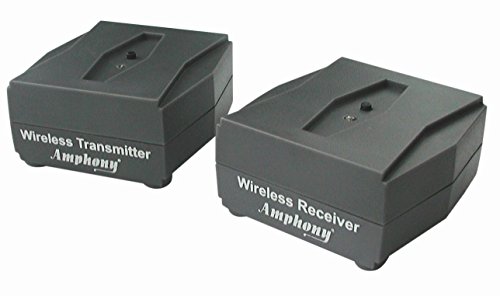
| Amphony 1700 Kit | Any-brand receivers | 2×40 W amplifier inside receiver | Surrounds with mixed gear |
| iFinity Wireless Transmitter/Receiver | Subwoofers and surrounds | Full CD-quality, wall-through capability | Whole-home wireless bass and surrounds |
Nodelay S-AIR100-PRO Wireless Rear Speaker Kit

Best for high-powered surround setups, the Nodelay S-AIR100-PRO uses 5.8 GHz transmission with ultra-low latency (20 ms) to reduce lip-sync issues in fast-paced scenes. It delivers 80W+80W (4Ω) default output, with potential upgrades to match loudspeakers’ impedance and power. Surround speaker volume is adjustable, allowing precise tuning for room layout. This kit suits larger living rooms and home theaters equipped with an A/V receiver. Limitation: official data does not specify universal compatibility beyond certain receivers, so verify impedance and speaker pairing before purchase.
YMOO 2.4GHz TX+2 RX Wireless Transmitter System

Choose this when you need two receivers to drive two separate surround speakers or two powered devices. It supports RCA and 3.5 mm connections, automatically turns on and connects, and claims a long range of up to 320 feet line-of-sight for the transmitter. Best for multi-speaker layouts where two rear channels are placed far apart. Caution: 2.4 GHz can be susceptible to Wi‑Fi interference in crowded spaces; ensure line-of-sight or test performance in your room before final placement.
OSD Nero 5.8GHz Wireless Surround Rear Kit

Designed to eliminate rear-channel wiring with a compact, 5.8 GHz wireless kit, this option promises clear sound with reduced interference and a range of up to 100 feet. It is ideal for rooms where running cables is difficult, such as rentals or rooms with hard flooring. Best for users who want a simple, install-and-go rear-channel upgrade. Limitation: the kit focuses on rear channels and may require a compatible powered sub and AVR for full effect.
iFinity Wireless Transmitter/Receiver For Subwoofers
Best for wireless subwoofers and surrounds in a mixed-gear setup, the iFinity system transmits stereo audio in a digital format with adaptive frequency hopping to minimize interference. It supports full-frequency audio and can be paired with external power amplifiers. Choose this if you want to extend wireless audio beyond rear surrounds to subwoofers without sacrificing signal integrity. Caution: not compatible with passive speakers; requires active or powered speakers/subwoofers.
Buying Guide
What should you consider when choosing a wireless transmitter for surround sound?
- Room size and speaker power: Larger rooms and higher-wattage speakers benefit from higher power output and longer range. Look for kits that advertise wattage per channel and reliable range specs.
- Frequency band and interference: 5.8 GHz tends to have less congestion than 2.4 GHz, but walls and other devices can affect performance. For multi-room layouts, 2.4 GHz with multiple receivers can work well if interference is managed.
- Latency: For movies and gaming, lower latency improves lip-sync. Seek products advertising 20 ms or lower latency and lossless audio.
- Compatibility: Ensure the transmitter’s outputs (RCA, 3.5 mm, or digital) match your AVR or receiver inputs. Also verify that powered speakers or amplifiers are compatible with the kit’s receiver.
- Install simplicity: Plug-and-play kits are ideal for renters or quick upgrades. Some kits require more involved wiring or external amplifiers.
- Future expansion: If you plan to add more speakers, choose a system that supports multiple receivers or dual outputs without performance loss.
Frequently Asked Questions
Can wireless transmitters work with any AV receiver?
Most work with receivers that have analog outputs or speaker-level connections. Always check the input/output options to ensure compatibility with your AVR.
Will wireless audio introduce noticeable latency?
Some latency is common, but select models advertise ultra-low latency (around 20 ms) to minimize lip-sync issues.
Is 5.8 GHz better than 2.4 GHz for wireless surround?
5.8 GHz typically experiences less congestion, reducing interference, but range and wall penetration can vary by setup.
Can I use wireless transmitters for both subwoofers and rear surrounds?
Yes, many kits support subwoofers and surrounds, but verify that the system is designed for subwoofers specifically if you plan to use a dedicated woofer.
Do these kits require special software or firmware updates?
Most are plug-and-play with minimal firmware needs. Some may include automatic pairing or auto-on features.
What if I have passive speakers?
Some kits require active or powered speakers. If you have passive speakers, look for a kit that includes its own amplifier or is clearly compatible with passive setups.