
Best XLR Female to 1/4 Inch Female Adapters for Pro Audio
If you need to connect XLR-enabled gear to 1/4″ (6.35 mm) jacks, this guide helps you pick adapters that preserve signal integrity and minimize noise. These adapters are best for musicians, sound engineers, podcasters, and live sound technicians who work with microphones, mixers, and instruments. Below, you’ll find five top options with clear reasons to choose each, plus a practical buying guide and FAQs to answer common questions.
The table summarizes key choices to compare at a glance:
| Product | Best For | Why It Stands Out |
|---|---|---|
| Jozzai 1/4″ Female to XLR Female Cable Bundle | Studio and stage users needing stereo/mono flexibility | High-purity OFC conductors and dual-layer shielding for EMI/RFI protection |
| CableCreation XLR Female to 1/4″ Adapter | Professional connections requiring solid metal build | Metal XLR 3-pin to 1/4″ stereo adapter with a two-year warranty |
| Devinal XLR Female to 1/4″ Cable | Studio and live performances needing durable connectors | Nickel-plated connectors and reinforced strain relief for many cycles |
| D’Addario Planet Waves XLR to 1/4″ Adapter | Rugged, design-focused setups | Premium components with gold-plated connectors and distinctive Planet Waves design |
| HUALEU Lockable 1/4″ TRS to XLR Female Adapter | High-mobility rigs needing secure connections | Locking mechanism plus rugged alloy housing for live scenarios |
Jozzai 1/4 Inch Female to XLR Female Cable Bundle

Best for versatile studio and stage setups needing both stereo and mono output. The bundle uses high-purity 4N OFC conductors and double-layer shielding (copper and aluminum foils) to guard signal transmission from EMI and RFI. It is designed to connect 1/4″ TRS/TS jacks to XLR Female sockets, making it suitable for microphones, amplifiers, guitars, and other audio devices. Caution: while offering robust shielding, the overall length is modest at 1.1 feet, which may limit reach in some setups.
CableCreation XLR Female to 1/4 Inch Adapter

Best for professional-grade signal transmission in live or studio environments. This metal XLR 3-pin female to 1/4″ stereo female adapter provides sturdy physical construction and a clean signal path for stereo microphone cables, monitors, audio interfaces, and PA setups. It comes with a two-year warranty, which supports long-term reliability. Limitation: the description focuses on basic use; it may not emphasize locking or advanced strain relief features found in some competitors.
Devinal XLR Female to 1/4″ Cable

Best for studio and live performances needing durable connectors and long-term reliability. The Devinal cable advertises stereo/mono dual compatibility with TRS/TS balanced signaling, nickel-plated metal connectors, and reinforced strain relief rated for extensive insertion cycles. It supports connections between mixers, guitar amps, keyboards, and XLR-enabled devices. Caution: actual performance can vary with nonstandard gear; ensure compatibility with your specific equipment before use.
D’Addario Planet Waves XLR Female to 1/4 Inch Female

Best for rugged, high-quality signal transfer with a distinctive design. The Planet Waves adapter emphasizes premium components, black ABS/plastic housing with a steel frame and gold-plated connectors for durable, low-resistance connections. This is ideal for users who value brand-centric aesthetics and consistent signal quality. Limitation: the listing does not specify locking mechanisms or advanced shielding features beyond standard catalog claims.
HUALEU Lockable 1/4 TRS to XLR Female Adapter
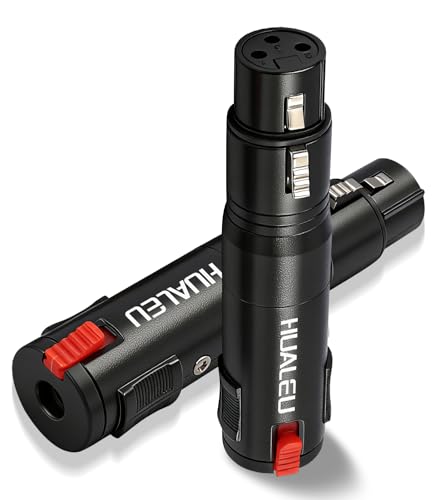
Best for high-reliability live environments needing a secure connection. The lockable 1/4″ TRS female to 3-pin XLR female design minimizes accidental disconnections during performances. It also features a rugged zinc alloy housing with nickel plating, offering resistance to shock and corrosion. Caution: locking mechanisms can add a small amount of bulk and may require a snug fit with certain cables.
Smithok 2 Pack XLR to 1/4″ Cable

Best for a cost-effective option with balanced signaling and robust metal construction. Smithok’s dual-pack offers XLR female to 1/4″ TRS connectors in a compact 1-foot length, suitable for small studios, keyboards, and audio interfaces. It emphasizes durable metal construction to minimize signal loss. Limitation: non-locking design may be less secure in mobile or active environments.
Voluty Tek XLR Female to 1/4″ Adapter (4-Pack)

Best for versatile multi-device setups needing multiple adapters. The Voluty Tek set emphasizes high-quality zinc alloy construction and wide compatibility with microphones, mixers, amplifiers, sound consoles, and speakers. It’s a practical choice for studios and racks needing spare adapters. Caution: as a multi-pack, ensure you have the correct pinout for your gear and check fit with your cables to avoid compatibility issues.
Buying Guide: Key Considerations For XLR To 1/4 Inch Adapters
- Signal Type: Decide between mono and stereo compatibility. Some adapters support TRS balanced signals, others are simpler TS/mono paths. Choose based on your microphones and devices.
- Connector Durability: If you travel or perform live, prioritize rugged housings, nickel plating, and strain relief to extend lifecycle.
- Locking Mechanisms: Locking 1/4″ (TRS) adapters reduce disconnections in active environments. Consider whether a lock is essential for your use case.
- Shielding And Cabling Quality: Look for OFC conductors and multi-layer shielding to minimize EMI/RFI and maintain signal integrity.
- Compatibility: Ensure the adapter’s pin configuration aligns with your XLR devices and 1/4″ jacks. Some models emphasize compatibility with specific equipment like mixers, interfaces, or amps.
- Warranty And Support: A longer warranty can provide confidence for frequent use in professional settings.
Frequently Asked Questions
- What is an XLR to 1/4 inch adapter used for?
It connects XLR-output devices such as microphones or mixers to 1/4″ inputs on instruments, interfaces, or amps, enabling flexible signal routing. - Should I choose a locking adapter?
Locking adapters are beneficial for mobile or stage environments where cables may be tugged or jostled frequently. - Can these adapters affect sound quality?
High-quality materials and shielding minimize signal loss and interference, but all adapters introduce minor contact resistance. Choose reputable brands for best results. - Are metal-bodied adapters more durable than plastic?
Yes, metal housings typically withstand more wear, corrosion, and repeated insertions in pro contexts. - Do I need stereo or mono compatibility?
If your device outputs stereo (TRS) signals, choose a stereo-capable adapter. For mono sources (TS), ensure the adapter supports mono signal routing. - Can I use these adapters with any XLR microphone?
Most standard XLR mics with compatible pinouts will work, but always verify compatibility with your gear before use.