Best XLR Female to 3.5mm Adapter Options for Clear, Balanced Audio
If you need to connect XLR microphones or devices to 3.5mm inputs, these adapters offer balanced or enhanced transmissions to reduce noise and maintain signal integrity. This guide highlights five reliable options, suitable for home studios, live setups, podcasts, or field recording. Best for musicians and audio engineers who require stable connections, flexibility, and durable construction.
| Product | Best Use | Key Benefit |
|---|---|---|
| CableCreation 3.5mm to XLR Female Adaptor (2pcs) | Camcorders, mixers, speakers | Two adapters per pack; zinc alloy shell |
| uxcell XLR Female to 1/8″ Male TRS | Audio interfaces, field recording | Balanced transmission; long-distance potential |
| HUALEU 2Pack 1/8 TRS to XLR Female | Microphones, power amps | Phantom power compatible; durable build |
| JOLGOO XLR Female to 3.5mm Stereo Jack | Speakers, CD players, PCs | High-quality shielding; gold-plated connectors |
| XANHAM XLR Female to 3.5mm (1/8″) Male | iPhone/iPad, laptops, recorders | 24K gold-plated connectors; multiple shielding |
CableCreation 3.5mm to XLR Female Adaptor (2pcs)

The CableCreation adapters convert a 3.5mm TRS female jack to a standard XLR female, enabling balanced audio transmission from 1/8″ devices to XLR gear. The package includes two adapters, offering flexibility for multi-device setups. Best for small studios, camcorders, and portable rigs that need reliable, balanced connections. Note that performance depends on the source device’s output quality and cabling.
uxcell XLR Female to 1/8 Inches Male TRS Adapter

The uxcell adapter converts XLR female to a 3.5mm male TRS, enabling an interface to connect XLR-equipped devices to smaller inputs. It emphasizes balanced transmission with resistance to interference, suitable for longer cable runs under 100 meters. Choose this when you need a compact, budget-friendly option for field recording or live setups, but beware of the potential for crowding if multiple adapters are used together.
HUALEU 2Pack 1/8 TRS Female to 3Pin XLR Female
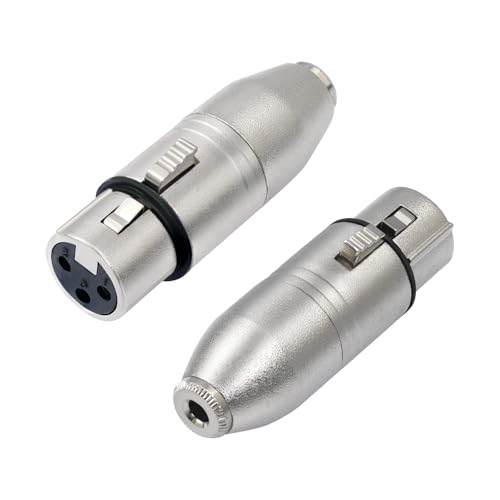
These adapters use a thick zinc alloy casing with riveted construction for durability. They deliver a balanced 3.5mm TRS to 3-pin XLR female connection, ideal for microphones, mixers, and audio interfaces requiring phantom power support. Best for rugged environments or frequent transport. A limitation is that phantom power compatibility depends on the connected gear and power delivery path.
JOLGOO XLR Female to 3.5mm Stereo Jack

The JOLGOO adapter provides a balance of quality and cost, featuring 20 AWG OFC conductors and multiple shielding layers to minimize hum and interference. Gold-plated connectors ensure low contact resistance and durable signal transfer. Best for users prioritizing clean audio over long cables, or who need a reliable connector for laptops, CDs, and portable players. Avoid this if you require higher-end XLR features or phantom power support beyond standard microphone use.
XANHAM XLR Female to 3.5mm (1/8″) Male

The XANHAM cable uses 24K gold-plated connectors and a robust shielding system to minimize noise when connecting iPhone, iPod, laptops, or recorders to mixing consoles or powered speakers. It supports enhanced signal transmission and provides durable construction for daily use. Choose this if you need a reliable, portable solution compatible with consumer devices and field recording. The unbalanced nature means it may be more susceptible to interference in very noisy environments.
Buying Guide: How To Choose The Right XLR To 3.5mm Adapter
What to consider when selecting an adapter:
- Signal type: Decide between balanced vs unbalanced. Balanced connections reduce noise over longer runs, ideal for professional setups.
- Connector compatibility: Confirm XLR female and 3.5mm TRS compatibility with your devices and phantom power needs.
- Durability: Look for zinc alloy or robust casings and gold-plated contacts for longevity and stable connections.
- Shielding and interference: Adapters with multiple shielding layers perform better in electrically noisy environments.
- Package contents: Some packs include two adapters, which can be beneficial for multi-device arrangements.
- Compatibility with phantom power: If using condensers or power-demanding mics, ensure the adapter supports the required power.
What type of buyer should consider these adapters?
Musicians and podcasters seeking reliable connections for field recordings will benefit from balanced adapters. Home studio users working with mixers or audio interfaces will value durability and shielding. Content creators needing quick compatibility with consumer devices should consider adapters that suit unbalanced, consumer-grade gear.
How to use these adapters safely?
Connect the XLR end to the microphone or mixer, and the 3.5mm end to the device input. Ensure the receiving device is powered or phantom power-enabled if required. Avoid forcing incompatible connectors or twisting cables, which could damage ports and degrade sound quality.
FAQ
- What does balanced audio mean in these adapters? Balanced audio uses XLR connections to cancel noise on long cables, improving signal integrity.
- Can I use these with consumer headphones? Most adapters are designed for microphones and gear with XLR inputs, not typical consumer headphones.
- Is phantom power required for all adapters? No. Only condenser mics or devices needing phantom power will require it; check device specifications.
- Are these adapters backwards-compatible with standard 1/4″ jacks? Most are designed for 3.5mm inputs; compatibility with 1/4″ jacks varies by model.
- Will these adapters fix noise issues caused by poor cables? They can help by improving shielding and connections, but cable quality and source interference also matter.
- Do these adapters come with warranties? Warranty details depend on the seller and model; refer to product pages for specifics.