
Best XLR Female to 1/4 Inch Cables for Studio and Stage
Answering the common need for reliable XLR female to 1/4 inch connections, this guide highlights five solid options and clarifies who each one is best for. These cables convert balanced XLR outputs to balanced or unbalanced 1/4″ inputs, making them suitable for mixers, speakers, and recording gear. They’re ideal for musicians, sound engineers, and home studio setups that demand clean signal transfer with minimal noise. See the quick product comparison below to pick the right match.
Summary table — Top picks for XLR female to 1/4 inch connections
- Tisino XLR Female to 1/4″ TRS Cable — Balanced, versatile, 6.6 ft
- Tisino XLR Female to 1/4″ TS Cable — Unbalanced, 10 ft
- Devinal XLR Female to 1/4″ Cable — Durable, compact, 1 ft
- HUALEU 2 Pack XLR Female to 1/4″ TRS Cable — Dual pack, 3 ft
- Twozoh XLR Female to 1/4″ TRS Cable — 3.3 ft, durable
Tisino XLR Female to 1/4″ TRS Balanced Cable Review

This balanced XLR to 1/4″ TRS cable is designed to carry a balanced signal from a mixer or audio interface to a speaker or stage box. It suits live sound engineers and studio operators who need reliable, minimal-noise connections. The 20 AWG oxygen-free copper core and multi-layer shielding reduce hum and RF interference, delivering a clean signal path.
Best for: professional-stage setups and compact studios that rely on balanced connections for both input and output paths. Choose this if you frequently run long cable runs and require strong shielding.
Limitation: While sturdy, the cable’s performance hinges on the connected equipment’s input/output balance; ensure your gear supports balanced TRS connections to maximize benefits.
Tisino XLR to 1/4″ TS Unbalanced Cable

This XLR female to 1/4″ TS cable uses a mono, unbalanced path ideal for microphones to mixers or amps where a balanced path isn’t required. It’s well-suited for musicians and home studios connecting dynamic mics to amplifiers or single-channel mixers. The design emphasizes corrosion resistance with 24K gold-plated connectors and robust shielding for clearer signals.
Best for: unbalanced mic connections in small venues or home studios where simplicity and cost-efficiency are priorities. Avoid this if you need true balanced signaling to cancel hum across long runs.
Limitation: Unbalanced TS cables can pick up more noise over long distances compared to TRS balanced cables.
Devinal XLR Female to 1/4″ Cable

This compact 1 ft cable is designed for quick, on-the-fly signal conversion with XLR Female to 1/4″ TRS or TS interfaces. It’s built with a nickel-plated metal connector and reinforced strain relief to withstand frequent insertions. It supports stereo/mono dual compatibility, making it flexible for studio or stage use when you need rapid adapter-style connectivity.
Best for: on-the-go setups, small studios, or quick-connect tasks that require a short, reliable patch. Choose this for portable rigs where space and weight matter.
Caution: Shorter cables limit reach; verify cable length aligns with your stage or studio layout to avoid tension on connectors.
HUALEU 2 Pack 1/4″ TRS to XLR Female Cables

This two-pack includes 3-foot cables with 1/4″ TRS to XLR Female ends. It’s a practical choice for studios needing multiple, consistent cables for connecting microphones or line-level devices to mixers and powered speakers. The design features 24K gold-plated 1/4″ jacks and nickel-plated XLR connectors with shielding to reduce interference.
Best for: studios or small live rigs where multiple identical cables simplify setup and inventory. Better for short-distance connections where portability matters.
Caution: The pair may be redundant if you only need a single lengthy run; consider single-length variants if you don’t require multiples.
Twozoh XLR Female to 1/4″ TRS Cable

Twozoh’s 3.3-foot XLR to TRS patch cable is designed for high-clarity mic to mixer or powered speaker connections. It emphasizes durable construction, a self-locking XLR connector, and a robust, flexible jacket. The cable aims to minimize interference and maximize hum and noise cancellation while preserving signal integrity.
Best for: live sound or studio environments where reliable, quick-mate connections are essential and where space is not plentiful. Choose this if you need a balance of length and reliability in a compact patch cable.
Caution: Self-locking mechanisms may require some force during insertion; ensure compatibility with your equipment’s connectors before use.
Tisino Female XLR to 1/4″ TS Mono Cable
This 6.6 ft unbalanced microphone cable targets dynamic mics and stage setups requiring a direct XLR to mono 1/4″ connection. Features include a robust aluminum alloy shell, gold-plated connectors, and shielding for clearer, quieter performance. It supports a straightforward signal path from mic to mixer or amplifier.
Best for: stage performances or small studios using unbalanced connections. Avoid if you need true balanced signaling to minimize hum on long runs.
Jozzai 2-Pack XLR to 1/4″ TRS Mono Cable
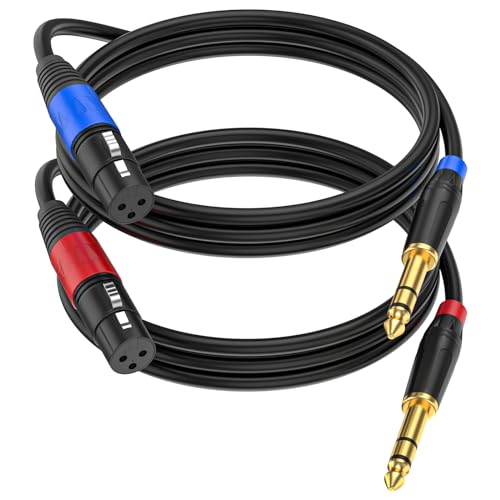
Jozzai’s two-pack offers 3.3-foot XLR to 1/4″ TRS mono cables designed for dynamic mics and mixers or amps. They emphasize 24K gold-plated connectors and high-quality shielding for minimal interference. The cables aim for clear, consistent signal transfer with robust connector design for frequent use.
Best for: users who need a multi-pack solution for multiple microphones or multiple gear connections. Better for organized setups where identical cables simplify routing.
Caution: As with any short patch cable, ensure the length fits your stage or studio layout to avoid tension on connectors.
Buying Guide
What should you consider when choosing XLR female to 1/4 inch cables?
- Connection type: Balance vs unbalanced. Use TRS for balanced paths to cancel hum; TS for unbalanced, shorter runs.
- Cable length: Shorter cables reduce signal loss but limit placement. Choose lengths that match your space without excess slack.
- Connector quality: Gold plating and shielding reduce corrosion and interference. Look for multi-layer shielding and robust strain relief.
- Durability: Metal connectors, reinforced jackets, and locking features improve longevity in live environments.
- Use case: Studio vs live sound informs whether you prioritize balanced signaling (TRS) or unbalanced simplicity (TS).
- Compatibility: Ensure your equipment accepts 1/4″ TRS or TS and XLR female inputs for optimal results.
Frequently asked questions
- Q: Are XLR to 1/4 inch cables always balanced? A: Not necessarily. XLR to TRS can carry balanced signals, while XLR to TS is typically unbalanced.
- Q: When should I choose TRS over TS? A: Choose TRS for balanced connections to reduce hum, especially on longer runs.
- Q: Can I use XLR to 1/4 inch cables with guitars? A: They are generally intended for mics and line-level devices; check instrument input compatibility before use.
- Q: Do these cables require special care? A: Yes. Keep connectors clean, avoid excessive bending, and store properly to extend life.
- Q: Will these cables improve overall audio quality? A: They can reduce noise and interference when matched to the right equipment and signaling path.