
Best XLR to 1/4 Microphone Cable: Top Options for Your Setup
Direct answer: these XLR to 1/4 cables are designed to connect mics or mixers to devices with 1/4″ inputs, with balanced or unbalanced configurations depending on the model. This guide highlights five reliable choices for different users, from home studios to live performances. Best for portable setups are compact, lightweight cables; better for studio work are versions with robust shielding and high-quality connectors; choose this if you need a balanced path to reduce hum; avoid this if your gear requires a specific connector type not supported by the cable.
Buyer profiles:
- Home studio singers and podcasters seeking reliable sound with minimal noise.
- Live performers needing durable construction for frequent setup and teardown.
- Podcasters or content creators connecting dynamic mics to mixers or audio interfaces.
Overview of selected products:
| Product | Connector Type | Length | |
|---|---|---|---|
| Tisino Female XLR to 1/4″ TS Mono Jack Unbalanced Microphone Cable, 10FT | XLR female to 1/4″ TS | 10 ft | Unbalanced signals; dynamic mics to mixers or amps |
| Cable Matters 6.35mm 1/4 Inch TRS to XLR Cable, Male to Female, 6ft | 1/4″ TRS to XLR | 6 ft | Balanced connections to equipment with TRS jacks |
| Cable Matters XLR to 1/4 TS Microphone Cable, 1/4 Male to XLR Female, 6ft | 1/4″ TS to XLR | 6 ft | Unbalanced, direct mic-to-amplifier setups |
| Cable Matters 6.35mm 1/4 Inch TRS to XLR Cable, Male to Male, 10ft | 1/4″ TRS to XLR | 10 ft | Balanced path between gear with XLR and 1/4″ TRS |
| Tisino Female XLR to 1/4″ TS Mono Jack Unbalanced Microphone Cable, 6.6 FT | XLR female to 1/4″ TS | 6.6 ft | Unbalanced, portable setups with compact length |
Tisino Female XLR to 1/4″ TS Mono Jack Unbalanced Microphone Cable, 10FT

Best for: musicians or speakers using dynamic mics with mixers or amps requiring unbalanced 1/4″ inputs. Selected for robust metal shell, gold-plated contacts, and a thick core with shielding to reduce hum.
Why chosen: this model emphasizes professional build quality and shielding to deliver clear audio with minimal noise. It is well suited for live or rehearsal environments where occasional tugs and movement occur. Note a potential limitation: unbalanced 1/4″ connections may pick up more hum in high-interference spaces.
Cable Matters 6.35mm 1/4 Inch TRS to XLR Cable, Male to Female, 6ft
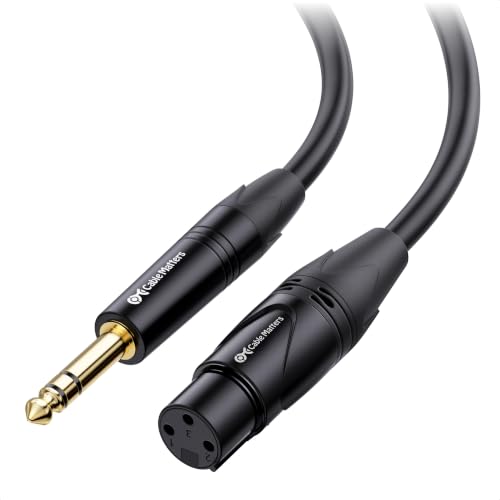
Best for: connecting a shotgun or condenser mic with a male XLR to equipment with a balanced 1/4″ TRS jack. This is ideal for studio or stage applications requiring balanced signal transmission and strong noise rejection.
Why chosen: engineered with OFC conductors and shielding to minimize hum and maximize high-fidelity sound. Limitation: longer runs can still be susceptible to EMI if shielding isn’t properly grounded in your system.
Cable Matters XLR to 1/4 TS Microphone Cable, 1/4 Male to XLR Female, 6ft

Best for: direct unbalanced connections from dynamic mics to karaoke speakers or amps without needing a separate adapter. This is a compact option for small performances or home karaoke setups.
Why chosen: the cable uses bare copper shielding for hum suppression and polyethylene insulation to improve high-frequency response. Caution: for professional studio use, unbalanced paths may introduce more noise in noisy environments.
Cable Matters 6.35mm 1/4 Inch TRS to XLR Cable, Male to Male, 10ft

Best for: interconnecting equipment with XLR and 1/4″ TRS jacks, such as studio monitors, mixers, and audio interfaces. This length is suitable for mid-size studio desks or small venues.
Why chosen: emphasizes balanced signal paths and shielding to minimize noise. Limitation: ensure both ends are truly balanced to fully realize the benefits of 1/4″ TRS to XLR balancing.
Tisino Male XLR to 1/4″ TRS Balanced Microphone Cable, Nylon-Braid, 3.3FT

Best for: balanced 1/4″ TRS to XLR connections in studio or live settings where long cable runs are not required. Short length favors mobile setups and reliable signal integrity.
Why chosen: robust nylon-braid outer sheath, 24K gold-plated connectors, and shielded conductors to reduce interference. Caution: shorter length may require additional cables for larger rigs.
Buying Guide
What to evaluate when selecting an XLR to 1/4 cable
- Connector direction: Choose XLR female to 1/4″ TS for unbalanced paths or 1/4″ TRS for balanced paths depending on your gear.
- Shielding and conductor material: OFC conductors and copper shielding reduce hum and preserve high-frequency details.
- Length: Longer cables add capacitance and potential signal loss; match length to your space to minimize noise.
- Durability: Look for metal housings, reinforced jackets, and secure connectors for live use.
- Intended application: Unbalanced cables suit simple mic-to-amp routes; balanced cables are better for studio or stage environments with longer runs.
Practical tips: test each cable with your mic and mixer in a quiet environment, verify shielding integrity, and check for any intermittent hum. For stage use, prefer cables with robust shielding and durable construction. For studio work, prioritize connectors with gold plating and high-quality OFC conductors to maximize signal fidelity.
FAQ
- What is the difference between XLR to 1/4″ TS and XLR to 1/4″ TRS cables?
TS is unbalanced and more prone to hum over long runs; TRS is balanced and better for reducing noise on longer connections. - Can I use an XLR to 1/4″ cable for any microphone?
Not all mics or inputs support 1/4″ connections; check your mixer, amp, or audio interface input type before purchasing. - Are gold-plated connectors really worth it?
Gold plating resists corrosion and can provide reliable contact, which may help maintain signal quality over time. - Which length should I choose for a small home studio?
6 ft to 10 ft covers most desk-to-mixer setups without excessive capacitance. - Is shielding more important for live performances?
Yes, shielding helps cancel hum and EMI in environments with ambient noise and electrical equipment. - Should I avoid unbalanced cables for recording?
Unbalanced cables work well for short runs and controlled environments but can pick up noise in longer or interference-heavy spaces.