
Best XLR to Phone Jack Cables for Audio Connections
Answering the need for reliable, flexible cabling between consumer devices and professional audio gear, these XLR to phone jack cables bridge balanced and unbalanced signals with clarity. This guide highlights five top options, explains who each is best for, and helps you choose based on length, shielding, and connector quality. Ideal buyers include musicians, podcasters, live sound operators, and home studio hobbyists who link smartphones or laptops to mixers, amplifiers, or powered speakers.
| Product | Best For | Key Benefit |
|---|---|---|
| Cable Matters 3.5mm to XLR Cable, 6ft | Musicians and DJs needing stereo to mono conversion | Balanced mono XLR output with OFC conductors |
| Tisino Female XLR to 1/4″ TS 10ft | Studio setups with professional mixers | Fourteen gold-plated connectors and strong shielding |
| Seefeful 3.5mm to XLR Cable, 1.5 ft | Quick mobile-to-studio links | Balanced mono signal to XLR with shielded design |
| Cable Matters 3.5mm TRS to 2 XLR Cable, 6ft | Home studios and small setups needing stereo to dual XLR | Stereo breakout for left/right to XLR inputs |
| JOMLEY 3.5mm to XLR Balanced Cable, 1 ft | Compact, portable field use | Balanced mono transmission with robust connector build |
Cable Matters 3.5mm to XLR Cable, 6ft

The Cable Matters 3.5mm to XLR Cable provides a practical link between devices with a 3.5mm output and professional XLR inputs. It converts stereo signals to a single mono XLR feed, making it a solid choice for performers and audio enthusiasts who need to bring consumer devices into mixers or powered speakers. The cable uses oxygen-free copper conductors for clear sound and features shielding designed to minimize noise and hum. Best for musicians or DJs who want a simple, reliable path from a phone, tablet, or laptop to studio gear. Caution: unbalanced signals from some devices may introduce hum if used with highly sensitive equipment in a noisy environment.
Best for: Musicians, DJs, and mobile players connecting consumer devices to professional audio systems. Why selected: Good balance of stereo-to-mono conversion and straightforward compatibility.
Tisino Female XLR to 1/4″ TS Mono Jack Unbalanced 10ft

This Tisino cable pairs an XLR female to a 1/4″ TS mono jack, enabling unbalanced signals to travel to mixing consoles or amplifiers. Its high-strength aluminum shell, gold-plated connectors, and 24K gold-plated contacts ensure durability and corrosion resistance. The multi-layer shielding minimizes interference for clearer audio with dynamics suitable for stage or studio use. Best for connecting dynamic microphones to mixers or power amps in environments where durable, shielded construction is valued. Limitation: designed for mono signals; not suitable for stereo sources without a dedicated stereo path.
Best for: Professional connections from microphones to mixers. Why selected: Strong shielding and durable connectors support reliable long-term use.
3.5mm to XLR Cable, 1.5 ft from Seefeful
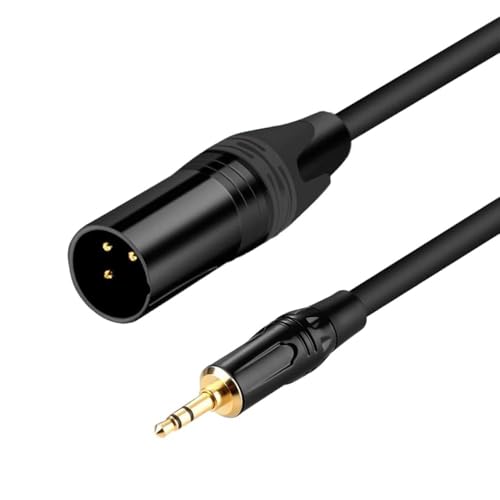
The Seefeful 3.5mm to XLR cable is a compact option designed for quick, portable links. It converts a 3.5mm stereo signal into a balanced mono XLR feed, suitable for mobile journalism, field recording, or on-the-go presentations where space matters. The 20 AWG OFC copper conductors and shielding help reduce interference, supporting cleaner sound when connecting a phone, laptop, or camera to a mixer or speaker. Best for on-location setups or small studios where cable length is at a premium. Caution: shorter length may require closer equipment placement or additional extension cables for some rigs.
Best for: Field recording or on-the-go setups. Why selected: Ultra-short length and compact design suit portable environments.
Cable Matters 3.5mm TRS to 2 XLR Cable, 6ft

This cable splits a 3.5mm stereo signal into two XLR lines, allowing one source to feed two XLR inputs with left and right channels. It uses OFC conductors for clean signal transfer and braided shielding to minimize hum and interference. Best for home studios or small venues where you need to drive both left and right inputs from a single source. Limitation: the cable handles a stereo source to dual XLR inputs, so it’s not ideal for mono mics unless a mono path is required in your setup.
Best for: Home studios needing stereo distribution to two XLR channels. Why selected: Easy left-right separation and robust construction.
JOMLEY 3.5mm to XLR Balanced Cable, 1 ft

The JOMLEY cable emphasizes a balanced mono transmission from a 3.5mm source to an XLR device, making it a compact, portable option for field use or quick stage connections. It features continuous tip and ring to pins 2 and 3, 20 AWG OFC shielding, and 24K gold-plated connectors for durability and signal clarity. Best for users who need a short, reliable link from a handheld device or portable recorder to XLR inputs. Caution: this is a balanced mono path, not a stereo cable, so stereo playback requires alternative routing.
Best for: Portable field connections from mobile sources to XLR inputs. Why selected: Short, robust, and easy to route in tight spaces.
Buying Guide
What matters most when choosing an XLR to phone jack cable?
- Signal type: Decide between mono balanced, stereo-to-mono, or stereo breakout. Mono paths are common for mics; stereo-focused setups may require dual XLR or a splitter.
- Length: Longer cables reduce clutter, but can introduce more resistance and noise if not well shielded. Shorter cables are portable and tidy for on-the-go work.
- Shielding and conductors: Oxygen-free copper (OFC) and braided shielding minimize hum and EMI/RFI. Gold-plated connectors resist corrosion and improve longevity.
- Durability: Look for molded strain relief, robust housings, and durable connectors for live or field use.
- Compatibility: Ensure your devices’ outputs and inputs align (3.5mm TRS vs. TS, XLR male vs. female) and that the cable supports the intended signal path.
Practical decision questions
- Do you need stereo input from a single source or a mono feed to an XLR input? Choose based on your mixer’s configuration.
- Will you be using the cable primarily in a studio, on stage, or on location? Prioritize shielding and build quality accordingly.
- Is portability important? Short cables are easier to carry and stash, but may require extensions in larger setups.
- Are there space limitations around ports? Some connectors feature stepped designs to fit recessed jacks.
Quick comparison at a glance
- Best for field work: Seefeful 1.5 ft or JOMLEY 1 ft for compact setups.
- Best for mobile-to-mixer: Cable Matters 6 ft or Cable Matters 3.5mm TRS to 2 XLR for stereo-to-dual XLR paths.
- Best overall shielding: Tisino XLR to 1/4″ TS with gold plating and 24K connectors.
FAQ
- Can I use a 3.5mm to XLR cable to connect a phone directly to a mixer? Yes, many models support this path, but ensure the signal is appropriate for your mixer’s mic or line input.
- Is a balanced mono connection always better than an unbalanced one? In noisy environments, balanced mono paths reduce noise and hum more effectively.
- Will these cables carry phantom power? The listed cables are designed for signal transfer; phantom power depends on the equipment and cable construction, not the general cable type.
- Do I need XLR female on the device side? Most consumer devices provide a 3.5mm output; XLR male or female ends depend on the target input side on your gear.
- What length should I choose for a home studio? A mid-length (4–6 ft) balances flexibility and signal integrity in typical desk setups.
- Are these cables compatible with all smartphones? Compatibility depends on the phone’s 3.5mm output and whether it supports headset/mic functionality through the shared jack or adapter.