
Best XLR Wireless Microphone System for Clear Sound and Flexible Performances
In short, the best XLR wireless microphone system choices deliver stable multi-channel wireless operation, clear 24-bit/48kHz audio, and easy setup for live sound, ministries, classrooms, or event venues. This guide highlights five strong options and explains who each is best for, with practical buying notes to help you compare quickly. Whether you need 5.8GHz isolation, 2.4GHz simplicity, or rugged UHF performance, there’s a model that fits your setup and budget.
Buyer type summary (quick reference):
- Best for dynamic vocalists and churches: JOYO 5.8GHz MW-1A or JBL Wireless Two Microphones
- Best for portable setups and small venues: JOYO 2.4GHz MW-2 or Xvive U35
- Best for multi-mic choir or conference use: Phenyx Pro PTU-71-2H or TONOR system
Product comparison snapshot
| Product | Best For | Frequency Band | Key Strength | Typical Range |
|---|---|---|---|---|
| JOYO MW-1A 5.8GHz System | Live sound, church, larger rooms | 5.8 GHz | Low latency, stable multi-channel | Up to 100 ft |
| JOYO MW-2 2.4GHz System | Portable, smaller venues | 2.4 GHz | Plug-and-play, auto-pairing | Up to 100 ft |
| JBL Wireless Two Microphone System | Dual-channel reliability | UHF | Enhanced vocal clarity | Up to 6 hours playback |
| Phenyx Pro PTU-71-2H | Dual-mic flexibility, large rooms | UHF | Auto-scan, multi-channel | Up to 328 ft |
| Bietrun UHF Dual System | Long-range church or conference | UHF | Rechargeable, long battery | Up to 240 ft |
JOYO MW-1A 5.8GHz Wireless Microphone System

The JOYO MW-1A uses a 5.8GHz ISM band with frequency hopping and four selectable channels, delivering low latency and stable transmission for vocal performances, church services, meetings, and stage use. It is optimized for XLR dynamic microphones, with broad compatibility for some low-power condenser mics needing 24V or less phantom power. Best for dynamic mics to minimize noise in busy RF environments.
Best for: live performances and churches that prioritize stable, low-noise vocal transmission with simple setup. Limitations: some condenser mics may introduce noise depending on power demand and shielding.
JOYO MW-2 2.4GHz Wireless XLR System

The MW-2 converts any wired XLR mic into a wireless system with 2.4GHz auto-frequency hopping, offering up to 100 feet range and 24-bit/48kHz audio. It supports up to four simultaneous MW-2 systems and emphasizes dynamic mics for lowest noise, with a caveat that some condenser mics may require testing before critical events.
Best for: portable setups and quick launches with dynamic mics. Limitations: potential noise with certain condenser mics due to shielding or EMI.
JBL Wireless Two Microphone System
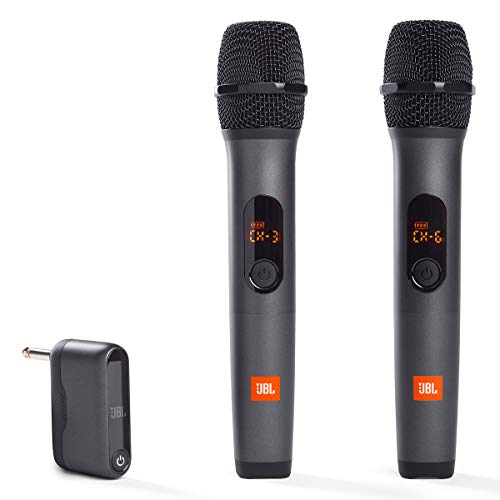
JBL integrates a rechargeable dual-channel UHF receiver with two wireless mics and a plug-and-play setup. Clear JBL Original Pro Sound aims to minimize delay and distortion, making this suitable for speeches, worship services, and events where quick setup and reliable performance matter. Battery life up to six hours supports longer events without frequent recharges.
Best for: venues needing fast setup and dependable dual-channel coverage. Limitations: UHF systems can be sensitive to RF crowding in some environments.
Phenyx Pro Dual UHF Auto Scan PTU-71-2H

The PTU-71-2H system features auto scan for least-interference frequencies, dual UHF channels, and a broad range with 2×100 selectable frequencies per channel. It supports up to 16 transmitters and emphasizes refined sound with cardioid pickups and quick IR synchronization. A strong choice for multi-mic conferences and larger rooms.
Best for: events requiring multiple mics with robust interference handling. Limitations: slightly more complex setup due to auto-scan and frequency management.
Bietrun XLR Wireless System

Bietrun’s UHF dual system includes rechargeable mics and a receiver with a built-in 1200mAh battery, LED indicators, and an alloy-body mic design. It offers up to 240 feet range in open space and is suitable for conferences, churches, and performances where long-range wireless freedom matters. The package includes 6.35 mm adapters for broader compatibility.
Best for: long-range applications and battery-conscious setups. Limitations: ensure the exact microphone compatibility with your mixer’s phantom power and RF environment.
New Bee 5.8GHz/Condenser Active Transmitter

This 5.8GHz system emphasizes anti-interference performance and up to 100 feet of range. It features dual-mode compatibility for 48V phantom-powered condenser mics and dynamic mics, plus a long battery life. It suits broadcast setups, churches, and classrooms that need flexible mic types without wires.
Best for: studios or venues needing dynamic and condenser compatibility in one compact kit. Limitations: 48V condenser mode may introduce more noise depending on mic power demand.
Xvive U35 Wireless System

The Xvive U35 uses 5.8GHz true diversity with a 100 ft/30.5 m range and a channel-scan mode to identify the best channel. It delivers 24-bit/48kHz audio with 110 dB dynamic range and SNR, suitable for stages and home studios where RF conditions are stable. Channel scanning simplifies setup in RF-crowded spaces.
Best for: performers who want a reliable, channel-optimized wireless path. Limitations: performance depends on environment and RF activity.
TONOR Wireless System With Handheld And Lavalier Options

TONOR’s system provides handheld mics and a versatile set with headsets or lapels. It emphasizes stable wireless connectivity over a long range up to 200 ft/60 m, robust channel options, and compatibility with mixers and amplifiers. This is a practical selection for churches, classrooms, and events requiring flexibility in mic type.
Best for: multi-setup environments needing both handheld and bodypack options. Limitations: larger systems may require careful RF planning in crowded venues.
Buying Guide: How to Choose Your XLR Wireless Microphone System
- Frequency band and interference: 5.8GHz typically offers better isolation from common 2.4GHz Wi‑Fi/Bluetooth congestion, but check for local channel availability and potential noise in your venue.
- Channel count and expansion: If you need multiple mics, choose systems with multiple channels and the ability to add additional transmitters, ideally with automatic pairing.
- Microphone type: Dynamic mics reduce noise in RF-heavy environments. Condenser mics may require phantom power and careful power management; test compatibility if possible.
- Range and line of sight: Consider venues with long rooms or outdoor spaces. Long-range models with line-of-sight performance help prevent dropouts.
- Battery life and charging: Look for systems with rechargeable options and clear battery indicators to avoid mid-event power loss.
- Audio quality: Seek systems offering 24-bit/48kHz sampling and good SNR to ensure clear vocals without artifacts or hiss.
FAQ
What type of wireless system should I choose for a church service?
Dynamic microphone systems using 5.8GHz or UHF bands typically offer stable performance and lower noise in loud RF environments. A dual-channel option helps in paired vocal use.
Is 5.8GHz better than 2.4GHz for live sound?
Yes, 5.8GHz generally provides stronger isolation from common Wi‑Fi and Bluetooth interference, reducing dropouts in busy venues.
Can condenser mics work with wireless XLR systems?
Some systems support phantom-powered condenser mics, but noise and power requirements vary. Dynamic mics are usually the safest default choice.
What’s a practical range for most venues?
Room-range systems typically cover 100 ft (30 m) or more; larger venues may benefit from UHF models with longer reach and better RF stability.
Do I need to pair transmitters and receivers one at a time?
Many 2.4GHz systems require syncing TX first, then RX, to ensure proper pairing and stable operation.