Best Zero Latency Audio Interfaces for Clear, Real-Time Monitoring
Zero-latency monitoring is essential for broadcasters, podcasters, and musicians who need real-time playback without distracting delays. This guide highlights five USB audio interfaces that emphasize zero-latency monitoring, high compatibility, and solid preamps. It helps different buyers choose quickly: creators needing simple setups, podcasters seeking reliable USB options, and musicians who want studio-grade monitoring on a budget. Below is a quick comparison table of the top five picks.
| Product | Best for | Key Benefit |
|---|---|---|
| Shure MVX2U | Broad mic compatibility and streaming | Zero-latency monitoring with adjustable gain and phantom power |
| M-Audio M-Track Solo | Simple recordings and podcasts | Zero-latency USB/Direct monitoring and compact design |
| M-Audio M-Track Duo | Two-channel recording and streaming | Dual inputs with USB Direct monitoring for low-latency workflows |
| Creative Live! Audio A3 | Mobile creators and on-the-go recording | Built-in 4-channel mixer and direct monitoring options |
| MAONO PS22 Lite | Budget-friendly home studios | High-resolution 24-bit/192kHz with USB direct monitoring |
Shure MVX2U XLR-to-USB Interface

Best for: Microphone enthusiasts and streamers who need effortless setup with broad mic compatibility. The MVX2U delivers up to 60dB gain and 48V phantom power, supporting dynamic and condenser mics. It includes zero-latency monitoring, allowing real-time listening while recording or streaming. The interface is compact and USB-C powered, making it suitable for on-the-go studios and home setups.
Why selected: Its automatic level features and simple XLR-to-USB workflow reduce latency-related complexity, appealing to users who want reliable, plug-and-play performance.
Caution: Some users may require additional accessories for very high-output mics or unusual impedance needs. While it supports many mics, exceptionally loud sources may benefit from a mic preamp with higher headroom.
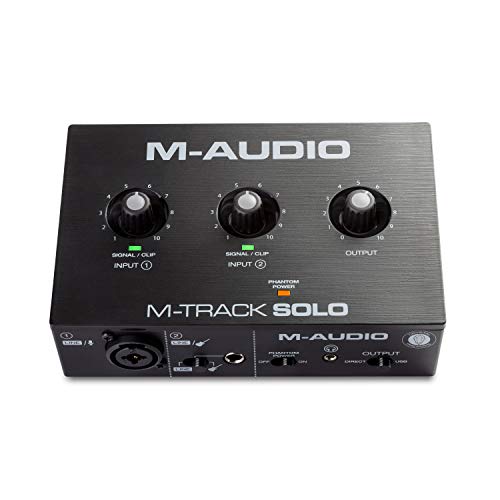
M-Audio M-Track Solo USB Audio Interface

Best for: Solo creators who want a straightforward, budget-friendly setup with reliable latency handling. The Solo offers one XLR combo input with phantom power and a second instrument/line input, plus a USB/Direct switch for zero-latency monitoring.
Why selected: It provides a clean route from microphone or instrument to computer with minimal setup fuss, and the dedicated direct monitor path helps prevent distractions from latency during vocal or guitar takes.
Caution: Fewer inputs than some multi-channel models mean you might outgrow it if you record with multiple instruments at once.
M-Audio M-Track Duo USB Audio Interface
Best for: Small studios requiring two separate inputs for vocal and guitar, or two performers streaming simultaneously. The Duo includes two combo inputs and a USB/Direct switch for zero-latency monitoring, supporting an efficient two-mic or mic-instrument setup.
Why selected: Its dual-input layout and transparent monitoring path suit duet sessions or podcast panels where immediate feedback is crucial to the performance.
Caution: While versatile, the interface focuses on a compact form factor, which may limit additional hardware like external mic preamps or extra outputs.
MAONO PS22 Lite USB Audio Interface

Best for: Budget-conscious home studios and hobbyists needing high-resolution audio for podcasts and music. The PS22 Lite supports 24-bit/192kHz resolution and includes a loopback feature for streaming and recording.
Why selected: It offers strong value for the price, with a robust feature set suitable for creators who want clear, professional-sounding recordings without a steep learning curve.
Caution: The preamp headroom is adequate for typical voices and instruments, but extremely dynamic sources may require careful gain staging to avoid clipping.
Buying Guide: Key Considerations for Zero-Latency Interfaces
What to check before buying a zero-latency audio interface:
- Monitoring options: Look for USB Direct or zero-latency monitor switches to hear your performance in real time without round-trip delay.
- Input count: Choose the number of XLR/line inputs you actually need. If you record with multiple mics or instruments, a two-input or four-input model is preferable.
- Phantom power and mic compatibility: If you plan to use condenser mics, confirm 48V phantom power and adequate preamp gain (dB) for your mics.
- Converters and headroom: Higher dynamic range (dB) and 24-bit/192kHz support yield cleaner, more detailed recordings and better conversion for mixes.
- Portability and power: USB-powered interfaces are convenient for mobile setups; consider USB-C compatibility for newer laptops and desktops.
- Software bundle: Some interfaces include DAW entry software and plugins, which can influence overall value and workflow.
FAQ
- What is zero-latency monitoring?
Real-time listening of input audio with no perceptible delay, usually via a direct monitoring path inside the interface. - Do I need an audio interface with many inputs for podcasting?
Not necessarily; for solo podcasting, one or two inputs are often enough, with zero-latency monitoring to hear yourself clearly. - Can I use any microphone with these interfaces?
Most support dynamic and condenser mics with phantom power, but check each model’s gain range for your mic. - Is 24-bit/192kHz necessary for home recording?
It improves detail and headroom, but for many users 24-bit/96kHz is sufficient; higher rates are beneficial for critical recording. - Which interface is best for a beginner?
A compact two-input model with simple monitoring controls and a software bundle is typically easiest to start with. - Do these interfaces require drivers?
Many are class-compliant and driver-free on modern systems; some may offer optional drivers for specific features.