

ANC vs. Noise Isolation: What Each Can—and Can’t—Do
Passive isolation, active cancellation, and transparency solve different problems. Learn what to expect before blaming your headphones—or turning them up.
In this guide
- Know which kind of quiet you're asking for
- Passive isolation starts at the contact points
- What the electronics contribute
- Expect different results from different sounds
- Use transparency for a deliberate reason
- Listening features and hearing protection need separate checks
- Check a weak result in a sensible order
- Choose the combination that fits your day
Know which kind of quiet you're asking for 1 2
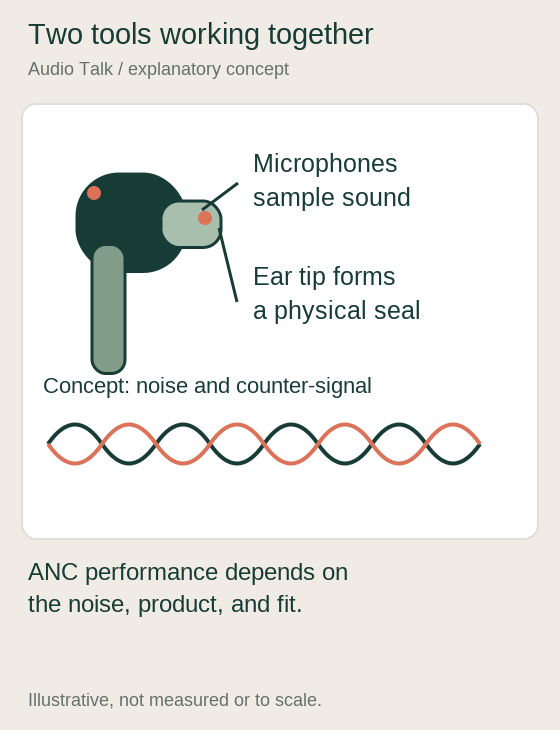
Noise isolation comes from the physical fit of your headphones or ear tips, while active noise cancellation uses microphones and electronics to reduce unwanted sound. Many products combine both, so the fit and the selected listening mode matter at the same time.
Transparency is a different tool: it lets you hear more of your surroundings through the headphones. It isn't another strength setting for silence, and accidentally leaving it on can make a perfectly functional pair seem as though its cancellation has disappeared.
Start by identifying the mode shown in your product's own app or settings. Then decide what bothers you in your usual environment, because a steady fan, nearby conversation, and a sudden dropped object don't present the same problem.
Passive isolation starts at the contact points 1
For in-ear models, the tip provides the physical barrier around the ear opening. For over-ear models, the pad arrangement and how the headphone sits around your ears are important parts of the overall design.
Check for a loose tip, a folded pad, or a position that changes when you turn your head. You're looking for a comfortable, consistent fit, not trying to squeeze the headphone harder until every outside sound disappears.
Try a compatible alternative tip or a gentle repositioning before changing the volume. If your product offers a fit check, use its instructions alongside your comfort judgment and note whether the result changes on the left or right side.
Physical fit can still matter when active cancellation is enabled. Sennheiser's explanation links a good ear-tip seal with better ANC performance, so software adjustments are only one part of the setup rather than a replacement for properly fitted parts.
What the electronics contribute 1 2
An ANC system samples unwanted sound and produces a counteracting signal through the headphone. Apple's explanation describes outside and inside microphones on supported AirPods models, but the exact microphone arrangement depends on the product rather than one universal construction.
You don't need to understand the circuit to make a useful comparison at home. Pause the music, keep the headphones in the same position, and switch between the modes your manufacturer provides so you can notice the change without masking it with playback.
Keep your comparison in a normal, comfortable environment and don't create loud noise to test the feature. A fan or ordinary room sound is enough to learn what the setting does during everyday use, without turning the exercise into a noise-exposure experiment.
Also check what happens when the battery is low or the headphone is used with a cable. Some products change which electronic features remain available, so the manual is a better guide than assuming ANC will always work in every connection mode.
Expect different results from different sounds 1
Sennheiser explains that ANC is generally more effective against low-frequency noise such as engine hum or air conditioning than against higher-frequency sounds such as voices. That helps explain why a train ride may feel calmer while you can still notice a nearby conversation.
It doesn't mean every pair handles the same noise equally well, or that speech will vanish on demand. The fit, product design, environment, and sudden changes in the sound all affect the practical result.
Name the noise you're trying to manage before deciding the feature is disappointing. “The fan feels less prominent, but I still hear the door” is a useful observation; “ANC doesn't work” skips the distinction that could help you choose a better setting or setup.
If voices are your main distraction, consider the physical environment as well as the headphones. A quieter work location or a closed door may be more useful than expecting a listening mode to solve every interruption in a shared room.
Use transparency for a deliberate reason 2
Transparency can help you hear a conversation or announcement without immediately removing both earbuds. Check the instructions for switching modes, and try it in a familiar place so you know what the change sounds like before relying on it during travel.
Some products also offer adaptive modes that alter how much ambient sound they allow. Treat those as product-specific features and learn their controls, because an adaptive mode isn't necessarily the same thing as keeping a fixed cancellation setting selected.
Don't treat transparency as a guarantee that you'll notice everything around you. Music level, the product, and the surrounding noise still matter, so pause playback or remove the headphones when you need to pay close attention.
When evaluating a pair, include the routine you actually expect to use. If you often stop to talk, check whether switching modes is comfortable and predictable rather than buying solely from a claim about the strongest possible cancellation.
Listening features and hearing protection need separate checks 3
NIOSH cautions that ordinary active noise cancellation should not be treated as hearing protection unless the product has an appropriate Noise Reduction Rating. A quieter impression by itself doesn't establish that the headphone is suitable for a hazardous workplace or loud activity.
Some specific products have separately documented hearing-protection functions, with defined requirements and limitations. If that's the reason for your purchase, read the exact feature documentation rather than assuming the general ANC label includes the same protection on every model.
For noisy work or another activity that requires protection, choose suitable rated equipment and follow the relevant instructions. Don't use a comfortable consumer headphone comparison as a substitute for evaluating the noise and the protection required in that setting.
For everyday music, keep the volume modest and take listening breaks. Reducing background distraction may make lower playback levels easier to enjoy, but it isn't a reason to increase the volume or assume long sessions have become risk-free.
Check a weak result in a sensible order
First confirm the listening mode, then check the fit, charge level, and the condition of the ear tips or pads. Make one change at a time so you can explain which adjustment helped instead of resetting everything and losing your starting point.
If the result differs sharply between the two sides, inspect the removable parts and review the manufacturer's cleaning instructions. Avoid inserting tools into microphone or speaker openings, because a blocked opening needs the product's permitted care method rather than improvised probing.
Compare the headphones in another ordinary setting and note whether the issue follows them. That can help distinguish a change in your surroundings from a persistent problem with the product, without claiming that an informal check measures cancellation performance.
If something still seems wrong, contact support with the exact model, selected mode, affected side, and changes you've already tried. That information is more useful than asking for a universal “best ANC setting” that may not exist on your particular headphones.
Choose the combination that fits your day
For a regular commute, a comfortable seal and useful reduction of steady background noise may matter most. For a quiet desk, passive fit, comfort, and how easily you hear a colleague could outweigh the strongest available active mode.
Use a short personal checklist that covers comfort, usual noise, mode controls, and the moments when you need awareness. Add battery and connection behavior if you switch between wireless listening and a cable during the day.
Compare actual headphones under similar conditions, using a modest music level and the same seat or location. Keep your notes descriptive rather than assigning invented cancellation percentages from a brief personal impression.
The right result is a headphone routine that feels easier to use and suits your surroundings. Understanding which tool is doing the work helps you adjust that routine without expecting one feature to provide every kind of quiet.
Sources & how this guide was prepared
Audio Talk Editorial checked these primary sources on October 14, 2026. This is a research-based guide with original practical examples; it does not report our own equipment tests.
- Sennheiser: what affects true-wireless ANC
- Apple: ANC and transparency listening modes
- NIOSH: provide hearing protection
Manufacturer instructions for your exact model take priority. Read our editorial method · Photo and illustration credits