

RMS vs. Peak Power in Car Audio: Read the Numbers Correctly
Compare power with its channels, load, and test conditions attached. A peak number alone cannot tell you how a system will behave—or whether its parts belong together.
In this guide
- Read the conditions before comparing the watts
- Understand the RMS label without turning it into a shortcut
- Keep the channel count attached to the number
- Compare output ratings at the stated load
- Speaker power handling isn't amplifier output
- A louder signal can become a different problem
- Include the rest of the electrical and signal plan
- Finish with a specification record you can trust
Read the conditions before comparing the watts 1
In car-audio shopping, RMS or continuous ratings are generally intended to describe sustained output or handling under stated conditions, while peak ratings describe a different maximum claim. Read the manufacturer's definition rather than assuming every number with the word watts uses the same method.
Kicker's technical paper explains why amplifier-power claims need defined measurements and a load, instead of an unqualified peak headline. That is a useful starting point for comparing specifications, but it doesn't turn every manufacturer's printed number into the same standardized test.
Your first note should include the number of channels, impedance, supply conditions, and distortion limit where stated. Without those details, two impressive ratings can describe different jobs rather than competing answers to the same question.
Understand the RMS label without turning it into a shortcut 1
RMS is a mathematical term commonly attached to car-audio power specifications, even though practical average power is calculated from relevant electrical measurements and the load. For buying decisions, use the documented continuous-rating method rather than inventing a conversion from the word alone.
A measurement taken into a defined test load is not the same thing as a guarantee about every loudspeaker playing every song. The speaker's behavior, music signal, amplifier limits, and operating conditions all belong to the real system.
Don't simply divide a peak rating by two and call the result a verified continuous rating. Without a defined waveform, measurement method, and duration, that shortcut can give a number that the manufacturer never established.
When the specification provides only a dramatic maximum claim, ask for the continuous output or handling information you actually need. Leaving a field unresolved is more useful than filling it with a calculation based on undocumented assumptions.
Keep the channel count attached to the number
An amplifier rated at a certain wattage per channel needs the channel count in the comparison. Four smaller channel ratings and two larger ones can add to the same arithmetic total while providing very different ways to power the speakers in a vehicle.
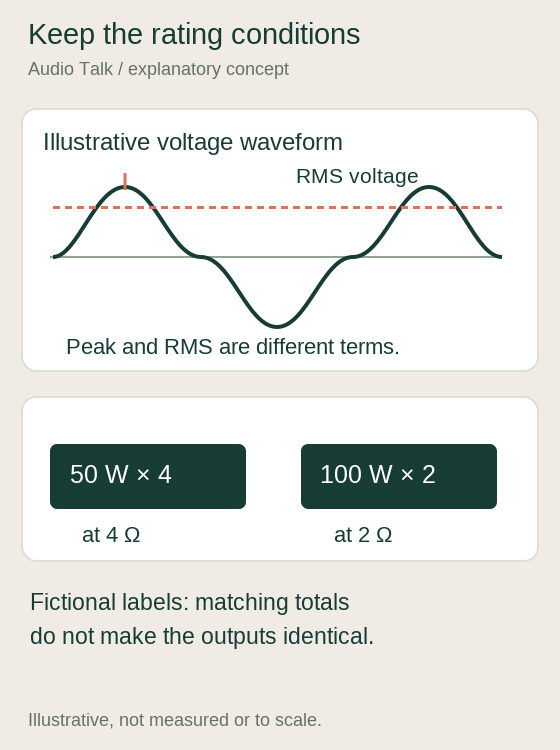
For an illustrative label, “50 watts per channel, four channels, at 4 ohms” describes four outputs under a stated load. “100 watts per channel, two channels, at 2 ohms” describes another arrangement, and the matching total doesn't make the two amplifiers interchangeable.
Those examples are invented labels to show how to read the conditions, not product recommendations or measurements. Write the actual manufacturer's values into the same fields when you compare real amplifiers, and preserve any additional qualifications it provides.
Bridged operation also needs its own documented output and minimum-load requirements. Don't assume a bridged specification can be used independently on every channel or that a load supported in one operating mode is supported in another.
| Illustrative label | Channels and load | Arithmetic total |
|---|---|---|
| 50 W per channel | 4 channels at 4 Ω | 200 W |
| 100 W per channel | 2 channels at 2 Ω | 200 W |
Compare output ratings at the stated load 2
An amplifier's output specification is tied to the load and conditions used for the rating. A figure at 2 ohms shouldn't be treated as the same comparison point as a figure at 4 ohms unless you also have the appropriate matching specifications.
Crutchfield's amplifier glossary gives an example of ratings that state impedance, supply voltage, and distortion conditions together. Use that level of detail as a reading habit, without assuming every product you encounter used that exact procedure.
A different supported load can change the amplifier's available output, but the manufacturer's minimum-load rules still apply. Do not infer that connecting a lower impedance is a safe way to obtain a bigger number from any amplifier.
For multiple speakers or a subwoofer arrangement, obtain the actual final load from the documented wiring plan. If you can't establish it confidently, have an appropriate installer verify the configuration instead of treating the label on one individual driver as the complete answer.
Speaker power handling isn't amplifier output
A speaker's power-handling specification and an amplifier's output specification describe different parts of the system. Similar numbers may be useful in a compatibility discussion, but they aren't proof that the combination is ideal at every volume or with every signal.
Use the speaker manufacturer's amplifier recommendations and operating limits together with the amplifier's documentation. If either provides a range or qualified condition, keep that information rather than reducing the match to a single number on two boxes.
The larger peak-handling claim isn't automatically a reason to choose a speaker over another model. Physical fit, impedance, sensitivity under comparable conditions, frequency coverage, and the vehicle's signal route can all matter to the actual result.
Also distinguish power-handling capacity from a requirement to supply that much power during normal music. A rating isn't a listening instruction, and an ordinary volume preference doesn't require pushing the system toward the edge of its documented limits.
A louder signal can become a different problem
If increasing volume produces obvious roughness or distress, reduce the level and investigate the system rather than treating the sound as proof that the speakers need to be driven harder. The source, processing, amplifier, and speaker limits can all deserve attention.
An unqualified wattage number doesn't tell you the distortion conditions used to obtain it. Compare the stated measurement limits and ask for missing details instead of assuming the largest printed value represents the clean output you expect to use.
Don't use an ordinary listening session as a maximum-power test for an installed system. You can evaluate whether your usual level is comfortable and clear without trying to demonstrate the peak rating from a product package.
If a persistent problem needs diagnosis, record the source, approximate control setting, affected channel, and whether it happens with different recordings. That information helps an installer investigate a real symptom rather than guessing from a power total alone.
Include the rest of the electrical and signal plan
Amplifier selection also involves the vehicle's electrical supply, suitable wiring, protection, mounting, and integration requirements. A knowledge article about ratings doesn't supply a vehicle-specific installation procedure, so have those parts defined by the equipment documentation and an appropriate installer.
If a factory amplifier or processed signal is involved, include it in the plan before comparing replacement power. More available output doesn't automatically correct the frequency content, level, or factory functions of the signal entering the new device.
Ask for the exact speaker loads, channel assignments, and operating modes in an installation quote. Those details reveal whether the proposed amplifier is being used in a supported arrangement, which a large combined-wattage headline can conceal.
Keep the comparison focused on the job you need, such as suitable front-speaker channels and a separately defined subwoofer route. That makes it easier to assess a practical system without buying unused capacity solely because its advertised total is larger.
Finish with a specification record you can trust
Make one row per real product with continuous rating, channels, load, stated conditions, and relevant operating mode. Add the supported speaker requirements and missing information before assigning any preference.
Keep the original specification page with the comparison so you can revisit its footnotes. A copied headline can lose the qualifications that made the value useful, especially when an advertisement summarizes several operating modes in one short phrase.
If two products don't provide comparable conditions, label that limitation rather than declaring a numerical winner. You can still compare their documented functions, physical fit, controls, and integration requirements while asking for the missing power information.
Use listening preference or an actual measured test only when you have evidence for it, keeping that separate from the manufacturer's specification. This guide doesn't report equipment tests, and the illustrative labels above don't establish which real amplifier sounds better.
Reading the watts this way turns a confusing package into a useful system question. Keep the conditions attached, follow the documented limits, and choose the arrangement that fits the speakers and vehicle you actually intend to use.
Sources & how this guide was prepared
Audio Talk Editorial checked these primary sources on October 14, 2026. This is a research-based guide with original practical examples; it does not report our own equipment tests.
Manufacturer instructions for your exact model take priority. Read our editorial method · Photo and illustration credits