Best Full Range Speaker Kits for DIY Projects and Learning
If you’re looking to build your own compact sound system or explore electronics hands-on, a full-range speaker kit is a smart starting point. These kits help beginners and hobbyists assemble working speakers without complex soldering. The top picks below are suited to students, makers, or anyone wanting a portable audio project. Each entry shows who it’s best for, why it stands out, and any notable limitations.
| Product | Best For | Key Benefit |
|---|---|---|
| CYOEST DIY Bluetooth Speaker Box Kit | STEM learners and classroom projects | All-in-one kit with dual 2″ full-range drivers and Bluetooth |
| KIBBEH 2 Pack 1.69″ Full Range Speakers | Compact replacements and small DIY builds | Two 2″ drivers with 8 Ohm impedance |
| KBT Mini Full Range 45mm Speaker | Small DIY demos and ESP32/Arduino setups | Compact, 3W with 4 Ohm impedance |
| XYRSTOLR 3″ 8Ohm 20W Speaker | Higher-power DIY projects and stereo setups | 20W rating with clear, stronger sound |
| Gikfun EK1794 4Ohm 40mm Dual Speaker | Arduino and radio replacement projects | Two-pack compact 40mm drivers, 3W each |
CYOEST DIY Bluetooth Speaker Box Kit

Brand: CYOEST
- Bluetooth speaker DIY kit with laser-cut wooden components
- Two 2″ full-range speakers (4 ohm, 3W) and dual-channel Bluetooth amplifier
- Clear, simple instructions; built-in educational STEM value
Who it’s best for: students, teachers, and beginners who want a hands-on project that yields a wireless speaker. Why selected: it combines kit assembly with Bluetooth streaming and a straightforward build, ideal for demonstrating basic circuits and enclosure design. Caution: power requires four batteries (not included) for operation, which can affect portability and setup time.
KIBBEH 2 Pack 1.69″ Full Range Speakers
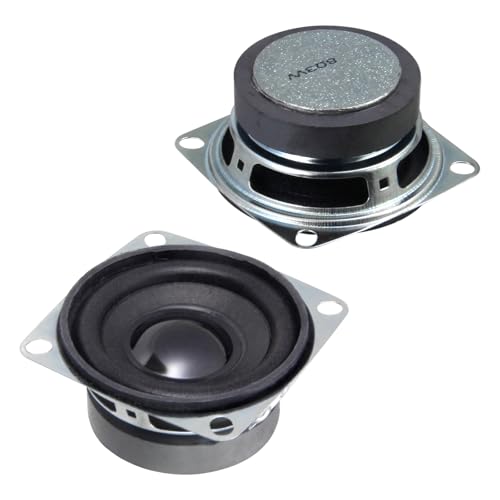
Brand: KIBBEH
- Two 2″ full-range drivers, 8 Ohm impedance, 3W
- Compact size suitable for small DIY speakers or replacements
Best for: small, space-constrained projects or replacement drivers in compact enclosures. Better for: slightly higher impedance designs that prioritize stable playback and reduced loading. Caution: lower wattage limits output volume for larger projects.
KBT Mini Full Range Speaker 4 Ohm 3W

Brand: KBT KEEP BETTER TECH
- Compact 45mm by 38.5mm package; 4-ohm impedance; 3W output
- Two-pack for stereo applications or backup drivers
Best for: small, space-limited audio projects and ESP32/Arduino demos. Choose this if you need a small, easy-to-integrate driver with predictable performance. Limitation: limited bass potential due to compact size and low power rating.
XYRSTOLR 3″ 8ohm 20w Speaker

Brand: XYRSTOLR
- 3″ diameter, 8 Ohm, 20W rated power
- Designed for easy installation and broad compatibility
Best for: higher-powered DIY speakers and stereo setups that need more punch. Better for: projects requiring a larger midrange and improved listening clarity. Caution: higher power requires proper enclosure and cooling considerations to avoid distortion.
Gikfun EK1794 4Ohm 40mm Duo

Brand: Gikfun
- Pack of 2, 4 Ohm, 3W each; 40mm diameter
- Versatile for Arduino and DIY audio projects
Best for: compact DIY demos and hobby projects that need two reliable drivers. Useful for: home audio-visual substitutes and DIY radio/hi-fi experiments. Caution: ensure correct power handling and enclosure design to avoid distortion at higher volumes.
Buying Guide
What considerations matter when choosing a full-range speaker kit?
- Power needs: Match driver wattage with your amplifier or battery capacity. Higher watt speakers can deliver louder sound but require better enclosures and power management.
- Impedance and compatibility: Most small DIY kits use 4–8 Ohms. Check your amplifier’s compatibility to avoid poor performance or overheating.
- Enclosure type: Sealed vs. ported enclosures affect bass response and size. Choose based on space and desired sound profile.
- Physical size: Diameter and mounting depth influence enclosure design and where the speaker can be installed. Smaller drivers fit tighter spaces but may deliver less bass.
- Ease of assembly: Some kits include laser-cut parts and clear instructions, ideal for beginners, while others require more soldering or mechanical work.
- Connectivity: If you want wireless playback, prioritize Bluetooth-equipped kits like the CYOEST option or ensure your design supports Bluetooth modules.
- Educational value: Kits with STEM-oriented components help learners understand circuitry, enclosure design, and sound physics.
FAQ
- What is a “full-range” speaker kit? — It includes drivers designed to reproduce most audible frequencies without requiring separate tweeters or woofers.
- Do I need soldering for these kits? — Some kits are plug-and-play with pre-wired components, while others may require basic soldering or wire connections.
- Can these speakers work with Arduino or ESP32? — Several kits and drivers are suitable for microcontroller projects with compatible audio interfaces.
- Is bigger always better for speaker kits? — Not necessarily. Driver size affects enclosure size and bass performance; smaller drivers fit compact builds but may need tuned enclosures for acceptable bass.
- Are two-pack drivers better for stereo? — Yes, two drivers enable stereo configurations or offer a spare for later expansion.
- What enclosure should I use for DIY builds? — A properly sized sealed or ported enclosure designed for the specific driver impedance and wattage yields the best balance of clarity and bass.