Best Left and Right Audio Cables for Clean Stereo Sound
Answering your search for reliable left and right audio cables, this guide highlights five solid options across RCA-to-RCA and aux-to-RCA configurations. These selections suit home theater setups, Hi-Fi systems, active speakers, and device-to-speaker connections. Whether you need short runs for a compact desk setup or longer cables for a living room, these picks balance durability, signal integrity, and ease of use.
| Product | Length | Connector Type | Best For |
|---|---|---|---|
| Tan QY 2RCA to 2RCA Cable | 3 ft | 2x RCA Male to 2x RCA Male | Compact desks, gaming consoles, HDTVs |
| Amazon Basics 2 RCA to 2 RCA (8 ft) | 8 ft | 2x RCA Male to 2x RCA Male | Mid-sized rooms, subwoofers, Hi-Fi |
| Amazon Basics 2 RCA to 2 RCA (4 ft) | 4 ft | 2x RCA Male to 2x RCA Male | TVs to receivers, tight setups |
| J&D 2 RCA M/M (3 ft) | 3 ft | 2x RCA Male to 2x RCA Male | Home theater, amplifiers with minimal cable clutter |
| JSAUX RCA to 3.5mm Cable (6.6 ft) | 6.6 ft | RCA Male to 3.5mm Jack | Smartphones to stereo receivers, TVs with RCA inputs |
Tan QY 2RCA to 2RCA Cable 3Ft
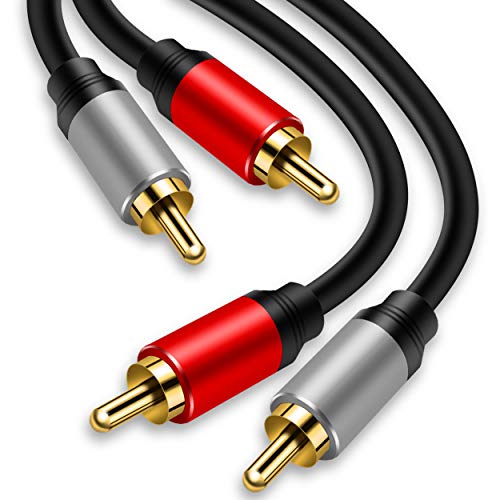
Best for compact spaces and gaming gear. Tan QY uses gold-plated RCA connectors and a durable PVC jacket, designed to deliver clear left and right channel transmission with corrosion resistance. The color-coded red and silver white housings help quick identification of right and left channels, reducing setup mistakes in busy stereo systems.
Who it’s for: users who need a short, reliable link between a console or TV and a receiver or speaker without taking up much room. Why selected: robust build and color-coded convenience support quick, accurate connections in tight setups.
Caution: shorter length may require routing considerations in larger rooms or with longer playback distances.
Amazon Basics 2 RCA Cables, 8 Feet

Best for mid-sized rooms and Hi-Fi setups. This 8-foot stereo RCA cable provides straightforward, reliable signal transfer with gold-plated plugs for corrosion resistance. It supports typical left and right channels and is compatible with amplifiers, subwoofers, and active speakers.
Who it’s for: listeners who want a long, simple cable for home theater or stereo systems without needing extra features. Why selected: consistent signal path and standard RCA configuration suit most common AV connections.
Caution: longer cables can introduce minor signal loss if used with marginally powered equipment; pair with quality connectors to minimize this effect.
Amazon Basics 2 RCA Cables, 4 Feet
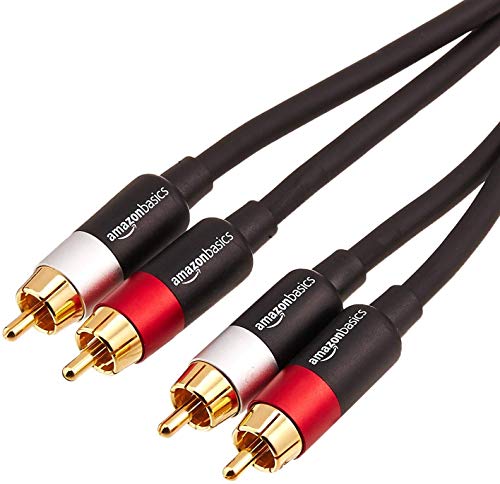
Best for tight living-room setups and compact media centers. The 4-foot option offers crystal-clear audio with dual RCA channels and gold-plated connectors. It’s ideal for connecting a TV or gaming console to a receiver or active speaker system where space is at a premium.
Who it’s for: users with limited space who still want reliable stereo performance. Why selected: balanced length and solid construction fit most small to medium AV layouts.
Caution: shorter runs may not be suitable for longer speaker distances; measure your setup before choosing length.
J&D 2 RCA M/M 3 Ft
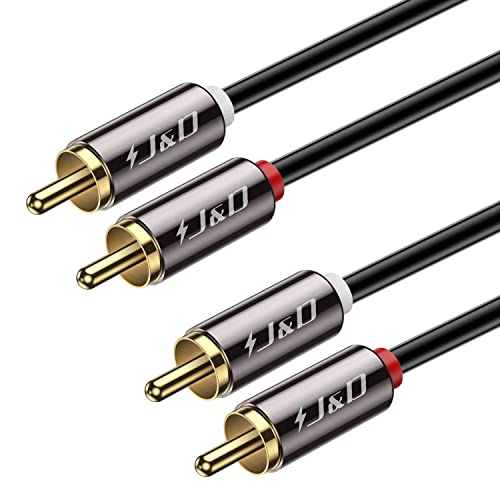
Best for clean, reliable left-right connections in home theater or Hi-Fi setups. J&D uses 24K gold-plated connectors and copper shielding to minimize EMI and RFI, helping preserve audio clarity. The bonded yet separable design offers neat cable management while letting you split into two individual cables when needed.
Who it’s for: enthusiasts seeking improved signal integrity and flexible cable management. Why selected: strong shielding and gold-plated connectors reduce interference in typical living-room AV configurations.
Caution: longer runs than 3 feet may require careful routing to prevent tangling or EMI exposure in dense setups.
JSAUX RCA to 3.5mm Cable 6.6ft

Best for connecting smartphones, tablets, or laptops to stereo receivers or powered speakers with RCA inputs. The JSAUX cable uses dual shielding and a gold-plated 3.5mm plug for stable, low-noise audio transfer. Color-coded left/right RCA connectors help quick setup.
Who it’s for: users who want to integrate mobile devices with traditional RCA-equipped audio systems. Why selected: versatility for analog-to-stereo playback and longer reach for multi-room setups.
Caution: the 3.5mm to RCA adapter length may be longer than needed in tight spaces; ensure routing accommodates both ends without bending.
Buying Guide: Key Considerations For Left And Right Audio Cables
Cable type matters. RCA-to-RCA preserves standard stereo channels, while 3.5mm-to-RCA adapters expand compatibility with portable devices. Consider these questions:
- What devices need to connect? If you’re linking a TV, receiver, and speakers, RCA-to-RCA is often simplest. If you’re connecting a phone or tablet to a stereo, a 3.5mm-to-RCA option may be required.
- What length is appropriate for your space? Short cables minimize clutter but may limit placement. Longer cables improve reach but risk signal loss if quality is lower.
- Are there shielding and connector quality requirements? Gold-plated connectors resist corrosion and reduce signal degradation; dual shielding helps minimize interference.
- Is color-coding important? Color markers simplify left/right identification during setup, especially in multi-component systems.
- Future-proofing considerations? If you anticipate mobile-device inputs or multiple AV sources, consider cables that support both 3.5mm and RCA connections with easy adaptors.
FAQ
- What is the difference between RCA-to-RCA cables and 3.5mm-to-RCA adapters? – RCA-to-RCA cables connect two RCA-equipped devices directly, while 3.5mm-to-RCA adapters bridge devices with a 3.5mm headphone jack to RCA inputs.
- Do I need high-end cables for good sound? – For typical home use, standard gold-plated connectors with solid shielding provide clear audio. Higher-end cables mainly matter for long runs or highly resolving systems.
- Can I use these cables with a subwoofer? – Yes, most RCA-to-RCA cables support subwoofer connections when the devices have compatible RCA inputs/outputs.
- Is length more important than build quality? – Both matter. A well-built shorter cable can outperform a poorly made longer one; choose based on your room layout and equipment.
- Do color-coded cables help with setup? – Yes. Color-coding helps quickly identify left and right channels, reducing misconnection risks during setup.
- Are gold-plated connectors necessary? – They resist corrosion and can improve long-term durability and signal integrity in contact surfaces.