Best Car Audio Equalizers for Clear, Custom Sound
Answering the question “What is the best equalizer for car audio?” this guide highlights top 7-band and multi-band options designed to refine tone, balance, and bass response in a variety of installs. The listed models suit different needs—from compact 1/2-DIN units to feature-rich DSP crossovers. This overview helps buyers decide who each product is best for, whether you’re tuning a budget setup, upgrading a factory system, or building a high-performance sound stage.
Summary table of selected products:
| Product | Best For | Key Benefit | Notes |
|---|---|---|---|
| CT Sounds CT-7EQ | Compact 1/2-DIN installs | 7-band parametric control from 50 Hz to 12 kHz | Simple, precise tone shaping |
| Clarion EQS755V | High-utility, multi-outputs | Independent master/subwoofer control and fader | Versatile inputs/outputs |
| Taramp’s Pro 2.4S DSP Crossover | DSP-based tuning | 15-band graphic with ISO center frequencies | Advanced crossover options |
| Taramps TEQ 7.4 | 2-input, 3-output setups | 7-band with 2-channel inputs and 3 outputs | Bright blue LED, flexible routing |
| Audiopipe 9 Band EQ-909X | Budget, easy install | 9-band graphic with subwoofer frequency control | Half-DIN chassis for easy fit |
CT Sounds CT-7EQ 7-Band Parametric Equalizer
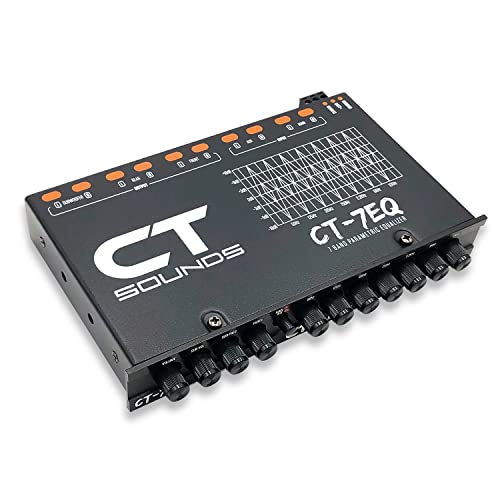
The CT-7EQ provides seven frequency bands from 20 Hz to 20 kHz, with a 50 Hz, 125 Hz, 315 Hz, 750 Hz, 2.2 kHz, and 12 kHz parametric layout. This compact 1/2-DIN solution is ideal for vehicles with tight dash space where precise tonal shaping is needed. Best for listeners who want targeted control without a DSP suite, and for setups where front-channel or front/subwoofer balance is paramount.
Who it’s best for: drivers seeking precise, band-limited adjustments in a small chassis. Why chosen: straightforward 7-band parametric control makes tuning faster and more predictable. Caution: lacks advanced crossovers or DSP sequencing found in higher-end units.
7-Band Car Audio Equalizer by Lnrueg

This 7-band graphic equalizer covers 63 Hz to 12 kHz with adjustable Hz and a dedicated subwoofer control (30 Hz–120 Hz). It also offers a complete set of front, rear, and sub adjustments, making it versatile for multi-speaker configurations. Best for enthusiasts who want flexible per-band tweaking and dedicated sub tuning in a mid-range price point.
Who it’s best for: multi-channel setups needing broad per-band control. Why chosen: flexible Hz tuning plus sub frequency control. Caution: some users may prefer more than one input source option for complex installs.
Clarion EQS755V 7-Band Graphic Equalizer

The Clarion EQS755V offers a 7-band graphic EQ (50 Hz, 125 Hz, 315 Hz, 750 Hz, 2.2 kHz, 6 kHz, 16 kHz) with six-channel/8-volt RCA outputs for front, rear, and sub. It adds independent master volume and subwoofer level with fader and selectable 12 dB low-pass filters (60 Hz or 90 Hz). Best for customers who want clear, musical tuning plus robust output routing for a multi-zone system.
Who it’s best for: users needing flexible output configuration and independent level control. Why chosen: strong feature set for front/rear/sub balance. Caution: built-in features are solid but may require compatible head unit or amplifier pairing for full effect.
Clarion EQS755 7-Band Graphic Equalizer (Black)
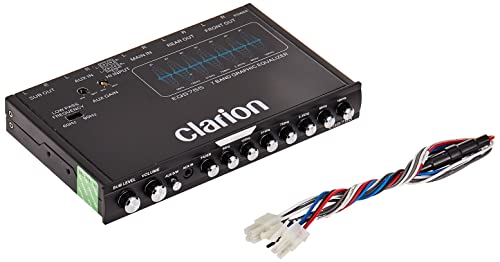
This version mirrors the features of the white variant, offering a 1/2-DIN chassis, 6-channel outputs, and 7-band graphic equalization with a built-in low-pass filter. It includes front auxiliary input plus two-channel RCA auxiliary inputs and independent master/subwoofer control with fader. Best for installs that value color-and-function synergy with clear blue illumination.
Who it’s best for: color-coordinated dashboards and straightforward signal routing. Why chosen: compact, flexible, and consistent with popular Clarion ecosystems. Caution: appearance varies by color option; ensure your dash aesthetic matches.
Taramp’s Pro 2.4S DSP Crossover

The Taramp’s Pro 2.4S combines a DSP crossover with a 15-band graphic equalizer (ISO center frequencies) and a two-input/two-channel in and four-channel out configuration. Its adjustable crossovers and presets support nuanced system tuning for complex installs. Best for users seeking digital precision and advanced routing for multi-amp systems.
Who it’s best for: enthusiasts building a detailed, DSP-driven setup. Why chosen: extensive crossover options and 2-in/4-out flexibility. Caution: DSP-focused devices require compatible software or interface for full use.
Taramps TEQ 7.4 Graphic Equalizer

The TEQ 7.4 offers a 7-band graphic EQ with two inputs (MAIN and AUX) and three outputs (FRONT, REAR, SUB), plus adjustable subwoofer gain and a cross-mix of signals. It supports a wide 6 Hz–55 kHz range and claims a high dynamic range. Best for systems that need straightforward, multi-channel equalization with clear subcontrol and a simple hookup path.
Who it’s best for: users prioritizing easy wiring and flexible channel management. Why chosen: balanced feature set for room-to-room sound shaping. Caution: might be basic compared with DSP-based options for very complex acoustics.
Audiopipe 9 Band Graphic Equalizer
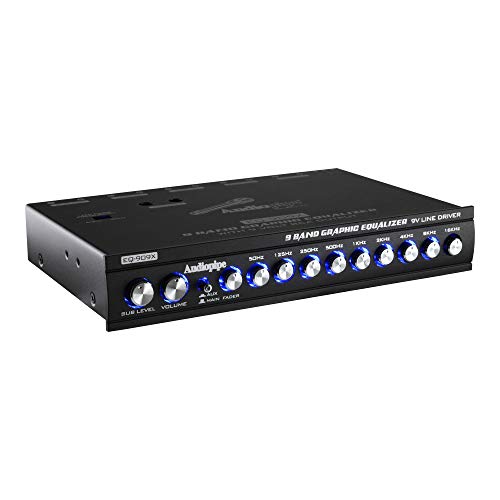
The Audiopipe 9-band graphic equalizer provides a higher-band count for detailed tone shaping and includes a 9 V line driver and subwoofer frequency adjustments. Its half-DIN chassis promotes easy installation in many compact dashboards. Best for budget-conscious buyers who still want substantial control over the sound profile.
Who it’s best for: budget builds needing more bands without complexity. Why chosen: higher band count for more precise adjustments at a lower price. Caution: may require additional components to maximize performance in high-demand systems.
Buying Guide: How To Choose The Right Car Equalizer
- Channel count and form factor: If space is limited, choose a 1/2-DIN unit or a compact DSP crossover to fit dash contours.
- Band count and type: Graphic vs. parametric; graphic offers broad tone shaping with fixed center frequencies, while parametric channels provide precise center frequency control and Q factors for surgical adjustments.
- Outputs and inputs: Ensure compatibility with your head unit, amplifiers, and subwoofers. Independent master and sub controls can simplify tuning in multi-amp systems.
- DSP features: For complex setups, DSP crossovers, time alignment, or ISO-standard frequency centers enable deeper customization but may require software access and learning curve.
- Ease of installation: Some units offer plug-and-play wiring, while others require additional adapters or harnesses. Plan wiring routes to minimize noise.
- Aesthetics and build: Blue illumination, button layout, and chassis color can affect visibility and dashboard integration.
FAQ
- What is the main difference between graphic and parametric equalizers?
– Graphic EQs offer fixed center frequencies with fixed bands, while parametric EQs provide adjustable center frequencies and bandwidth for precise tuning. - Do I need a DSP with an equalizer?
– A DSP enhances crossovers and timing alignment; it’s helpful for complex multi-amp systems but not strictly necessary for simpler setups. - Is a higher number of bands always better?
– Not necessarily. More bands allow finer control, but the quality of the controls and the overall system tuning matter more than the count alone. - Can an equalizer improve stock car audio?
– Yes, it can improve tonal balance, reduce harshness, and tailor bass response when paired with a suitable amplifier and speakers. - What should I consider for installation space?
– Check Chassis size (DIN/half-DIN), depth, and wiring access behind the head unit to ensure a clean fit.