Best Portable Battery-Powered Radios for Any Situation
Looking for a compact, reliable portable radio that runs on batteries and keeps you connected? This guide highlights five top options that fit common needs—from emergency prep to everyday listening. Each pick favors strong reception, easy operation, and flexible power options. The buyers below are best for: outdoor adventurers, seniors needing simple controls, emergency-prepared households, and users who want clear audio with a big dial. A quick product comparison follows to help you decide fast.
| Product | Brand | Power Options | Best For |
|---|---|---|---|
| PRUNUS J-166 Portable Radio | PRUNUS | Battery Powered, Clip & Lanyard | Travelers and gym-goers who want ultra-portable tuning |
| Portable AM/FM Transistor Radio with Loud Speaker (Model BJL-671) | BAIJIALI | Battery or USB Powered | Home use and outdoor activities with strong sound |
| DreamSky AM FM Portable Radio (B088ZQ5DYQ) | DreamSky | AC Plug or 4 AA Batteries | Senior-friendly listening with easy tuning |
| Jazmm AM FM Portable Radio | Jazmm | AC Power or 4x DC Batteries | Retro-style listening with long-range reception |
| PRUNUS J03 AM FM Radio | PRUNUS | AC Plug or AA Batteries | On-the-go listening with large speaker and knobs |
PRUNUS J-166 Portable Radio
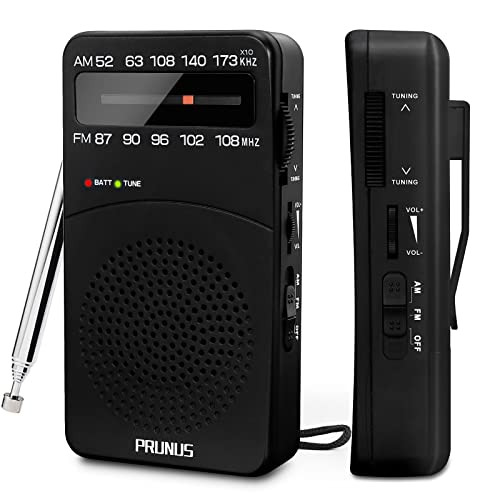
Features include a compact design, back clip, and lanyard for hands-free carrying. The 2.7 x 5 x 1.1 inch body weighs about 4.2 ounces (battery not included), making it easy to stash in a pocket, bag, or emergency kit. The radio emphasizes simple operation with three controls—tuning knob, volume knob, and band/power switch—and a tuning indicator to show available stations. It supports AM and FM with a 16.5-inch long, 360-degree adjustable antenna and a DSP chip to enhance signal reception. Best for: travelers, hikers, or anyone who wants a tiny, dependable radio for quick station access in diverse locations. Limitation: tiny size may limit bass presence and long-range audio depth.
Portable AM/FM Transistor Radio (Model BJL-671)

This model offers AM/FM plus shortwave (SW) reception, with a DSP anti-jamming chip to boost sensitivity. It supports 88-108 MHz for FM, 530-1710 kHz for AM, and 2.8-22 MHz for SW, with a telescopic antenna for stronger signals. A clear 5W speaker provides louder, crisper sound. The unit is simple to operate with clearly labeled AM/FM/SW controls, a large channel tuner, and volume controls. Best for: home use during storms or travel where easy channel switching and robust reception matter. Caution: SW reception may vary by locale and requires tuning patience in some areas.
DreamSky AM FM Portable Radio (B088ZQ5DYQ)

DreamSky emphasizes strong reception and loud, clear sound from a large speaker, with an earphone jack for private listening. It’s designed for ease of use with a large analog dial for quick tuning to favorite stations—ideal for seniors or first-time users. Power options include an AC adapter or four AA batteries. Best for: indoor use, outdoor activities, and scenarios where simple operation is prioritized. Limitation: battery-powered operation may require frequent battery changes on extended trips.
Jazmm AM/FM Portable Radio
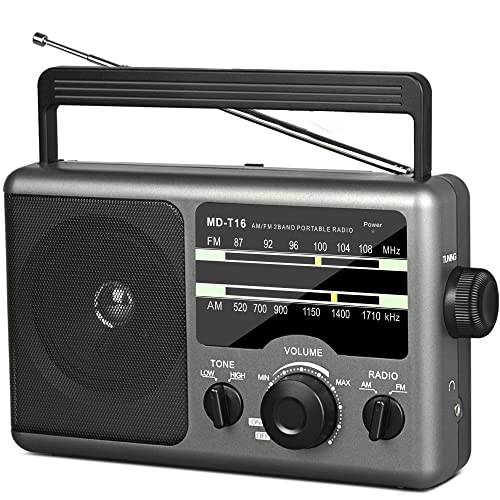
Jazmm’s model emphasizes a classic analogue tuner and strong reception with a long antenna. It features two tone modes (high/low) to tailor sound for different environments, plus support for AC power and four DC batteries for emergency use. Best for: fans of retro radio design who want robust AM/FM reception and flexible powering. Limitation: battery life may vary with tone setting and volume, so plan for spare batteries in longer outings.
PRUNUS J03 AM FM Radio

PRUNUS J03 adds flexibility with both AC power and four AA batteries, plus a foldable handle for on-the-go listening. It features a large speaker and large tuning knobs for easier operation, making it a practical gift for seniors or everyday users who value simple controls and strong audio. Best for: daily use at home and on outdoor trips where quick dial access and portability matter. Limitation: larger size than ultra-compact models may reduce pocket-fit convenience.
Buying Guide
- Power options: Decide between always-on AC power versus battery independence. Look for models offering both, so you can switch to battery during outages or outdoor use.
- Reception and tuners: If you travel or live in fringe areas, prioritize radios with DSP or anti-jamming tech, and include additional bands like SW for broader station access.
- Ease of use: For seniors or beginners, choose radios with large dials, clear labeling, and straightforward one-button switching between AM/FM.
- Portability: Small, clip-able designs are ideal for pockets, bags, or emergency kits, while larger models with big speakers suit home listening.
- Sound quality: A larger speaker and a good antenna improve clarity and volume. If quiet listening is needed, check for a headphone jack and private listening options.
- Durability and extras: Consider rugged finishes, backlit displays for night use, and feature sets like NOAA alert radios for emergencies.
Frequently Asked Questions
- What makes a portable radio suitable for emergencies?
Look for models with long battery life, multiple power sources, and NOAA weather alert capability. - Is SW reception necessary for daily listening?
Not for everyone. SW adds extra stations in some areas, but many users prioritize AM/FM with strong local signals. - Which features help seniors most?
Large dials, simple controls, clear labeling, and a readable display are especially helpful. - Can these radios double as music players?
Many offer clear AM/FM airwave reception; you’ll need to pair with external devices if you want digital streaming. - How important is the antenna type?
A long, adjustable telescopic antenna typically improves reception, especially in weak-signal zones. - Do these radios support USB charging?
Some models offer USB power or battery options; verify each product’s exact power input if USB charging matters.