Best Speaker Wire Red and Black Cords for Clearer Sound and Easy Install
Looking for reliable speaker wire that’s color-coded red and black for quick, error-free wiring? This guide highlights five practical options that balance flexibility, durability, and cost. Each pick is suitable for home audio, car audio, LED lighting, and other low-voltage DC applications. Whether you’re wiring bookshelf speakers, car audio, or LED strips, these cords help you keep polarity correct and installations neat.
| Product | |||
|---|---|---|---|
| VIABRICO 10 Gauge Wire | 10 AWG | 100 ft per color | Heavy-duty speaker runs, car or home systems needing minimal resistance |
| Nilight 12 AWG Copper Clad Aluminum | 12 AWG | 100 ft total (50 ft red + 50 ft black) | Robust, versatile for car and home audio |
| Energeaster 14 Gauge Wire | 14 AWG | 100 ft per color | Balanced flexibility and affordability for longer runs |
| GOSDENG 14 Gauge Wire | 14 AWG | 100 ft per color | Good value with strong PVC insulation for tight spaces |
| Nilight 12 AWG 100 ft | 12 AWG | 100 ft total (colored red/black) | Clear polarity distinction for larger systems |
VIABRICO 10 Gauge Wire 100FT
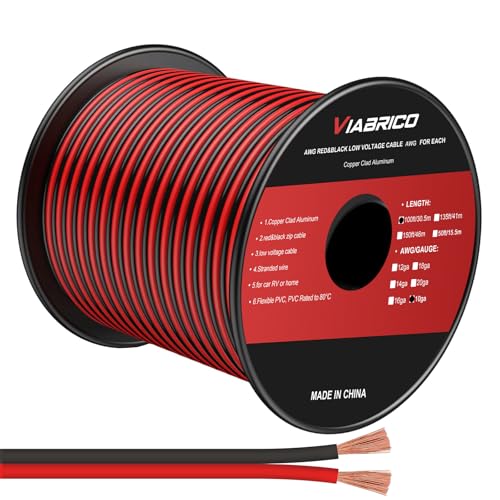
Product overview: The VIABRICO 10/2 gauge red and black speaker wire is designed for low-voltage DC circuits, making it suitable for home and car speakers, LED strips, and automotive applications. This CCA (copper-clad aluminum) wire provides lighter weight and flexibility while aiming to keep cost low. Each spool includes 100 feet of red and 100 feet of black conductors.
- Best for heavy speaker runs or installations where lower total weight is helpful.
- Better for outdoor or vehicle use due to flexible CCA composition.
- Limit: CCA is not copper; performance differences may appear in extreme conditions.
Nilight 50FT 16AWG Red Black CCA Wire

Product overview: This 16-gauge CCA wire provides a balance between flexibility and economy, featuring a rugged PVC jacket and color-coded two-conductor design (50 ft red, 50 ft black). It’s suitable for 12V/24V DC systems, including car audio and LED projects.
- Best for projects needing easy polarity differentiation and moderate runs.
- Better for car audio or lighting setups where weight matters less than ease of installation.
- Limit: Slightly thicker than thinner gauges, which may affect tight spaces.
GOSDENG 14 Gauge Wire 100FT

Product overview: The GOSDENG 14 AWG two-conductor wire is designed for low-voltage wiring in speakers, LED lighting, and automotive circuits. It uses a CCA core with a durable PVC jacket suitable for indoor and some outdoor installations.
- Best for longer runs where flexibility and cost matter.
- Better for LED strips and small speaker installations where tighter bends are needed.
- Limit: CCA may perform differently in extreme heat environments compared to pure copper.
TYUMEN 40FT 18 Gauge Wire

Product overview: TYUMEN offers true 18 AWG two-color red/black wire with 40 feet, designed for LED strips and light-duty speaker connections. It’s noted for damp resistance and easy peel-and-cut usability for compact installations.
- Best for tight spaces and lightweight speaker connections.
- Better for LED lighting or small audio projects where a slim profile helps.
- Limit: Higher resistance compared to thicker gauges may affect longer speaker runs.
Energeaster 14 Gauge Wire 100FT

Product overview: Energeaster 14 AWG two-conductor wire comes with a high-quality PVC jacket, offering good conductivity and flame retardant properties. Suitable for a wide range of low-voltage applications including LED lighting, automotive, and home electronics.
- Best for general-purpose low-voltage wiring and longer runs where flexibility matters.
- Better for mixed-use projects with LED strips and speakers.
- Limit: CCA wire may not match the thermal performance of pure copper in extreme conditions.
Buying Guide: Key Considerations For Red And Black Speaker Cords
- Conductor material: Copper clad aluminum (CCA) is lighter and cheaper but may have higher resistance than pure copper. For long runs or high-power speakers, thicker gauges (like 10–12 AWG) can reduce voltage drop.
- Gauge and length: Thicker gauges (lower AWG) handle more current with less resistance. Match gauge to your speaker impedance and distance. Longer runs often justify thicker wire to minimize loss.
- Two-conductor color coding: Red/black jackets help avoid polarity errors. Ensure jackets are clearly color-coded and labeled to prevent miswiring.
- Insulation and jacket: PVC jackets with good flexibility resist aging and moisture. For outdoor or automotive use, look for UV-resistant and rugged jackets.
- Flexibility and bending radius: For installations behind walls or in dashboards, flexible stranded designs and tighter bending radii ease routing.
- Voltage rating: Ensure compatibility with expected DC voltages (commonly 12V/24V in audio and LED systems).
- Cost vs performance: CCA offers lower cost and lighter weight, which is suitable for many consumer installations. For critical, high-current audio runs, consider thicker copper or specialized speaker wire.
FAQ
- What gauge should I use for home stereo speakers?
- Is copper wire better than copper-clad aluminum for speakers?
- Can I mix different gauges in a multi-speaker setup?
- How important is color-coding on speaker wire?
- What’s the best way to cut speaker wire without fraying?
- Is there a heat rating I should look for?
For typical home stereo runs under 50 feet, 16–14 AWG is common. For longer runs or higher-power speakers, 12–10 AWG provides lower resistance.
Pure copper offers the lowest resistance, but copper-clad aluminum is lighter and cheaper. Choose copper for longest runs or high-power setups; choose CCA for budget-friendly, short-to-moderate runs.
Mixing gauges is possible but not ideal. Try to keep the majority of runs at a consistent gauge to minimize mismatch and maintain even performance.
Color-coded red and black helps prevent polarity mistakes, which can degrade sound quality. Always connect red to positive and black to negative on each speaker.
Use proper wire strippers or a sharp knife with care, ensuring a clean cut. If possible, strip only the insulation needed and cap unused conductors to prevent shorts.
Look for PVC jackets rated for typical room temperatures or outdoor conditions. Avoid wiring that may overheat in your installation environment.