Best Single-Channel Audio Interfaces for Clear, Studio-Quality Recordings
Choosing the right single-channel audio interface helps you capture vocals and instruments with clarity and low latency. This guide highlights top options ideal for podcasters, guitarists, and solo content creators who need straightforward, reliable USB interfaces. The selections emphasize pre-amps, dynamic range, and easy software bundles. The best pick depends on whether you need auto gain, studio-grade converters, or a compact setup for travel.
| Product | Why It’s Notable |
|---|---|
| Focusrite Scarlett Solo 3rd Gen | Excellent pre-amps, Air mode for brighter recordings, strong converters up to 24-bit/192kHz |
| Focusrite Vocaster One | Auto Gain and on-device controls ideal for solo podcasting |
| Focusrite Scarlett Solo 4th Gen | New generation pre-amps and Air mode with superb dynamic range |
| Mackie Onyx Artist 1X2 | Professional Onyx preamps, solid build, versatile inputs |
| M-Audio M-Track Solo | Simple, compact, solid 48 kHz/24-bit recording with XLR and instrument input |
Focusrite Scarlett Solo 3rd Gen USB Interface

The Focusrite Scarlett Solo 3rd Gen is designed for solo performers who need studio-grade sound without a complicated setup. It features two high-headroom inputs for guitar or bass, plus a superb microphone pre‑amp and Gain Halos to prevent clipping. Air mode enhances acoustic instruments and vocals, delivering brighter, more open recordings. Its converters support up to 24-bit/192kHz for high-fidelity playback and tracking. Best for guitarists or vocalists who want a compact, reliable interface for demos or podcasts. Caution: The Solo 3rd Gen has a single XLR input; if you need robust multi-mic setups, consider a two-input model.
Focusrite Vocaster One — Podcasting Interface

The Focusrite Vocaster One is tailored for podcast creators who record solo. It provides Auto Gain to set levels automatically, a high-gain mic preamp (over 70dB), and easy-on-device controls for mute and enhance features. This interface emphasizes straightforward, broadcast-quality sound with minimal setup, making it ideal for solo podcasters who want quick, consistent results. Caution: Fewer traditional input options compared to larger interfaces; great for spoken-word but limited for complex music sessions.
Focusrite Scarlett Solo 4th Gen

The Scarlett Solo 4th Gen brings a refreshed design with studio-grade converters and an improved Air mode for vocal and guitar tracks. It maintains the single-input XLR and one instrument input, making it a strong choice for solo artists who want the newest Scarlett features and a consistent workflow across generations. Best for musicians who need reliable, studio-quality recording on a portable setup. Caution: Limited to one mic input for multi-track projects; consider a two-channel model for more simultaneous sources.
Mackie Onyx Artist 1X2 USB Interface

The Mackie Onyx Artist 1X2 offers professional Onyx mic preamps with high fidelity and dynamic range. It includes 2 inputs (one XLR and one instrument/line), plus 48V phantom power for condenser mics. This interface is well-suited for solo vocalists or guitarists who require reliable preamps and a sturdy, portable unit. Caution: The feature set is solid but may require familiarity with Mackie’s software for optimal monitoring and routing.
M-Audio M-Track Solo
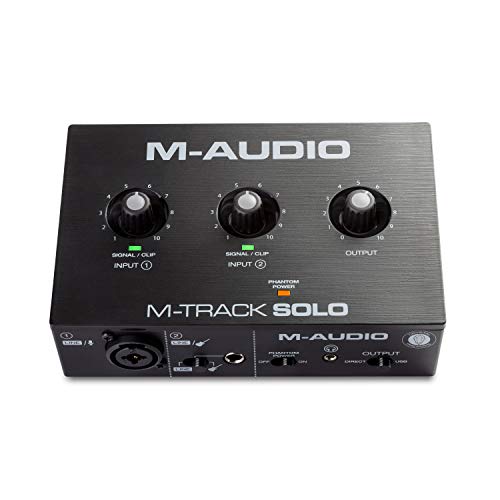
The M-Audio M-Track Solo provides a simple, compact interface with a single mic XLR input and a separate instrument input. It supports 48 kHz/24-bit recording and includes a software bundle for those starting out. Best for beginners or travelers who want a lightweight solution for streaming, podcasting, or basic music recording. Caution: For deeper production work, the limited input count may require an upgrade to a two-channel model.
Buying Guide: Key Purchase Considerations
- Input and output needs: Do you need only one mic input or two, plus instrument support? If you record solo with guitar, a single mic input plus instrument input is often enough.
- Preamp quality and headroom: Interfaces with high-headroom mic pre-amps reduce clipping and noise. Look for models advertising “Air” or enhanced vocal/guitar presence.
- Conversion quality and sample rate: Higher bit depth and sample rate (e.g., 24-bit/192kHz) yield clearer, more accurate recordings, especially for music and podcasts with dynamic ranges.
- Gain management and monitoring: Auto Gain (as in Vocaster) can simplify setups. Direct monitoring helps avoid latency during recording.
- Software and compatibility: Ensure the interface includes compatible software bundles and works with your OS and DAW of choice.
- Portability and build: If travel is common, prioritize compact form factors with solid builds and USB bus-powered operation.
- Future-proofing: Consider if you might expand to multi-mic or multi-instrument setups; a two-channel model may be more scalable in the long run.
FAQ
- What is a single-channel audio interface best for? It’s ideal for solo vocal work, podcasting, and one-instrument recording where simplicity and high-quality preamps matter.
- Do I need phantom power? If you plan to use condenser microphones, yes. Look for interfaces with 48V phantom power.
- Is auto gain useful for beginners? Yes. Auto gain helps set levels quickly, especially for busy recording sessions or live streaming.
- Can I use these interfaces for streaming? Most support direct monitoring and low-latency monitoring, making them suitable for streaming and live performances.
- Do I need the latest generation of Scarlett? The latest generation offers improvements in pre-amps and Air mode, but older gens remain solid, depending on your budget and needs.
- What about software bundles? Many interfaces include a bundle of DAW software and plug-ins, which can be valuable for starting projects quickly.