Best RCA Adapters for Stock Radios: Upgrade Your Car Audio With Confidence
The top question is: which RCA adapter best connects a factory radio to an external amplifier or subwoofer? This guide answers with practical, objective picks for American buyers seeking reliable line-out converters. Each product is chosen for compatibility with stock radios and ease of installation, plus clear reasons for who should buy. If you want stronger bass, cleaner highs, or a simple upgrade path, you’ll find a suitable option here. The following sections highlight five strong candidates and how they fit common installation needs.
| Product | Best For | Key Benefit |
|---|---|---|
| Kicker KISLOC2 | Owners needing remote turn-on and RCA conversion | Remotely turn on amplifier; true sonic accuracy |
| Skar Audio SKAR2CH-LOC | OEM and aftermarket radios, versatile wiring | Flat 20Hz–20kHz range at all levels |
| NuIth Car Audio Converter | Simple bass/amp upgraders | High-to-low RCA conversion with gain adjustment |
| PNGKNYOCN Hi‑Lo Converter | Noise-free signal for aftermarket amps | Low-noise transfer with 50W input |
| Scosche LOC2SL | Subwoofer-focused upgrades | Flexible installation, crisp sound for subs |
Kicker KISLOC2 K-Series Stereo Line-Output Converter

The KISLOC2 converts factory speaker wires into both RCA output and a remote turn-on signal. It supports up to 55 watts input and provides a 12-volt remote wire via DC offset, enabling a clean, reliable amp start-up. This unit is best for buyers who want a compact, sonically neutral converter with an integrated remote feature and straightforward installation.
Best for: Players upgrading stock radios with a separate amplifier who value a simple, all-in-one wiring solution.
Why selected: Combines line-out and remote turn-on in a small footprint, preserving original sound fidelity at various volumes.
Caution: Ensure your head unit’s output does not exceed 55 watts to avoid clipping or distortion.
Skar Audio SKAR2CH-LOC 2-Channel LOC

The SKAR2CH-LOC accepts up to 55 watts and is designed for compatibility with OEM, aftermarket, and smart radios. It preserves a flat 20Hz–20kHz range across volumes, making it suitable for listeners seeking balanced, consistent sound from factory systems upgraded with aftermarket amps.
Best for: Users who want broad compatibility across radio types and a flat frequency response.
Why selected: Flexible across radio platforms and maintains full-range clarity when driving a new amplifier.
Caution: The device relies on proper grounding and clean power; improper installation can introduce noise.
NuIth Car Audio Speaker Wire to RCA Converter

The NuIth converter transforms speaker-wire outputs to RCA signals, enabling two-channel or mono amplifier and subwoofer connections. Its gain-adjustment feature helps tailor bass response without stopping to readjust the amplifier manually while driving.
Best for: Drivers adding a subwoofer or additional amp who want adjustable bass control directly at the converter.
Why selected: Built-in gain control provides practical fine-tuning on the go, reducing setup time.
Caution: 12-volt system limits mean performance depends on compatible amplifiers and clean wiring.
PNGKNYOCN Car Stereo Hi‑Lo Converter
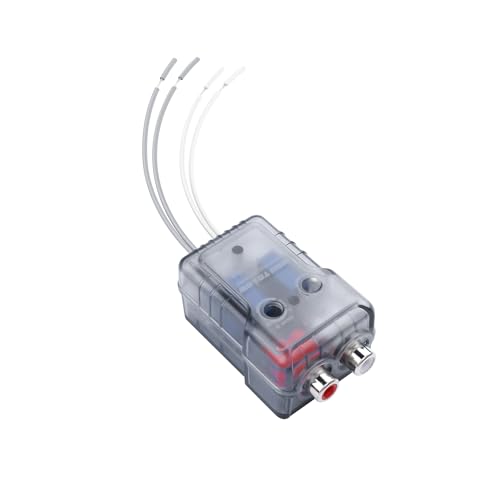
The PNGKNYOCN Hi-Low Converter specializes in converting factory speaker-level signals to RCA line level, suitable for integrating aftermarket amplifiers and subwoofers. It emphasizes minimal signal interference and a stable low-noise output, with an input tolerance up to 50 watts.
Best for: People aiming for clean, quiet signal paths when adding an amp in a factory-installed system.
Why selected: Strong emphasis on noise reduction and compatibility with standard radios and smart radios.
Caution: Higher-wower inputs may require careful mounting to avoid interference.
Scosche LOC2SL Line Output Converter

The LOC2SL is a versatile high-to-low RCA converter designed to bridge factory optics with aftermarket amplification. It aims for a seamless integration that preserves sound quality while boosting subwoofer performance. It’s presented as an easily installed option for varied car audio systems.
Best for: Upgrading a factory system with a subwoofer or external amp without rewiring extensively.
Why selected: Noted for flexible installation and clear subwoofer enhancement with minimal signal loss.
Caution: Some installations may require additional wiring harnesses or adapters for perfect fit in certain vehicles.
Buying Guide: Key Purchase Considerations
- What is your primary goal? Subwoofer upgrade, full-range amplifier, or easier integration with OEM radios?
- What radio type is in your vehicle (OEM, aftermarket, or smart radio)? Choose a converter with broad compatibility.
- How much power can your head unit supply safely? Look for units that tolerate up to 50-55 watts to avoid distortion.
- Do you need a remote turn-on feature? If yes, select a model with this built-in capability.
- Is in-vehicle noise a concern? Favor converters that specify low-noise performance and good shielding.
- Is adjustable gain important? For bass control on the fly, prefer models with gain adjustment.
- Installation complexity: Some units are plug-and-play; others require additional wiring or adapters.
FAQ
- Q: Do RCA converters degrade sound quality? A: Quality-constructor units are designed to minimize signal loss and preserve fidelity when used within their rated input range.
- Q: Can I use these with a factory radio and a subwoofer? A: Yes, most models convert speaker-level output to RCA, enabling an external amplifier or subwoofer.
- Q: Do I need a remote turn-on wire? A: Remote turn-on is helpful to automatically power an amplifier; many models include it or support DC offset triggering.
- Q: Will these work with all vehicles? A: They are designed for broad compatibility, but vehicle-specific harnesses may be required for a clean install.
- Q: Is higher wattage input always better? A: Not necessarily; ensure your radio’s output matches the converter’s rating to avoid clipping.
- Q: How do I choose between high-to-low and line-level outputs? A: Line-level outputs are typically preferred when adding an amp; high-to-low may be used if the source level is too high for RCA inputs.