

Open-Back vs. Closed-Back Headphones: What Changes in Real Life
Choose headphones around your room, your neighbors, and your day—not an assumption that one ear-cup design always sounds better.
In this guide
- Start with the job you need headphones to do
- What happens to the sound around you?
- Leakage matters when another person is nearby
- Think about microphones and nearby gear
- Give comfort a proper listening session
- Compare sound without making loudness the winner
- Decide whether this is also your travel pair
- Make the choice with three plain questions
Start with the job you need headphones to do 1
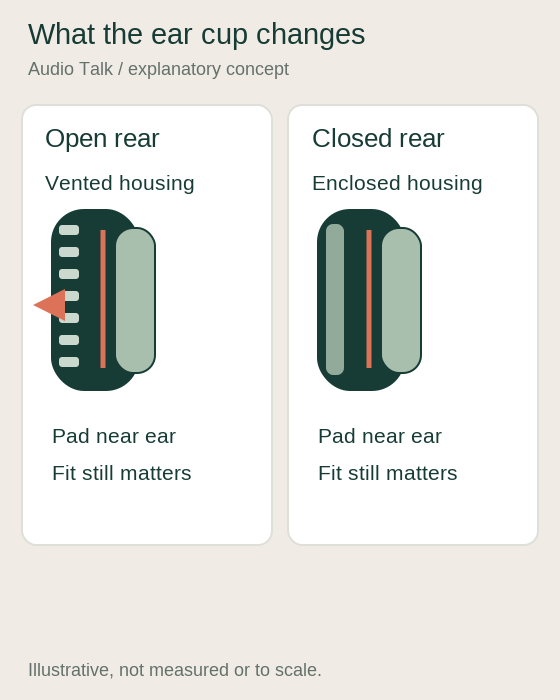
Open-back headphones leave the rear of the ear cups acoustically open, while closed-back headphones use an enclosed rear housing. That difference changes how you share sound with the room, but it doesn't decide whether a particular pair will sound good to you.
Sennheiser describes both designs as capable of accurate sound and makes listening circumstances part of the choice. Begin with where you'll use the headphones, how quiet that place is, and whether anyone nearby needs you to keep your music to yourself.
Picture two ordinary evenings: one at a private desk and one beside a partner reading on the couch. The same music and volume can create very different practical problems, so write down your usual situation before comparing prices or specifications.
What happens to the sound around you? 1
An open ear cup gives sound a route between the headphone and the surrounding space. Expect less separation from the room than you would normally get from a well-fitting closed design, rather than assuming an open pair will provide a quiet bubble.
At home, that might mean noticing the air conditioner or a conversation while you're listening. If those sounds make you keep nudging the volume up, the room is asking more of the headphone than a quiet product demonstration would reveal.
A closed enclosure can help reduce the exchange of sound, but the result depends on the whole headphone and its fit. Ear pads that don't sit evenly around your ears can leave gaps, so judge the actual pair instead of trusting the category name alone.
For an informal check, pause the music and listen to the room with the headphones on. This won't measure isolation, but it can tell you whether your everyday surroundings are likely to intrude enough to bother you.
Think about microphones and nearby gear
A desk isn't automatically a private listening space. You might have a roommate's desk across the room, a microphone close to your head, or a work routine that switches between music, calls, and quiet concentration.
If you record speech, make a short sample using your normal microphone position and headphone volume. Listen for unwanted playback in that recording, and compare a lower level or a different headphone before assuming software will remove it cleanly.
Also separate the ear-cup design from the connection type. Open and closed describe the acoustic housing; wired, Bluetooth, USB, and a built-in microphone describe other parts of the product, each of which deserves its own compatibility check.
For example, a wired open-back headphone without a microphone can work with a separate desk microphone. It still needs an audio output that suits its plug and practical volume requirements, so plan the complete setup instead of buying from one headline feature.
Give comfort a proper listening session
Try the headphones while sitting in your usual position, with your glasses on if you wear them. Check the headband, pressure around your ears, and whether the cable or controls become annoying when you turn toward your screen.
A brief store try-on can reveal a poor fit, but it can't tell you everything about an evening of listening. Use the retailer's actual return policy to decide how you'll evaluate comfort at home, and keep the packaging intact while you're still deciding.
Don't infer weight, clamping force, or pad comfort from an open or closed label. Compare the manufacturer's specifications and the actual construction, then give your own head the final vote rather than assuming a design category guarantees comfort.
Take breaks during the comparison and keep the listening level modest. If pressure or irritation develops, stop the session and reassess the fit; an expensive headphone isn't something you need to endure to prove you've chosen correctly.
Compare sound without making loudness the winner
Use a few familiar recordings with voices, bass lines, and instruments you can follow easily. You don't need a special collection of demonstration tracks, and unfamiliar recordings can make it harder to explain what changed between the two headphones.
Set both pairs to a similar perceived listening level before making a preference judgment. This is a practical comparison rather than a calibrated measurement, so write down that limitation and resist treating a slightly louder presentation as proof of higher quality.
Listen for the things that matter during your normal day: whether speech is easy to follow, whether the balance feels enjoyable, and whether an element becomes tiring. Those observations are more actionable than trying to reproduce somebody else's description of a soundstage.
Try one short passage, switch, and then repeat it rather than changing headphones halfway through a long playlist. A simple note such as “voice easier to follow at this level” gives you something concrete to reconsider the following day.
Decide whether this is also your travel pair 2
A headphone that suits a quiet desk may be an awkward choice on public transportation. Think about the size of the case, the cable, the noise around you, and whether you'll have a safe place to store it when you arrive.
Closed-back doesn't automatically mean active noise cancellation, and neither label alone establishes hearing-protection performance. NIOSH distinguishes ordinary noise-canceling headphones from hearing protectors with an appropriate rating, so don't choose everyday listening gear as a substitute for workplace protection.
For walking or travel, consider how you'll stay aware of announcements and your surroundings. An open design may let more ambient sound through, but it doesn't guarantee awareness once music is playing, especially if you turn the volume up.
If one pair has to cover both home and travel, give the less forgiving situation more weight. You may prefer a practical closed design for that mixed routine, then revisit a dedicated home pair only if you still have a specific reason.
Make the choice with three plain questions
Start by asking whether your space can tolerate sound leakage and whether the room is quiet enough for comfortable listening. Then check whether the exact headphone fits your head, your connection, and the way you use your gear.
If leakage is fine and the room is calm, put open-back models on your shortlist alongside any closed pairs you like. If the room is shared or noisy, start by comparing suitable closed models and check their real isolation and comfort.
Neither answer requires you to declare a winner for everyone. Keep the pair that makes your ordinary listening routine easier, and use a clear return plan if you can't settle those practical questions before buying.
You can even keep a one-page comparison with columns for room noise, leakage, comfort, connections, and preferred recordings. Filling it in with your own observations gives you a better reason for the purchase than repeating a claim that one construction is always more “audiophile.”
Sources & how this guide was prepared
Audio Talk Editorial checked these primary sources on October 14, 2026. This is a research-based guide with original practical examples; it does not report our own equipment tests.
Manufacturer instructions for your exact model take priority. Read our editorial method · Photo and illustration credits