

Component vs. Coaxial Car Speakers: What Actually Changes
The main difference is where the drivers sit and how they connect. Check the vehicle’s actual speaker locations and factory signal before choosing a component or coaxial set.
In this guide
- Understand the physical difference first
- A coaxial assembly keeps the drivers together
- A component set adds a location decision
- Find out how the frequencies are divided
- Understand the factory system before choosing the input
- Match the electrical requirements as carefully as the dimensions
- Include the installation parts and work in the comparison
- Choose the design that fits the system you can actually build
Understand the physical difference first 1
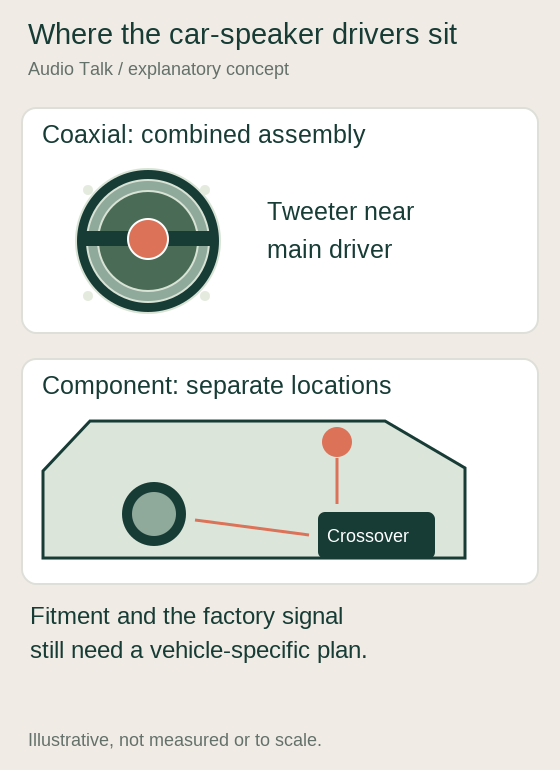
A coaxial car speaker combines the main driver and a higher-frequency driver in one assembly, while a component set separates those parts for different mounting locations. That changes the installation plan before it tells you anything about which exact product you'll prefer hearing.
JBL's Club documentation shows both kinds of system, with separate woofers, tweeters, and crossovers supplied for its listed component sets. Use the exact product's contents and instructions rather than assuming every box contains the same mounting hardware or connection arrangement.
Start with the car's year, model, trim, and audio package, then identify the speaker locations you intend to use. A general recommendation for “six-inch car speakers” is not enough to establish that the assembly fits or connects correctly in your vehicle.
A coaxial assembly keeps the drivers together
A coaxial speaker can be a practical option when the replacement location is intended to hold a combined assembly. The high-frequency driver stays with the main driver, which can reduce the need to find and mount an additional separate tweeter.
That doesn't mean the installation is automatically plug-and-play or that the speaker has no frequency-dividing components. Check the exact design and required adapters, because keeping the drivers together doesn't remove the need for proper filtering and electrical compatibility.
Measure or obtain verified fit information for the actual location, including depth and clearance around the moving window or trim. A nominal diameter describes only part of the assembly, so a speaker can match the headline size while still interfering with the door.
If the factory system already has a separate tweeter, ask how that location and its signal will be handled in the proposed coaxial replacement. Leaving another driver connected without a defined integration plan can change the result in ways the new speaker's brochure doesn't describe.
A component set adds a location decision 2
A component arrangement lets the woofer and tweeter use separate mounting positions, within the constraints of the vehicle and product. JBL's Club 605CSQ page describes tweeter mounting accessories, providing an example of the extra physical decisions a component set can involve.
Check whether the original tweeter location can accept the new unit and whether the supplied hardware suits the proposed installation. A component set offering mounting options isn't proof that every dashboard, pillar, or door location is appropriate in your car.
The installer also needs a place for any external crossover included in the system, with suitable mounting and cable routing. That extra item deserves space and access in the plan rather than being left loose because it doesn't appear in the speaker's nominal-size label.
Treat the position as a setup choice to evaluate, not a guarantee of a better soundstage. The exact drivers, vehicle interior, signal processing, and listening positions all matter, so the category alone isn't a measured performance ranking.
Find out how the frequencies are divided 1
A component set may use a supplied passive crossover to divide a suitable input between its drivers. Other arrangements can use separate amplifier or DSP channels with the documented filtering, so identify the actual design before deciding which factory wires should feed it.
Don't assume a coaxial system lacks a crossover just because there isn't a separate box beside it. Read its manual and specifications for the integrated arrangement, and keep the comparison focused on the complete design rather than a count of visible accessories.
If a supplied crossover has a documented tweeter-level adjustment, follow the product instructions and begin with the recommended setting. A level option is a setup control for that system, not a universal instruction to make all car tweeters brighter or quieter.
The useful question is which device or network provides each driver's intended frequency range. Write that on the connection sketch so the installation doesn't accidentally repeat a filter, omit one, or expect a band-limited signal to contain information it never received.
Understand the factory system before choosing the input 3
Some factory systems divide the audio into separate frequency ranges or use digitally controlled integration, rather than providing the same full-range signal at every speaker location. Crutchfield's factory-amplifier guide describes these different system types and the integration approaches they require.
That matters when a proposed replacement expects a signal containing both the woofer and tweeter's material. Feeding it only one already-filtered factory channel may not recreate the complete route, so the original amplifier and processing need to be identified.
Also check which factory functions use the audio system, such as calls, prompts, or warning sounds. An upgrade plan should retain the functions you need rather than treating the music signal as the only thing affected by a replacement.
Have a qualified installer assess an unclear system with the exact vehicle and audio-package information. This is a compatibility question, not a reason to cut wiring or bypass factory equipment from a generic diagram that wasn't made for your car.
Match the electrical requirements as carefully as the dimensions
Read the replacement speaker's impedance and power-handling information alongside the amplifier's supported load and output specifications. Those details need the exact models and stated conditions; the component or coaxial label doesn't settle the match.
Compare sensitivity only when the units and measurement conditions make the figures meaningful together. A number measured under one method shouldn't be treated as directly comparable with a differently stated figure merely because both appear next to the letters dB.
If you're retaining a factory amplifier, ask whether the proposed speaker is appropriate for its actual output and processing. A nominally fitting driver can still be a poor electrical or system choice, particularly in a premium package with vehicle-specific components.
Avoid a purchase based on the highest peak-power number on the box. A complete fit and integration plan is more useful than a dramatic rating that doesn't describe the load, practical signal, or functions of your existing system.
Include the installation parts and work in the comparison
For a coaxial option, list adapters, harnesses, mounting parts, and the labor needed for the chosen locations. A lower parts count can be convenient, but verify it against the actual car rather than assuming every combined assembly replaces the old speaker directly.
For a component option, include the separate tweeter mounting, crossover placement, and any documented integration work. That can make it the right arrangement for an existing separate-driver system, but it also changes the time and cost of the project.
Ask for a quote that identifies the vehicle, audio package, exact speaker set, and included parts. An installation estimate with those details is easier to compare than two product prices that leave the necessary brackets or interface out of the total.
If a demonstration or return option is available, compare the complete proposed systems under similar conditions. A loose driver on a shop counter doesn't reproduce your door, signal processing, or listening position, so keep the limits of that demonstration clear.
Choose the design that fits the system you can actually build
A coaxial set can suit a compatible combined-driver replacement location and a relatively simple documented integration plan. A component set can suit separate factory locations or an installation where separate driver placement has a clear purpose and appropriate support.
Neither choice is automatically the premium answer for every vehicle or budget. Choose the exact product and installation whose physical fit, electrical requirements, signal route, and retained factory functions you can verify.
Keep the original parts and a record of the completed connections where practical, following the installer's guidance. That makes future service easier and gives you a useful reference if another change alters the sound or a factory function later.
The best outcome is a car audio system that works predictably in the vehicle you own. Understanding where the drivers sit and how they receive their signal is a much stronger starting point than buying from a category name alone.
Sources & how this guide was prepared
Audio Talk Editorial checked these primary sources on October 14, 2026. This is a research-based guide with original practical examples; it does not report our own equipment tests.
- JBL Club speaker series specification sheet
- JBL Club 605CSQ component system
- Crutchfield: adding an amp to a factory-amplified system
Manufacturer instructions for your exact model take priority. Read our editorial method · Photo and illustration credits