
Why Your Bluetooth Speaker Sounds Different Indoors and Outside
A different space changes the speaker’s surroundings, listening distance, and background noise. Compare those conditions before deciding the speaker has lost its bass.
In this guide
- The speaker stayed the same, but the surroundings didn't
- Compare two positions in the same room first
- Outdoors, check which surfaces are still nearby
- Bring the comparison back to your listening distance
- Separate the music from the noise competing with it
- Check the mode, orientation, and battery state
- Build an outdoor arrangement around the actual routine
- Decide whether the change is expected or needs support
The speaker stayed the same, but the surroundings didn't 1
A Bluetooth speaker can seem fuller in one room and thinner outside because its surroundings and your listening position have changed. Nearby boundaries and reflections can affect the result, so the same volume setting doesn't create the same listening situation everywhere.
Genelec's placement guidance explains boundary interactions and the relationship between speakers, the room, and the listening position. Apply that as context for a comparison rather than copying a studio-monitor placement distance to every portable speaker.
Start by naming what changed: the speaker's location, your distance, the support surface, background noise, or a sound setting. That gives you a useful experiment to try before assuming the battery, drivers, or Bluetooth connection has developed a fault.
Compare two positions in the same room first
Put the speaker on a stable surface that follows its orientation and clearance instructions, then replay a familiar passage. Keep the listening position and volume consistent while you compare an alternative usable spot in the room.
Notice whether particular bass notes become more or less prominent, rather than judging only the overall loudness. That observation can help you distinguish an uneven balance from a simple level difference when you move between a cabinet, table, and open shelf.
Don't assume a corner is always the best location just because it can change the bass. Compare the complete sound from the seat you use, and keep the position that works comfortably with the speaker's own placement requirements.
Leave ports, radiators, and controls clear as the manufacturer directs, and avoid hiding the device deep inside tight furniture. A tidy-looking position isn't a useful improvement if it obstructs a part the speaker needs to operate normally.
Mark the original spot on your room sketch before moving the speaker. Keeping the starting position and cable route easy to restore makes the comparison useful even when the alternative location turns out to be less convenient.
Outdoors, check which surfaces are still nearby
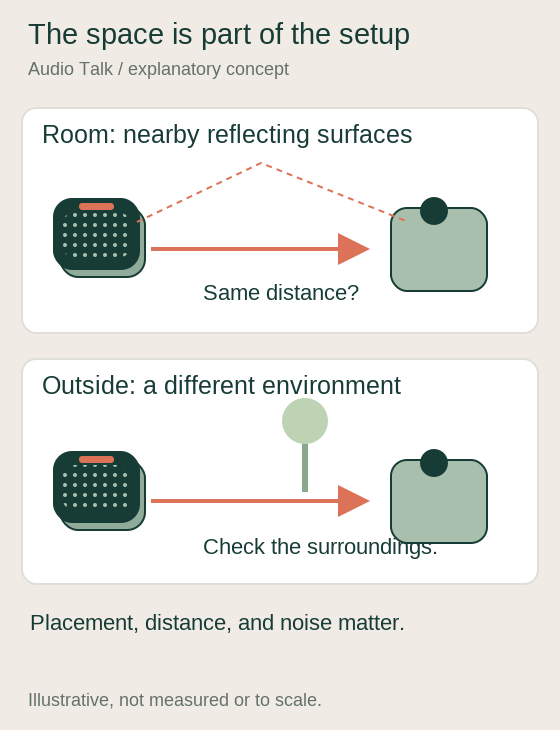
An open outdoor location often has a different set of nearby reflecting surfaces from a furnished room. A patio beside a wall and a speaker in the middle of a garden are also different arrangements, so “outside” isn't one uniform acoustic condition.
Use a stable support and the speaker's documented orientation, then compare a safe nearby position with the same recording. Treat the result as an observation about that location rather than proof that every outdoor speaker needs to sit against a wall.
Keep the environment practical: the placement shouldn't block a path, depend on an unstable edge, or exceed the product's care instructions. A portable label doesn't make every surface, weather condition, or mounting arrangement suitable.
Also consider the people around you when choosing the level and position. You can bring the listening area nearer to a supported setup instead of turning the speaker into a distant source that has to compete with the whole neighborhood.
Bring the comparison back to your listening distance
Check how far you are from the speaker in each setting before comparing the sound. At home you may sit close to a side table, while outdoors the speaker could be several steps away without you noticing that the practical listening arrangement changed.
For a useful informal check, keep the distance reasonably similar and replay the same short passage at a modest level. This won't measure the speaker's coverage, but it reduces one obvious difference between the indoor and outdoor comparison.
If you want a larger listening area, evaluate whether the exact speaker is intended to serve that routine. A compact device that is enjoyable beside one chair isn't automatically a substitute for a system designed to cover a gathering farther away.
Write down the seat or standing position as part of your placement note. That makes it easier to repeat the experiment and prevents a change in distance from being mistaken for a mysterious change in the speaker itself.
Separate the music from the noise competing with it
Wind, traffic, conversation, and other outdoor sounds can make details harder to follow even when the speaker continues to play normally. Compare in a quieter, appropriate spot if possible before deciding you need another bass boost or a larger device.
Listen for whether the same voices and bass notes become easier to follow when the background changes. That is useful information about the environment, although it doesn't establish a laboratory measurement of the speaker's output or your hearing.
Keep playback at a comfortable level and avoid solving every distraction by increasing volume. Moving the listening position or choosing a calmer location can be a practical answer when the surrounding noise is doing much of the competing.
If the speaker actually drops out or disconnects, investigate the source and wireless route separately. A radio interruption isn't the same complaint as a steady playback balance that seems different in a noisier location.
Check the mode, orientation, and battery state 2
Some portable speakers alter their behavior with documented orientation modes, EQ choices, or operating conditions. Check the exact manual and app so the comparison isn't unintentionally using a different preset or device setting outside.
Keep the battery state in your notes when testing a difference that appears later in a long session. Sony's SRS-XB100 guide provides a product-specific example of reduced maximum output at low battery, showing why operating state can be relevant alongside the environment.
That example doesn't establish the same behavior on every speaker, so use the documentation for the device you own. A battery icon alone isn't a full explanation of a sound change, especially when location and listening distance changed at the same time.
Compare one variable at a time and return to the saved baseline when a mode doesn't help. A dramatic bass setting may suit one passage while making another less clear, so check the normal range of music you actually play.
Build an outdoor arrangement around the actual routine
Decide how many people need to hear the speaker, where they'll sit, and how long the session should last. Then check placement, battery, and weather-related requirements before expecting the device to reproduce your indoor routine unchanged.
If the product supports a documented second-speaker mode, read its compatibility and channel behavior before adding another device. Two boxes playing nearby don't automatically create a properly paired stereo route, and the required model or app conditions can matter.
Keep a charging plan that follows the manufacturer's instructions, especially around moisture or temperature. A water-resistance rating doesn't necessarily apply to an open charging connection or every accessory in the setup.
For a future purchase, use the experience to define the missing function instead of looking only for a stronger bass claim. You may need a more suitable coverage arrangement, a longer documented runtime, or an easier supported placement for the actual space.
Decide whether the change is expected or needs support
Return to the original indoor arrangement with the same source, settings, and modest level if you suspect a fault. If the speaker behaves normally there, you've learned something useful about the changed conditions rather than confirming a general hardware failure.
If a persistent problem follows the speaker through several documented setups, contact support with the model, source, mode, battery state, and symptom. Include whether playback is continuous or interrupted so the manufacturer can separate the possible causes.
Keep the useful placement and settings as a simple reference for your next session. A small note about the table, seat, and mode can save you from repeating the same comparison each time you take the speaker outside.
A portable speaker doesn't have to sound identical in every space to be useful. Understanding the surroundings lets you choose a practical location and routine, then judge a real limitation without blaming every difference on the product.
Sources & how this guide was prepared
Audio Talk Editorial checked these primary sources on October 14, 2026. This is a research-based guide with original practical examples; it does not report our own equipment tests.
- Genelec: monitor placement and boundary interactions
- Sony SRS-XB100: charging and operating conditions
Manufacturer instructions for your exact model take priority. Read our editorial method · Photo and illustration credits