
A 1-ohm-stable monoblock amplifier can power a subwoofer system whose final impedance is 1 ohm, provided the amp’s output suits the subwoofer. The AUDIOZERONE ZE1000.1 is best for buyers comparing several impedance ratings; the Taramps BASS 1200 suits a system seeking 1,200 watts RMS; and the NVX is a fit for buyers who want a wired bass remote and speaker-level inputs. The options below cover a range of stated power outputs and tuning features.
| Amplifier | Best for | Key listed feature |
|---|---|---|
| AUDIOZERONE ZE1000.1 | Multiple impedance options | 1,000W RMS at 1 ohm |
| Taramps BASS 1200 | Higher-output bass systems | 1,200W RMS at 1 ohm |
| NVX Monoblock | Remote bass adjustment | Wired bass remote included |
| 2000W RMS Class D | High stated RMS output | Rated for 1–8 ohms |
| Taramps BASS 800 | Moderate-output systems | Up to +12dB bass boost |
AUDIOZERONE ZE1000.1 Monoblock Amplifier
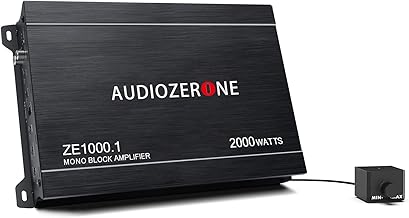
The AUDIOZERONE ZE1000.1 is best for buyers who want an amplifier with stated RMS output at multiple impedances. Its listed ratings are 1,000 watts RMS at 1 ohm, 650 watts RMS at 2 ohms, and 400 watts RMS at 4 ohms. The listing also gives a maximum output figure of 2,000 watts at 1 ohm; for system matching, the RMS rating is the more useful comparison.
The amp uses Class D circuitry and a MOSFET power supply. The supplied feature information describes Class D as a design that reduces power loss and supports a more compact, lighter amplifier format. It also lists a low-pass crossover, which is relevant for filtering the signal sent to a subwoofer.
- Best for: Buyers who may configure their system for 1, 2, or 4 ohms.
- Why it stands out: The listed RMS output changes by impedance, making its ratings straightforward to compare with a subwoofer system.
Limitation: The listed 1-ohm RMS output is 1,000 watts, so it is not the highest-output option in this group. Confirm the final speaker load is at least 1 ohm.
Taramps BASS 1200 Monoblock Amplifier

The Taramps BASS 1200 is best for a system that needs a listed 1,200 watts RMS at 1 ohm. Its feature information also specifies 1,000 watts RMS at 2 ohms, giving buyers a second stated output rating for comparison. Match the amplifier’s output to the subwoofer’s power handling rather than choosing by the largest number alone.
The listed frequency range is 8Hz to 250Hz. The amplifier also includes parametric bass boost from 35Hz to 60Hz, adjustable up to +10dB. These controls are useful to buyers who want to shape low-frequency response, but settings should be adjusted with the subwoofer and enclosure in mind.
- Best for: Buyers seeking more stated RMS power than the 800-watt option in this roundup.
- Why it stands out: It combines 1,200 watts RMS at 1 ohm with a specified bass-boost range.
Limitation: Bass boost can increase the demand placed on the subwoofer and amplifier. The listed information does not provide detailed installation or electrical-system requirements, so check the manufacturer’s guidance before installation.
NVX 1-Ohm Stable Monoblock Amplifier

The NVX monoblock is best for buyers who value flexible signal connection and convenient bass-level adjustment. Its listed output is 1,200 watts RMS at 1 ohm, with a stated peak figure of 2,400 watts. The product includes a wired bass-level remote, allowing the user to adjust bass level from the remote’s location.
Speaker-level inputs with signal-sensing remote turn-on are also listed. These features may be useful in an installation where the audio signal is taken from speaker wiring. The amp’s protection circuitry is described as covering thermal, overload, speaker-short, and DC-offset conditions.
- Best for: Buyers who want a bass remote and speaker-level inputs.
- Why it stands out: Its listed features combine 1,200 watts RMS at 1 ohm with four types of protection circuitry.
Limitation: The listed RMS output is lower than the 2,000-watt RMS figure claimed by one other product here. Verify that the NVX’s output meets the subwoofer’s requirements before choosing it.
2000W RMS Class D Monoblock Amplifier

This Class D monoblock is best for buyers looking for the highest stated 1-ohm RMS output among these five listings. Its supplied features claim 2,000 watts RMS at 1 ohm, 1,400 watts RMS at 2 ohms, and 800 watts RMS at 4 ohms. It is also described as supporting final speaker loads from 1 to 8 ohms.
The listing identifies Class D and MOSFET technology and describes the design as efficient, with reduced energy waste. The broad stated impedance range may offer more wiring flexibility, but the final load still needs to remain within the amplifier’s limits.
- Best for: Buyers whose subwoofer system is designed to use high RMS power at 1 ohm.
- Why it stands out: It lists output at three impedances and supports loads from 1 to 8 ohms.
Limitation: The supplied information gives no brand name or additional controls, such as a bass remote or crossover details. Confirm the product specifications and the subwoofer’s power handling before purchase.
Taramps BASS 800 Monoblock Amplifier
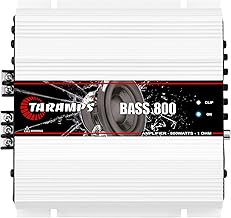
The Taramps BASS 800 is best for buyers who want a lower stated power level than the BASS 1200. Its supplied features identify it as an 800-watt RMS amplifier at 1 ohm for woofers and automotive sound systems. Selecting a lower-output amplifier can be appropriate when it better matches the subwoofer’s power-handling specifications.
The listed frequency response is 8Hz to 250Hz. For tuning, its parametric bass boost adjusts from 35Hz to 60Hz and can reach up to +12dB. This gives it a higher listed maximum boost than the BASS 1200, although boost amount alone does not determine overall system performance.
- Best for: Buyers seeking an 800-watt RMS option with bass tuning controls.
- Why it stands out: Its listed low-frequency range and adjustable boost provide system-shaping features.
Limitation: Its stated 1-ohm RMS output is lower than the other high-output options in this roundup. Avoid choosing it if the subwoofer system requires more power than the amplifier’s rating.
Buying Guide: How To Choose A 1-Ohm-Stable Monoblock Amp
What does 1-ohm stable mean?
A 1-ohm-stable amplifier is designed to operate with a connected speaker load of 1 ohm, according to its stated rating. The final impedance depends on the subwoofer voice coils and how they are wired. A system that ends below the amplifier’s minimum rated impedance can overload the amp. Check the final load before connecting the subwoofer, and do not assume that a 1-ohm rating means every wiring configuration is safe.
How much RMS power should the amp provide?
Use RMS output ratings when comparing sustained amplifier power. Peak or maximum figures describe a different measurement and should not replace the RMS rating when matching components. Compare the amp’s RMS output at the intended impedance with the subwoofer’s specified power handling. The amp should not be selected solely because it has the largest wattage number; the subwoofer, wiring configuration, and intended listening level all matter.
Why does the impedance rating change the output?
Many amplifiers list different output levels at different speaker impedances. In this group, the AUDIOZERONE provides stated RMS figures at 1, 2, and 4 ohms, while the 2000W Class D listing also gives output at those impedances. Use the rating for the actual final load, not a figure associated with another impedance. If the system may be reconfigured, check whether the amp lists output for each planned configuration.
Should I choose Class D?
Class D is a common amplifier design for subwoofer applications. The AUDIOZERONE and 2000W Class D listings describe efficiency and reduced power waste as design benefits. These claims do not replace a check of installation needs or product-specific instructions. Consider the amplifier’s listed output, available features, and the space and electrical requirements stated by its manufacturer.
Which tuning and connection features matter?
A low-pass crossover helps control which frequencies are sent to a subwoofer; the AUDIOZERONE listing identifies one. Bass boost can emphasize a selected low-frequency range, as listed on both Taramps amplifiers. The NVX adds a wired bass remote and speaker-level inputs with signal-sensing turn-on. Choose features that support your planned setup, and avoid assuming a control is included unless the product information says so.
What should I confirm before installation?
Confirm the subwoofer’s final wired impedance, the amplifier’s RMS rating at that impedance, and the subwoofer’s power-handling specifications. Follow the product’s installation instructions for wiring and electrical connections. The product details provided here do not specify every installation requirement, so consult the full manufacturer documentation for information not shown in the listing. If you are unsure how to calculate a multi-coil subwoofer’s final impedance, seek qualified installation help.
Frequently Asked Questions
Can a 1-ohm-stable amp power a 2-ohm subwoofer load?
A 1-ohm-stable amplifier may operate at a 2-ohm load if its specifications list that load. Check its 2-ohm RMS output, because power can differ from the 1-ohm rating.
Is a 1-ohm load louder than a 2-ohm load?
Not automatically. The amplifier may list more output at 1 ohm, but perceived loudness also depends on the subwoofer, enclosure, installation, and other system factors.
Should I compare peak watts or RMS watts?
Compare RMS watts for amplifier-to-subwoofer power matching. Treat peak or maximum output as a separate specification, not as a substitute for the RMS rating.
Can I wire any subwoofer to 1 ohm?
No. The final impedance depends on the subwoofer’s voice-coil configuration and wiring. Confirm the resulting load before connecting it to the amplifier.
Does bass boost increase amplifier output?
Bass boost raises the level in a selected frequency range. It can increase demand on the system, so use the control carefully and follow the amplifier and subwoofer guidance.