
The Edifier M90 is the clearest match for shoppers seeking 100-watt computer speakers because its listed name specifies 100W RMS. The other options below offer different trade-offs: compact 60W stereo speakers, a 66W RMS multimedia pair, a flexible soundbar system with 180W peak output, and wireless desktop speakers whose supplied product details do not state wattage.
| Product | Listed output | Best suited for |
|---|---|---|
| Edifier M90 | 100W RMS | Buyers prioritizing the requested rating |
| OHAYO 60W Speakers | 30W × 2 | Compact desktop stereo |
| INFITBO Detachable Soundbar | 180W peak | Flexible PC or TV placement |
| Edifier M60 | 66W RMS | Buyers considering a lower-output speaker |
| Audioengine A2+ Wireless | Not stated in supplied details | Wireless desktop listening |
Edifier M90 100W RMS Computer Speakers

The Edifier M90 is the most direct fit for a search focused on 100-watt computer speakers. Its product name identifies it as a desktop speaker pair with 100W RMS output, making it the only listed option that matches the requested wattage and explicitly labels that figure as RMS.
Best for: Buyers who want to start their comparison with a stated 100W RMS rating. Choose this if matching the wattage in the search is more important than choosing among detailed driver, connectivity, or enclosure specifications.
Limitation: The supplied product information does not describe the M90’s inputs, drivers, dimensions, or wireless features. Confirm those details on the product listing before deciding whether it suits your computer setup.
OHAYO 60W Compact Stereo Speakers
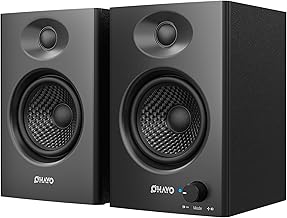
The OHAYO pair is rated at 30W per speaker, or 60W total according to its product description, so it is not a 100W model. Its stated components include a 0.75-inch carbon-fiber silk-dome tweeter and a 3-inch carbon-fiber full-range driver. A rear bass port and integrated independent sound card are also listed.
The compact design is intended for desktops and small rooms. Its MDF wooden enclosure is described as reducing box resonance, and the front-panel volume knob allows direct adjustment. Bluetooth 5.3 is identified in the product name.
Best for: Buyers who want a compact stereo pair and are willing to consider less than 100W RMS. It offers more detail about its drivers and physical controls than several alternatives here.
Limitation: Its listed 60W total output falls short of the 100W target. Do not treat its power rating as equivalent to the Edifier M90’s stated 100W RMS.
INFITBO Detachable Soundbar With Subwoofer

The INFITBO is a 2.1-channel system with a detachable layout rather than a conventional pair of desktop speakers. It can be arranged as a 32-inch soundbar, two connected speaker towers, or a wall-mounted bar. Its listed output is 180W peak, which is a peak figure and should not be compared directly with a 100W RMS rating.
The system includes a wired external 12-liter subwoofer with a 5.25-inch driver. The product description also lists Bluetooth 5.4 for receiving audio from source devices, three EQ modes, and independent bass and treble controls. Bar mode is just over two inches high, which may help it fit below some monitors or TVs.
Best for: Buyers who need flexible placement across a PC, monitor, or TV setup and want a separate subwoofer. The tower configuration is a better fit for a desktop than a single bar when speakers need to sit on either side of a display.
Limitation: The listed 180W is peak output, not RMS. The speaker sections and subwoofer use wired connections, so this is not a fully wireless speaker arrangement.
Edifier M60 66W RMS Multimedia Speakers

The Edifier M60 is listed as a 66W RMS multimedia speaker, making it a lower-output alternative to the M90. Its classic oak finish may suit buyers looking for a desktop pair that also fits a home-office or living-space aesthetic. The supplied product details identify the model and its RMS power rating but do not specify its drivers or connection options.
Best for: Shoppers comparing RMS-rated multimedia speakers who do not require a full 100W rating. The 66W RMS figure makes it easier to compare with the M90 than a product listing that provides only a peak-power number.
Limitation: The stated output is 34W below 100W RMS. Check the listing for connectivity and other specifications before choosing it for a specific computer or audio source.
Audioengine A2+ Wireless Desktop Speakers

The Audioengine A2+ is identified as a wireless Bluetooth desktop speaker pair. The product name makes it relevant to buyers who want wireless listening at a computer, but the supplied details do not state its wattage, speaker drivers, inputs, or dimensions. It therefore cannot be verified as a 100W model from the information available here.
Best for: Buyers whose main requirement is a wireless desktop-speaker option rather than a confirmed 100W RMS rating. Consider it alongside the M90 only after checking the current product listing for output and the connections you need.
Limitation: No power rating is provided in the supplied product information. Do not assume it meets the 100W target based on its inclusion in a search for 100-watt speakers.
Buying Guide: How to Choose Computer Speakers
Do you need exactly 100 watts?
Start by deciding whether 100W is a strict requirement or a general search target. Among these options, the Edifier M90 is the one explicitly listed at 100W RMS. The Edifier M60 is 66W RMS, and the OHAYO is listed at 60W total. The INFITBO’s 180W figure is peak output, while the Audioengine listing information supplied here does not state wattage.
Do not compare RMS and peak ratings as if they were the same measurement. RMS is a continuous-power specification, while peak output describes a maximum figure under specified conditions. A larger peak number does not, by itself, establish that a speaker delivers more continuous power than a model with a lower RMS rating.
What does RMS wattage tell you?
RMS wattage is useful for comparing the stated continuous output of speakers when manufacturers provide the same kind of specification. It does not tell you everything about how a speaker will sound. Driver design, enclosure construction, speaker placement, source quality, and the listening environment also affect the result.
For a fair comparison, look for an RMS rating for each model and check whether it describes the whole system or a single speaker. The OHAYO description’s 30W × 2 format makes its stated 60W total clear. The M90 name says 100W RMS, but the supplied details do not clarify how its output is allocated between speakers.
Would a stereo pair or soundbar fit your desk better?
A pair of desktop speakers can sit on either side of a monitor and may be easier to position for left-right stereo listening. The OHAYO is specifically described as compact, while the Edifier M90, M60, and Audioengine A2+ are identified as computer or desktop speaker pairs.
A soundbar can keep a desk visually simple, but the INFITBO offers several layout options instead of only one bar arrangement. Its sections can be split into towers, and its subwoofer requires a separate place on or near the floor. Measure your desk, monitor clearance, and available space before choosing a layout.
Do you want a separate subwoofer?
A separate subwoofer can be useful if low-frequency output is a priority, but it occupies space and adds another component to place. The INFITBO is the only product in this selection whose supplied description specifies an external subwoofer, including a 5.25-inch driver. The OHAYO product text mentions a rear bass port, which is part of its speaker enclosure and is not a separate subwoofer.
Choose a system with a subwoofer only if you can accommodate it and its wired connections. If your desk is small, a compact pair may be easier to place.
Which connections should you check?
Confirm that the speakers offer an input your computer can use before buying. The Audioengine product name identifies Bluetooth wireless support, and the OHAYO listing names Bluetooth 5.3. The INFITBO lists Bluetooth 5.4 for receiving audio from a source device, but its speaker sections and subwoofer connect by wire.
The supplied details do not list all inputs for the Edifier M90 or M60. Check the current product descriptions for wired input types, Bluetooth availability, and any included cables. A wireless source connection does not necessarily mean that every part of a speaker system operates without wires.
How much desk space is available?
Check the dimensions of the speakers and any subwoofer against your desk before ordering. The OHAYO is described as compact and space-saving, while the INFITBO can be configured as a bar or two towers. The M90 and M60 product information supplied here does not state their dimensions, so verify measurements from the listing.
Also consider where the volume control sits. The OHAYO description identifies an easy-to-reach front-panel volume knob. For models without a stated control location, check the product listing to see whether volume adjustments happen on the speaker, a remote, or the connected computer.
Frequently Asked Questions
Which product here is listed as 100W RMS?
The Edifier M90 is listed in its product name as a 100W RMS desktop speaker. The supplied details do not give a more complete breakdown of that output.
Is 180W peak the same as 100W RMS?
No. The INFITBO’s 180W figure is identified as peak output, while the Edifier M90’s 100W figure is identified as RMS. These are different types of power ratings and should not be treated as directly equivalent.
Are the OHAYO speakers 100 watts?
No. The OHAYO description lists 30W per speaker, or 60W total. It is a lower-output alternative, not a model listed at 100W RMS.
Which option has a separate subwoofer?
The INFITBO system includes an external 12-liter subwoofer with a 5.25-inch driver, according to its product description. Its speaker sections and subwoofer use wired connections.
Does the Audioengine A2+ meet the 100W requirement?
The supplied product information does not state the A2+ wattage, so its compliance with a 100W requirement cannot be confirmed here. Check the product listing for its power specification before choosing it for that reason.
Should I choose the highest wattage number?
Not without checking how the rating is measured. Compare RMS with RMS where possible, and consider desk space, inputs, speaker layout, and subwoofer needs alongside output.