
The best 1000-watt speaker amp depends on whether you need power for a subwoofer or several full-range speakers. For a subwoofer, the AUDIOZERONE ZE1000.1 and CT Sounds CT-1000.1D list 1,000 watts RMS at a 1-ohm load; the Skar Audio RP-1200.1D offers higher listed RMS output at 1 ohm. For multiple speakers, the Pioneer GM-A6704 and DS18 SXE-1200.4/RD are four-channel options, but their RMS ratings are much lower than their advertised maximum wattage.
| Product | Best For | Key Listed Output |
|---|---|---|
| AUDIOZERONE ZE1000.1 | Subwoofer systems needing selectable load support | 1,000W RMS at 1 ohm |
| Skar Audio RP-1200.1D | Subwoofers and remote bass-level adjustment | 1,200W RMS at 1 ohm |
| Pioneer GM-A6704 | Four-channel speaker setups | 60W RMS x 4 at 4 ohms |
| DS18 SXE-1200.4/RD | Full-range speakers with adjustable crossover | 60W RMS x 4 at 4 ohms |
| CT Sounds CT-1000.1D | Compact subwoofer installations | 1,000W RMS at 1 ohm |
AUDIOZERONE ZE1000.1 Monoblock Amplifier
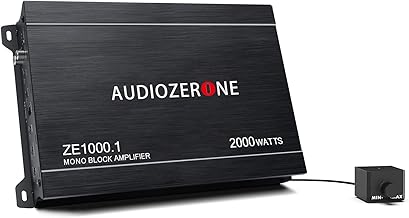
The AUDIOZERONE ZE1000.1 is a Class D monoblock amplifier designed for subwoofer use. It is the best fit among these picks for shoppers who want a stated 1,000 watts RMS at 1 ohm and published output figures for several speaker-load options.
Its listed ratings are 1,000 watts RMS at 1 ohm, 650 watts RMS at 2 ohms, and 400 watts RMS at 4 ohms. The amplifier is described as stable at 1 ohm and includes a low-pass crossover. Its Class D design is intended to reduce power loss and heat compared with less efficient designs.
Choose this if your subwoofer system’s final impedance matches one of the listed loads and you want a monoblock with multiple output ratings. Check your subwoofer wiring plan and amplifier specifications before installation. Limitation: this is a mono subwoofer amplifier, not a four-channel amp for powering a complete set of cabin speakers.
Skar Audio RP-1200.1D Monoblock Amplifier

The Skar Audio RP-1200.1D is best for a subwoofer setup that needs more than 1,000 watts RMS at a 1-ohm load, based on the supplied product specifications. It is a Class D MOSFET monoblock amplifier, with a listed peak output of 1,600 watts and RMS output of 1,200 watts at 1 ohm.
The listed frequency response is 20 Hz to 250 Hz, making this model suited to bass-focused use rather than a full-range speaker system. An onboard bass EQ switch provides a +6 dB or +12 dB boost at 45 Hz. A remote subwoofer-level control is included, allowing bass level adjustment from the listening position.
Best for: buyers who want a dedicated subwoofer amplifier with a remote level control and a selectable bass boost. Match the amp’s output to the subwoofer’s power handling and final impedance. Limitation: the listed 1,200-watt RMS rating applies at 1 ohm; do not assume that output at another impedance without checking the product’s specifications.
Pioneer GM-A6704 Four-Channel Amplifier

The Pioneer GM-A6704 is the better choice for buyers who need to power multiple car speakers instead of a single high-output subwoofer. It is a bridgeable, four-channel Class AB amplifier, and its listed maximum output is 1,000 watts. That maximum figure should not be confused with RMS power.
Pioneer lists 60 watts RMS per channel at 4 ohms, or 190 watts RMS per channel pair in bridged mode. The four-channel design lets users configure front and rear speakers, while bridging can provide a different channel arrangement. The product information also describes its Class AB design as balancing efficiency and performance.
Choose this if your priority is a multi-speaker setup and the RMS output suits the speakers you plan to use. It may also be relevant if you want the option to bridge channels for a compatible application. Limitation: its 1,000-watt maximum rating does not mean it supplies 1,000 watts RMS to one speaker or subwoofer.
DS18 SXE-1200.4/RD Full-Range Amplifier

The DS18 SXE-1200.4/RD is best for drivers who want a four-channel amp for full-range car speakers and adjustable sound settings. Its supplied product description lists 60 watts RMS x 4 at 4 ohms and a 1,200-watt maximum rating. It is a Class A/B design rather than a monoblock subwoofer amp.
The SXE series features a variable crossover and adjustable gain input sensitivity, which let users tailor the signal for their audio setup. Its multi-channel design supports separate speaker channels. The product description also emphasizes a compact form for custom vehicle installations, although buyers should confirm the available mounting space before choosing an amplifier.
Better for: a speaker-focused system where crossover adjustment and four channels matter more than high mono subwoofer output. Compare its RMS rating with the speakers’ needs, not just the 1,200-watt maximum figure. Limitation: the supplied information does not give alternate RMS ratings at other impedances, so verify the full specifications for your intended configuration.
CT Sounds CT-1000.1D Compact Monoblock

The CT Sounds CT-1000.1D is best for buyers seeking a compact, dedicated subwoofer amplifier with 1,000 watts RMS listed at a 1-ohm load. The product information also gives output figures at 2 and 4 ohms, making it easier to compare with different subwoofer wiring configurations.
Its listed output is 1,000 watts RMS at 1 ohm, 650 watts RMS at 2 ohms, and 350 watts RMS at 4 ohms, with those ratings specified at 14.4 volts. The frequency response is listed as 0 to 320 Hz. A bass knob is included, and the product description highlights a small footprint for vehicle installations.
Choose this if you need a compact mono amp and your subwoofer system’s load aligns with the stated ratings. Its listed output at 2 and 4 ohms is lower than at 1 ohm, so compare the rating for your actual final load. Limitation: the wattage figures are tied to a stated 14.4-volt condition, and the amplifier is intended for bass-focused use rather than powering four full-range speakers.
Buying Guide: How to Choose a 1000-Watt Speaker Amp
Do you need an amp for a subwoofer or multiple speakers?
Start by deciding what the amplifier must power. A monoblock amp, such as the AUDIOZERONE, Skar Audio, or CT Sounds model in this list, is designed for a single-channel subwoofer application. A four-channel amp, such as the Pioneer or DS18, is better suited to several speakers. A product described as “1000 watts” is not automatically appropriate for either job; channel count and RMS output matter.
What does RMS power tell you?
RMS output is more useful for matching an amplifier to speakers than a maximum or peak wattage figure. For example, the Pioneer’s listed maximum is 1,000 watts, but its specified RMS output is 60 watts per channel at 4 ohms. The Skar’s stated RMS output is 1,200 watts at 1 ohm. Compare the amplifier’s RMS rating at your intended impedance with the speaker or subwoofer’s power-handling specifications.
How important is impedance?
Impedance affects how much power an amplifier can provide. Several monoblock models here list different RMS outputs at 1, 2, and 4 ohms. Confirm the final impedance created by the subwoofer’s voice coils and wiring before buying. Do not select an amplifier based only on its highest wattage rating; use the rating that corresponds to the load you will actually connect.
Should you choose Class D or Class AB?
Class D designs are common among the monoblock subwoofer options here. The AUDIOZERONE description notes reduced power loss and heat, while the CT Sounds listing emphasizes efficiency and a compact chassis. The Pioneer and DS18 are Class AB models designed for multi-channel speaker use. Class alone does not determine whether an amplifier is the right match; channel layout, RMS output, and intended use should guide the choice.
Which controls and installation details should you compare?
- Crossover controls: A low-pass crossover or variable crossover can help tailor the signal to the connected speakers.
- Bass adjustment: The Skar includes an onboard bass EQ switch and remote subwoofer-level control; the CT Sounds listing specifies an included bass knob.
- Physical space: Check the amplifier’s dimensions and the mounting area in your vehicle before purchase. The CT Sounds and DS18 descriptions mention compact designs, but installation space still needs to be confirmed.
- Power ratings: Check whether a listed output is RMS or maximum, and note any stated conditions such as the 14.4-volt ratings for the CT Sounds model.
- System role: Choose a mono model for a subwoofer-focused application or a four-channel amp when you need several speaker channels.
How can you narrow down these five options?
For 1,000 watts RMS at 1 ohm, compare the AUDIOZERONE ZE1000.1 and CT Sounds CT-1000.1D, including their listed output at your intended impedance and their installation features. Choose the Skar if its 1,200-watt RMS rating at 1 ohm and remote bass-level control better match your requirements. For four-channel speaker setups, compare the Pioneer’s stated RMS output and bridged rating with the DS18’s crossover and gain adjustments.
Frequently Asked Questions
Is a 1000-watt amp always 1000 watts RMS?
No. Some products list maximum or peak power separately from RMS output. Check the RMS rating, the number of channels, and the impedance at which the rating applies.
Which of these amps is best for a subwoofer?
The AUDIOZERONE, Skar Audio, and CT Sounds models are monoblock amplifiers suited to subwoofer applications. Compare their RMS ratings at your subwoofer’s final impedance before choosing.
Which models are designed for multiple car speakers?
The Pioneer GM-A6704 and DS18 SXE-1200.4/RD are four-channel amplifiers. Their listed RMS output is much lower than the 1,000-watt-class monoblock ratings, so match them to speaker requirements rather than maximum wattage claims.
Does a 1-ohm rating mean every subwoofer can be connected at 1 ohm?
No. The subwoofer’s voice coils and wiring determine the final load. Confirm that the completed wiring configuration is supported by the amplifier and that the subwoofer can handle the resulting power.
Why do amplifier output ratings vary by impedance?
An amplifier can produce different output at different loads. The products in this list publish separate ratings for some impedance levels, so use the figure that matches your planned system load instead of assuming one output applies to every setup.