
The best 110V adapter for a car is a 12V-to-AC power inverter that converts vehicle DC power into household-style AC power. The PiSFAU 200W is best for compact, lighter-duty charging, while the BESTEK 300W suits travelers who want two AC outlets. For higher stated output, consider the Pro Chaser 400W or a BESTEK 400W model; the EPANEE inverter adds a high-output USB-C port. Check your vehicle’s outlet limit and each device’s power draw before choosing.
| Product | Best For | Listed AC Output | Notable Ports |
|---|---|---|---|
| PiSFAU 200W | Compact everyday charging | 200W | 2 AC, 4 USB |
| BESTEK 300W | Travel and common electronics | 300W continuous | 2 AC, 2 USB |
| Pro Chaser 400W | Higher stated output | 400W | 2 AC, 2 USB |
| BESTEK 400W | USB-C and USB-A charging | 400W | 2 AC, USB-C, USB-A |
| EPANEE 400W | USB-C fast charging and protections | Continuous rating not clearly stated | 2 AC, USB-C, USB-A |
PiSFAU 200W Car Power Inverter
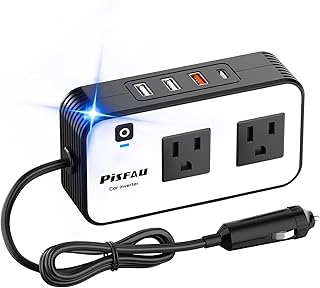
The PiSFAU converts a vehicle’s 12V DC power to 110V AC and provides two standard AC outlets alongside four USB charging ports. Its listed 200W output makes it the lower-output option in this group. The product is described as compact and lightweight, with dimensions of 2.7 by 1.4 by 5 inches and a listed weight of 8.5 ounces or more.
Best for: Drivers who want a small inverter for charging several low-power devices, such as phones, tablets, or compatible laptop chargers. It was selected for its combination of four USB ports and two AC outlets in a compact form.
Consider: Its stated output is 200W, below the 300W and 400W options here. Add up the wattage of devices that will run at the same time and avoid exceeding the inverter’s limit. The supplied features do not specify USB charging rates.
BESTEK 300W Car Power Inverter

This BESTEK inverter is listed with 300W of continuous DC-to-AC power and 700W of instantaneous peak power. It has two AC outlets and two USB ports, with the USB outputs described as 4.8A. The product description lists an 11–17V input range and a 32-inch cigarette-lighter plug cord.
Best for: Travelers who want two AC outlets for compatible electronics and USB ports for smaller devices. Its stated 300W continuous capacity is higher than the PiSFAU’s, while the iPhone-sized design is intended to be easy to carry on trips or camping outings.
Consider: The 700W figure is peak output, not the continuous rating. Use the 300W continuous figure when checking appliances. Its cigarette-lighter connection may not be suitable for drawing the full inverter output in every vehicle; check the vehicle’s outlet rating and product instructions.
Pro Chaser 400W Power Inverter

The Pro Chaser is listed as a 400W DC-to-AC inverter with an 800W peak output. It includes two 110V AC sockets and two USB ports. The feature information describes the USB ports as high-speed 3.1A ports and also refers to a 4.8A dual USB output. Its compact design has a 30-inch cord.
Best for: Buyers comparing inverters by stated continuous output who need AC outlets for compatible devices and USB charging for phones, tablets, or cameras. The product description names laptops, breast pumps, DVD players, and bottle warmers as examples in the 300W–400W range.
Consider: Appliances with motors or heating elements can have startup or operating demands that differ from their labels. Confirm the device’s requirements before use, and do not treat the 800W peak figure as available continuous power. The listed USB-output details are not entirely consistent, so check the current product specifications if USB speed is a deciding factor.
BESTEK 400W Inverter With USB-C

This BESTEK model is specified for 400W of DC-to-AC output and has two 110V AC outlets. Its USB connections include a USB-C port rated at PD 30W and a USB-A port rated at QC 3.0. The product description identifies phones, tablets, cameras, laptops, breast pumps, DVD players, and bottle warmers among its intended device examples.
Best for: Drivers who want a 400W-rated inverter and direct USB-C and USB-A charging in one unit. Compared with the BESTEK 300W model, this option has a higher stated continuous output and a USB-C port with a listed 30W PD rating.
Consider: The 400W figure does not mean every vehicle’s accessory socket can supply that much power. Verify the vehicle’s socket limit and the inverter’s connection instructions. A 30W USB-C port may not provide the charging rate required by every USB-C device.
EPANEE 400W Car Power Inverter

The supplied product details list two 110V AC sockets, a 65W PD USB-C port, and an 18W QC USB-A port. They also describe a built-in fuse and protection against short circuits, overload, low voltage, overvoltage, and high temperature. A cooling fan is said to start automatically when the internal temperature reaches 113°F.
Best for: Buyers who prioritize a higher-rated USB-C charging port and want the listed protective features and temperature-controlled fan. The product information mentions charging devices such as phones and MacBooks, as well as powering equipment such as a car vacuum or air compressor.
Consider: The supplied description does not clearly state the continuous wattage; it says “Watts continuous” without a number and mentions 800W instantaneous power. Confirm the continuous rating and device requirements before purchase, especially for equipment with high startup draw.
Buying Guide: How to Choose a 110V Car Adapter
Is a 110V car adapter an inverter?
Usually, yes. A car’s accessory outlet supplies low-voltage DC power, while common household-style devices use AC power. A car power inverter changes DC power into AC power and provides one or more AC outlets. These products are not simple plug-shape adapters: they perform a power conversion, and their output limits matter.
Check that the product is designed for a vehicle’s 12V system and that its outlet provides the voltage required by your device. The products compared here are described as 12V-to-110V inverters, though the BESTEK 300W listing gives an input range of 11–17V.
How much wattage do you need?
Look at the device label or manual for its power consumption, usually stated in watts. Add the wattage of devices you plan to run at the same time, and choose an inverter whose continuous rating meets that combined demand. Leave room below the limit rather than planning to run continuously at maximum output.
Pay attention to the distinction between continuous output and peak output. Continuous output is the relevant figure for ongoing use. Peak output is a short-term figure and should not be used as the inverter’s everyday capacity. For example, the BESTEK 300W listing specifies 300W continuous and 700W instantaneous output.
Devices with heating elements, motors, or compressors may draw more power when starting than during normal operation. Check both startup and running requirements. A product’s example list does not guarantee that every model of a named device will work; the device’s actual wattage and the inverter’s limits determine suitability.
Will a cigarette-lighter plug deliver the full rated power?
Not necessarily. The inverter’s headline output and the vehicle’s accessory-socket capacity are separate limits. A socket, fuse, or vehicle electrical system may restrict the power available through a cigarette-lighter plug. Read the vehicle manual and inverter instructions, and do not assume a 400W inverter can deliver 400W through every vehicle outlet.
If the device load exceeds the permitted socket capacity, do not try to overcome the limit by using the inverter beyond the instructions. Choose an appropriately rated power source and connection method. This is especially important for appliances that draw substantial or variable power.
Do you need AC outlets, USB ports, or both?
Choose AC outlets for devices that use a standard household plug, provided their power draw is within the inverter’s rating. USB ports can charge compatible phones, tablets, and other electronics without using an AC outlet. Port count alone does not indicate charging speed, so check the listed output for each port if fast charging matters.
Among these options, the PiSFAU has four USB ports. The BESTEK 300W and Pro Chaser have two USB ports, while the BESTEK 400W and EPANEE list both USB-C and USB-A outputs. The BESTEK 400W specifies USB-C PD 30W; the EPANEE lists USB-C PD 65W and USB-A QC 18W.
What other features should you compare?
- Port layout: Check the number of AC outlets and USB ports against the devices you need to connect.
- Size and cord length: Compact models can be easier to pack. Compare listed dimensions or cord length when placement in the vehicle matters.
- Cooling: Some inverters use fans or heat-dissipation designs. A fan may produce audible sound, and airflow can matter during operation.
- Protection details: Compare any listed safeguards, such as fuse, overload, or temperature protection. Do not assume a feature is included unless the product information says so.
- Device type: Confirm requirements for sensitive electronics, appliances, and equipment with motors. The product details provided here do not establish that every inverter is suitable for every device.
Which option fits a common use case?
For phones and other small devices with several USB connections, the PiSFAU offers four USB ports and a 200W listed output. For travel use with a 300W continuous rating, the BESTEK 300W has two AC outlets and two USB ports. For a higher stated continuous rating, compare the Pro Chaser and BESTEK 400W, while accounting for the vehicle outlet’s own limit.
Choose the BESTEK 400W if its listed USB-C PD 30W and USB-A QC 3.0 ports match your charging needs. Consider the EPANEE if its listed 65W USB-C output and protection features are priorities, but first verify its continuous wattage because the supplied description does not provide a complete figure.
Frequently Asked Questions
Can I plug a regular household device into a 110V car inverter?
Only if the device’s voltage, plug, and power requirements match the inverter’s output and limits. Check its wattage and any startup-power requirement before connecting it.
Can a car inverter charge a laptop?
It can charge a laptop if the laptop charger is compatible with the inverter’s AC output and its power draw stays within the inverter and vehicle limits. A compatible USB-C port may also work if it supplies the required charging power.
Is 400W better than 200W for a car inverter?
A 400W rating provides a higher stated continuous capacity than 200W, but it is not automatically a better choice. Match the inverter to the combined device load and the vehicle’s available power.
Can I run a car inverter while the vehicle is off?
The product information provided does not specify vehicle-off operating time. An inverter draws power from the vehicle’s electrical system, so consult the vehicle and inverter instructions before using it with the engine off.
What does peak wattage mean on a car inverter?
Peak wattage is a short-term maximum, not the ongoing output rating. Use the stated continuous wattage when deciding whether an inverter can operate a device.
Do USB-C ports on inverters charge every laptop?
No. The laptop must support charging through USB-C, and the port’s power output must meet the laptop’s needs. Check the laptop specifications and the inverter’s listed USB-C rating.