
A 12-channel amplifier can distribute audio across multiple rooms while providing separate speaker channels for a whole-home setup. The Dayton Audio MA1260 is a direct match for shoppers seeking a 12-channel multi-zone amplifier; the OSD Nero MX1250 adds six-zone DSP features. The Pyle PT12050CH.5 is another 12-channel option, while the Rockville and Pyle PT8000CH are alternatives for buyers whose room and channel needs differ.
| Product | Best For | Key Distinction |
|---|---|---|
| Dayton Audio MA1260 | 12-channel multi-zone setups | Purpose-named multi-zone amplifier |
| OSD Nero MX1250 | Six-zone systems needing DSP | Per-zone EQ and dual bus inputs |
| Pyle PT12050CH.5 | 12-channel systems with wireless source features | Bluetooth, USB, SD, and AUX inputs |
| Rockville Rock Zone | Eight-zone installations | Bluetooth, digital inputs, and zone volume controls |
| Pyle PT8000CH | Four-zone rack systems | Speaker selector volume control and bridgeable switches |
Dayton Audio MA1260 Multi-Zone Amplifier

The Dayton Audio MA1260 is the most direct match for shoppers searching for a 12-channel multi-room amplifier. Its product name identifies it as a 12-channel, multi-zone amplifier, making it a candidate for installations that need multiple amplified speaker channels distributed around a home.
Best for: Buyers who want a purpose-named 12-channel multi-zone amplifier and are comparing whole-home distribution equipment. It was selected because its stated channel count and multi-zone designation align closely with the search.
Choose this if your system plan calls for 12 amplifier channels and you are prepared to verify the number of zones, input arrangement, and speaker requirements in the full product documentation. The supplied product information does not specify those details, so confirm them before purchase.
Limitation: The provided listing data does not describe inputs, output power, or zone-level controls. Shoppers who need particular connectivity or per-zone adjustment should check those specifications rather than assume they are included.
OSD Nero MX1250 DSP Matrix Amplifier

The OSD Nero MX1250 is a 12-channel amplifier designed for a six-zone whole-home audio system. Its listed features include DSP, dual bus inputs, per-zone EQ, Class D power, and a rack-mount distribution format.
Best for: Buyers planning six listening zones who want more than basic amplification. Per-zone EQ is a useful listed feature for people who want to adjust equalization by room, while dual bus inputs may suit system designs that use two shared audio buses.
Choose this if your priority is a clearly specified six-zone, 12-channel configuration with DSP and rack installation. It is a strong comparison point against simpler 12-channel models when zone-level sound adjustment matters.
Limitation: Its stated configuration is six zones, not 12 independent zones. The product name does not detail every supported input, control method, or power rating, so verify those requirements in the full specifications before planning the installation.
Pyle PT12050CH.5 Wireless 12-Channel Amplifier
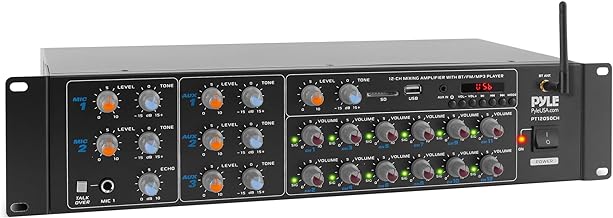
The Pyle PT12050CH.5 is listed as a 12-channel wireless Bluetooth power amplifier and multi-zone audio source mixer. Its named connections and source features include Bluetooth, USB, SD, and AUX inputs, plus a digital LED display panel.
Best for: Buyers who want a 12-channel amplifier with several built-in ways to access audio sources. Bluetooth and the listed USB, SD, and AUX inputs can be relevant when a system needs more than one source option.
Choose this if source flexibility is important alongside a 12-channel design. The product listing also advertises 6,000 watts maximum power output, but shoppers should consult the full specifications to understand how power is rated and distributed across channels.
Limitation: A stated maximum power figure alone does not explain real-world output per channel or the speaker load requirements. Confirm the detailed ratings and zone-control arrangement before matching the amplifier to speakers or a room plan.
Rockville Rock Zone Eight-Channel Receiver

The Rockville Rock Zone is an eight-channel, multi-room home receiver and amplifier with eight zone volume controls. Its listed connections include USB, optical, and coaxial inputs, along with RCA outputs. It is also described as rack mountable and includes Bluetooth.
Best for: Buyers whose planned system needs up to the listed eight-channel configuration rather than a 12-channel amplifier. The selection gives shoppers a lower-channel alternative with several named input types and individual zone volume controls.
Choose this if the system’s channel and room requirements fit its eight-channel description and you value the listed mix of wireless and wired source connections. Its advertised power figures are 4,000 watts peak and 1,000 watts RMS at 4 ohms; compare rating conditions carefully with other equipment.
Limitation: This is not a 12-channel model. Avoid choosing it if your installation specifically requires 12 amplified channels, and confirm how the eight zone controls correspond to the intended speaker layout.
Pyle PT8000CH Four-Zone Amplifier

The Pyle PT8000CH is a four-zone stereo amplifier described as a 19-inch rack-mount model. Its listed features include speaker selector volume control, LED audio level display, and four-channel bridgeable switches. The product name also advertises 8,000 watts, which should be checked against the full rating details.
Best for: Buyers building a four-zone system who prefer a rack-style amplifier with speaker selection and visible level indication. The bridgeable switches are a stated feature for shoppers who need to investigate different channel configurations.
Choose this if four zones match the project and the specified controls fit the system plan. It is included as a multi-room alternative, not as a direct substitute for every 12-channel installation.
Limitation: The listing identifies four zones, so it may not meet a system plan calling for six zones or 12 separate amplifier channels. Confirm channel mapping and power specifications before connecting speakers.
Buying Guide: How to Choose a Multi-Room Amplifier
How many channels and zones do you need?
Start by counting the rooms or listening areas that need audio, then determine how many speaker channels each area requires. A channel is an amplified output; a zone is an area that can be managed as part of the audio system. The two terms are related but do not always mean the same thing. For example, the OSD Nero MX1250 is described as 12-channel and six-zone, while the Rockville model is described as eight-channel with eight zone volume controls.
Map the intended setup before comparing products. Write down the number of rooms, speakers per room, and whether any room needs more than one channel. Do not assume that a model with a certain channel count automatically supports the same number of independently controlled zones.
Do you need 12 channels, or would fewer be enough?
A 12-channel model is a logical starting point when the installation requires 12 amplified speaker channels. The Dayton Audio MA1260 and Pyle PT12050CH.5 are both identified as 12-channel options. The OSD Nero MX1250 also has 12 channels, with a stated six-zone layout.
If the planned system needs fewer outputs, an eight-channel model such as the Rockville Rock Zone or a four-zone model such as the Pyle PT8000CH may be worth comparing. Choosing a product with fewer channels can limit future expansion, so allow for additional rooms or speakers only when the product’s specifications support the planned configuration.
Which inputs and sources are important?
List every source you expect to connect before selecting an amplifier. The Pyle PT12050CH.5 names Bluetooth, USB, SD, and AUX inputs. The Rockville Rock Zone lists Bluetooth, USB, optical, and coaxial inputs, plus RCA outputs. These feature lists make it easier to compare source options, but they do not establish that every input can feed every zone independently.
If you use a television, streamer, media player, or other source, verify the connection type and routing options in the full product documentation. Also check whether you need one shared source across rooms or different sources in different areas. That distinction can affect which input arrangement is suitable.
When does per-zone control or DSP matter?
Per-zone controls can help tailor a system to different rooms. The Rockville listing specifically names eight zone volume controls. The OSD Nero MX1250 lists per-zone EQ and DSP, features that matter to shoppers seeking room-by-room equalization options. The Pyle PT8000CH lists speaker selector volume control and an LED audio level display.
Check exactly what each control adjusts. A zone volume control, an equalizer, and a source selector perform different jobs. If you need independent source selection as well as separate volume, confirm that the product supports both functions instead of relying on a general multi-zone label.
What should you check about power and speakers?
Compare the amplifier’s detailed output ratings with the speakers’ requirements. Product titles may emphasize maximum or peak wattage, but those figures do not by themselves explain continuous output per channel, impedance conditions, or how power is shared. The Rockville listing provides both peak and RMS figures with a stated 4-ohm condition; the Pyle PT12050CH.5 and PT8000CH titles advertise maximum figures. Review the complete specifications before making a match.
Also confirm the supported speaker impedance and the wiring arrangement. Do not assume that a high total wattage figure guarantees an appropriate output for every room. If the installation includes many speakers or long cable runs, plan the system around the manufacturer’s stated limits and suitable installation practices.
Should you choose a rack-mount model?
Rack mounting can be useful when several audio components will be kept together in a cabinet or equipment room. The OSD Nero MX1250 and Pyle PT8000CH are described as rack-mount models, and the Rockville Rock Zone is listed as rack mountable. Check the unit’s physical dimensions and the space needed for connections and ventilation in its documentation.
If the amplifier will sit on a shelf instead, consider whether its size, controls, and cable connections suit the available area. The product data provided here does not include dimensions for every model, so verify fit before planning a rack or cabinet.
Frequently Asked Questions
What is a 12-channel multi-room amplifier?
It is an amplifier with 12 amplified channels intended for distributing audio across multiple rooms or listening areas. The number of channels does not necessarily equal the number of independently controlled zones.
Is a 12-channel amplifier the same as a 12-zone amplifier?
No. Channels describe amplified outputs, while zones describe listening areas or control groupings. Check the product’s zone layout and control features separately from its channel count.
Which listed model is specifically described as a six-zone amplifier?
The OSD Nero MX1250 is described as a 12-channel amplifier for a six-zone multi-room system. Its listed features include DSP and per-zone EQ.
Which option lists Bluetooth and several wired inputs?
The Pyle PT12050CH.5 lists Bluetooth, USB, SD, and AUX inputs. The Rockville Rock Zone lists Bluetooth, USB, optical, and coaxial inputs.
Can an eight-channel amplifier replace a 12-channel model?
Only if the installation needs no more than the supported channel configuration and the zone controls meet the project’s needs. The Rockville Rock Zone is an eight-channel model, so it is not a direct match when 12 channels are required.
What should I verify before buying?
Confirm the channel and zone layout, source routing, input types, per-zone controls, output ratings, supported speaker loads, and physical fit. Use the complete product documentation for details not stated in the product information here.