
A 12V cigarette lighter inverter converts a vehicle’s DC power into household-style AC power and often includes USB charging ports. The BESTEK 300W model is a strong option for buyers who want two AC outlets and two USB ports; the PiSFAU 200W suits travelers who need several USB connections; and the Ampeak and FOVAL 150W models are better for lighter-duty charging. For more rated AC output, the Pro Chaser lists 400W, but check your vehicle’s outlet limits before using a high-wattage inverter.
| Product | Best For | Listed AC Output |
|---|---|---|
| BESTEK Power Inverter | Two AC outlets and compact portability | 300W continuous |
| PiSFAU Car Power Inverter | More USB charging ports | 200W |
| Ampeak Car Power Inverter | Basic AC and USB charging | 150W |
| FOVAL Car Power Inverter | Small, lightweight travel charging | 150W continuous |
| Pro Chaser Power Inverter | Higher listed output for road trips | 400W steady |
BESTEK 300W Power Inverter
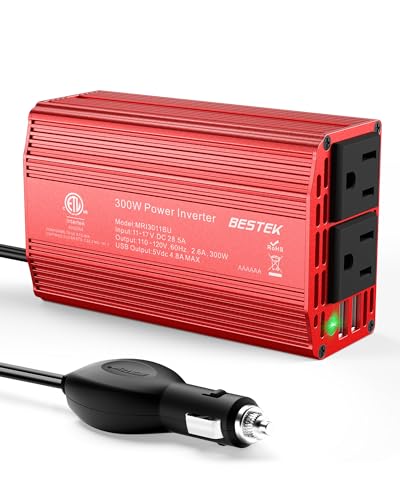
The BESTEK inverter converts 12–17V DC to 110V AC and lists 300W of continuous output with 700W of instantaneous power. It has two AC outlets and two USB ports, each listed at 4.8A. Its compact, iPhone-sized design and 32-inch cigarette lighter plug make it suited to travel, work trips, and camping.
Best for: Drivers who want two AC outlets alongside USB charging in a compact package. It was selected for its combination of stated 300W continuous output, multiple connection types, and longer-than-short cord.
Limitation: A vehicle’s cigarette lighter outlet may not support the inverter’s full rated output. Check the vehicle manual and the connected device’s power draw before use.
PiSFAU 200W Car Power Inverter

PiSFAU’s inverter provides DC 12V to AC 110V conversion, two U.S.-standard AC outlets, and four USB charging ports. The manufacturer describes its circuit design as high-efficiency and its heat-dissipation design as intended to reduce heat and operating noise. At 2.7 by 1.4 by 5 inches, it is designed to take up little space and weighs 8.5 ounces or more, according to the listing.
Best for: Travelers who expect to charge several USB devices and want two AC outlets available. The four USB ports distinguish it from simpler car inverters with only one or two USB connections.
Limitation: Its listed AC output is 200W, so compare that figure with the total wattage required by devices using the outlets. The listing does not specify the individual USB-port output in the supplied product details.
Ampeak 150W Car Power Inverter

The Ampeak converts 12V DC to 120V AC and includes one AC outlet and two USB ports rated at 2.4A. The product listing states that it has 11 layers of protection for vehicle electronics and accessories, along with 88% conversion efficiency for its AC outlets. It is intended for charging devices such as laptops, phones, and lighting strings in cars, RVs, and trucks.
Best for: Drivers who need a straightforward inverter for modest charging needs rather than several AC outlets. Its one AC outlet and dual USB ports cover a basic mix of plug-in and USB-powered devices.
Limitation: The listed output is 150W, which is lower than the 200W and 300W choices here. Confirm that the combined load of the devices you plan to connect stays within the inverter’s rating.
FOVAL 150W Compact Car Inverter
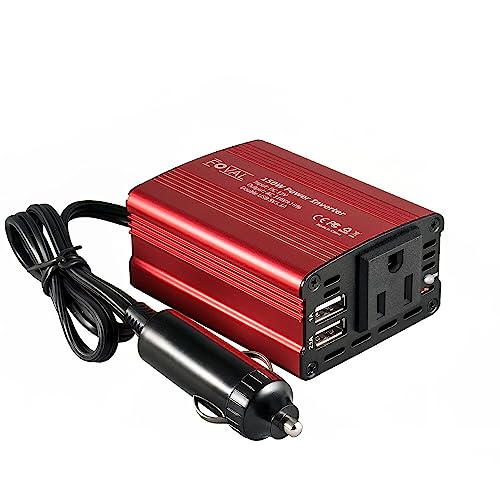
The FOVAL inverter supplies 150W of continuous 12V DC to 110V AC power through one AC outlet. It also has two USB ports with a combined maximum output of 3.1A. The listing describes the unit as credit-card-sized, measuring 3.2 by 2.5 by 1.5 inches, and weighing 8 ounces or more. Its aluminum shell is another listed feature.
Best for: Buyers who prioritize a compact unit for road trips, work, outdoor activities, or mobile living. Choose this if one AC outlet and two USB ports meet your needs and easy storage matters more than higher AC output.
Limitation: Its single AC outlet and 150W continuous rating make it less suitable for users who need to power several AC devices or higher-wattage equipment at once.
Pro Chaser 400W Power Inverter
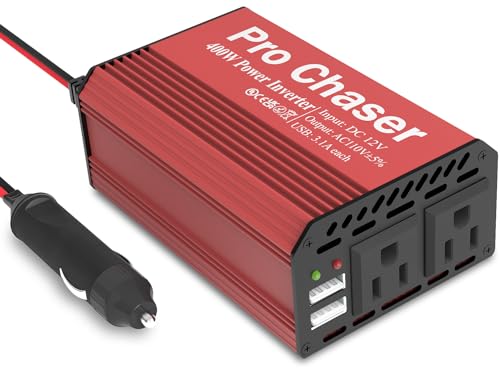
Pro Chaser lists 400W of steady DC-to-AC power and 800W peak output. The inverter has two 110V AC sockets and two USB ports. Its compact, cellphone-sized design comes with a 30-inch cord. The listing positions it for road trips and outdoor use, and names laptops, breast pumps, DVD players, and bottle warmers among examples of devices to power.
Best for: Buyers looking for the highest stated continuous AC output among these five picks, plus two AC sockets and USB ports. It may be a better fit than a 150W model when the combined device load is higher but remains within the inverter and vehicle limits.
Limitation: The listed 400W rating does not establish that every vehicle’s cigarette lighter outlet can supply that amount. Verify the vehicle’s outlet rating before relying on the inverter at high loads.
Buying Guide: How To Choose A 12V Cigarette Lighter Inverter
How much wattage do your devices need?
Start by checking the power requirements printed on each device or its power adapter. An inverter’s wattage rating is not the same as the amount every vehicle outlet can provide. Add the wattage of devices you may run at the same time, then compare the total with both the inverter’s continuous rating and the vehicle’s outlet limit. Leave room below the maximum rather than assuming the peak rating is available for continuous use.
Continuous output matters for devices that draw power for more than a brief moment. Peak output is a separate, short-duration figure when a product lists one. For example, BESTEK lists 300W continuous and 700W instantaneous output, while Pro Chaser lists 400W steady and 800W peak. Do not treat either peak figure as the normal operating capacity.
How many AC outlets and USB ports are useful?
Choose the connection layout around what you expect to charge. Two AC outlets can be useful when you need two plug-in devices, while several USB ports can reduce the need for separate car chargers. Port count does not necessarily mean every connection can deliver its maximum output simultaneously, so check the manufacturer’s detailed specifications if simultaneous charging performance is important.
A single AC outlet may be sufficient for one laptop charger or another compatible device, while a combination of AC and USB ports can serve passengers with different charging needs. Compare the total output rating as well as the number of ports.
Will it work with your vehicle’s cigarette lighter outlet?
Check the vehicle owner’s manual for the cigarette lighter or 12V accessory outlet’s voltage and current limits. The inverter must match the vehicle’s supply, and the outlet must be able to support the intended load. A product’s high wattage rating alone does not confirm that it can draw its full output from every 12V socket.
Also consider cord length and where the inverter will sit. BESTEK lists a 32-inch plug cord, and Pro Chaser lists a 30-inch cord. A compact model may be easier to store, but it still needs a stable, ventilated location that does not obstruct driving or vehicle controls.
What should you know about device compatibility?
Compare the device’s power adapter requirements with the inverter’s AC output and USB-port specifications. USB-C and USB-A charging speeds vary by port and connected device. The products selected above list different USB configurations, but the supplied details do not provide complete port-by-port output information for every model.
Do not assume that a device will operate simply because it can physically plug in. Some equipment has a startup demand or power requirement that exceeds what a small vehicle inverter can supply. If the listing does not clearly state compatibility with a particular appliance, check the device and inverter specifications before connecting them.
Which features matter for travel and regular use?
Portability is useful when the inverter moves between vehicles or is packed for trips. The BESTEK, PiSFAU, and FOVAL listings emphasize compact designs, while the FOVAL listing also gives dimensions and weight. For longer use, cooling and heat management deserve attention: PiSFAU describes heat-dissipation features, while other models may have different designs. Follow the manufacturer’s operating instructions and keep ventilation openings unobstructed.
Safety features are another point to compare. Ampeak states that its product includes 11 layers of protection, and other listings describe protection against specific electrical or thermal conditions. Check each product’s full documentation for the protections actually provided. Do not infer a protection feature that is not stated in the product information.
Frequently Asked Questions
What does a 12V cigarette lighter inverter do?
It converts power from a vehicle’s 12V DC accessory outlet into AC power for compatible plug-in devices. Many models also include USB ports for charging phones and other USB-powered electronics.
Can a car cigarette lighter inverter run a laptop?
It may run a laptop if the laptop charger’s power draw is within the inverter’s continuous output and the vehicle outlet can supply the required power. Check both ratings before connecting it.
Can I use multiple ports at the same time?
Some inverters are designed with multiple AC and USB ports, but the total available output is still limited. Check the product’s full specifications and keep the combined device load within the inverter and vehicle outlet limits.
Is a 400W inverter always better than a 150W inverter?
No. A higher-rated inverter can offer more stated AC capacity, but it may not be necessary for low-power charging. The vehicle’s outlet must also support the load, and the connected devices must stay within the inverter’s limits.
Can I leave a car inverter plugged in when the vehicle is off?
Use the vehicle and inverter instructions to determine whether the outlet remains powered when the vehicle is off. An inverter can draw power from the vehicle, so follow the manufacturer’s guidance to avoid unwanted battery drain.