Best 150 Watt Subwoofer Amplifier: Top Picks for Home Theater and Music
Choosing a 150 watt subwoofer amplifier helps ensure strong, controlled bass for home theaters, music systems, and gaming rigs. The following models feature solid power, reliable class D or A/B designs, and easy integration with passive subwoofers or full-range setups. This guide highlights five standout options, with practical notes on sound quality, power efficiency, and compatibility to help you decide which amplifier best fits your room and gear.
| Product | |||
|---|---|---|---|
| Dayton Audio APA150 | Dayton Audio | 150W | Low distortion, quiet operation, reliable Class A/B topology |
| Fosi Audio M03 | Fosi Audio | 150W RMS into 4 ohms | Versatile PBTL/ SUB modes, compact, efficient |
| Klipsch Synergy Sub-100 | Klipsch | 150W continuous | Cerametallic woofer, strong home theater bass |
| Rockville BLUAMP 21 | Rockville | 150W RMS (200W peak) | 2.1 channel with Bluetooth 5.1, flexible inputs |
| Soundavo PSB-300 | Soundavo | 150W RMS @ 8 ohms | Adjustable crossover/phase, multiple inputs |
Below are five highly relevant options, each offering solid bass performance and practical features for different setups—from compact living rooms to dedicated home theaters.
Dayton Audio APA150 150W Power Amplifier
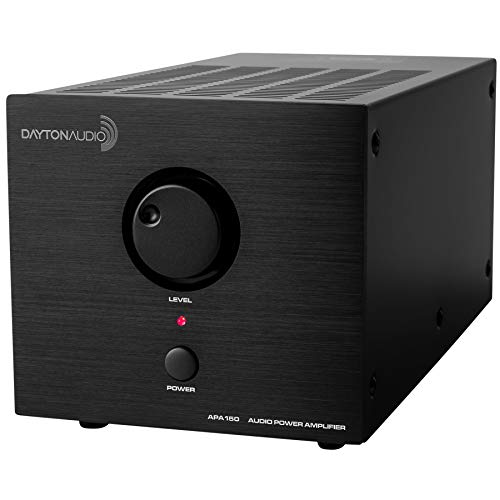
The Dayton Audio APA150 uses a Class A/B topology designed for low distortion and reliability. It also features near-silent fan operation suitable for near-field listening or compact setups. The amplifier employs high current, discrete output transistors that run cool and quiet, making it a solid choice for driving a sub or as part of a larger multi-amplifier system. Its straightforward, single-channel design makes integration with passive subwoofers straightforward and dependable in either home theater or stereo configurations.
Fosi Audio M03 200W Subwoofer Amplifier

The M03 offers two modes: PBTL for full-frequency mono or SUB for dedicated sub operation. It uses the TI TPA3255D2, featuring a high-speed gate driver and PurePath Ultra-HD design for low distortion. Power output reaches up to 200W, with 150W RMS into 4-ohm loads and 120W into 8-ohm loads. Note that the included 32V/5A supply limits maximum power, so a more robust supply would be needed for peak performance. This makes it versatile for both sub-specific and full-range applications in small to medium rooms.
Klipsch Synergy Black Label Sub-100

The Klipsch Sub-100 packs a 10-inch Cerametallic front-firing woofer with an all-digital amplifier delivering 150 watts continuous power and up to 300 watts dynamic power. Its front-firing design helps with placement flexibility, and Klipsch’s Cerametallic woofer is designed for strong, tight bass response with minimal distortion. Ideal for home theater bass underlays or music that benefits from punchy, accurate low-end performance in mid-sized rooms.
Rockville BLUAMP 21 2.1 Channel Bluetooth Amplifier

The Rockville BLUAMP 21 provides 200W peak/150W RMS across 2.1 channels, including a built-in Bluetooth 5.1 module for wireless streaming. With RCA and 3.5mm inputs, it supports a wide range of devices, enabling easy integration with turntables, TVs, or gaming consoles. The included passive subwoofer output and compact design make it a practical choice for compact living rooms or desktop setups seeking clean, room-filling bass with flexible source options.
Soundavo PSB-300 Subwoofer Amplifier

The Soundavo PSB-300 provides up to 240W RMS at 4 ohms and 150W RMS at 8 ohms, with a selectable low-pass filter and phase control, enabling precise subwoofer tuning. It supports a full range of connections from line-level inputs to LFE, and includes a passthrough for legacy receivers. The adjustable crossover (35 Hz to 180 Hz) and 0°–180° phase adjustment help tailor bass to room acoustics and speaker placement, making it suitable for serious home theater builds or multi-sub setups.
Buying Guide: Key Considerations for 150 Watt Subwoofer Amplifiers
When selecting a 150W subwoofer amplifier, consider how you plan to use it, the size of your room, and your existing system compatibility. Here are several perspectives to help you compare models effectively:
- Power and impedance compatibility: Confirm the amplifier’s RMS power at your target load (typically 4–8 ohms) and ensure it can drive your subwoofer without clipping. Some units list peak power that can be misleading for musical transients; focus on RMS ratings for a reliable benchmark.
- Topology and distortion: Class A/B designs often offer low distortion at mid-range volumes but can run warmer, while Class D designs tend to stay cooler and more efficient, with comparable bass output. Balance efficiency against thermal constraints in your space.
- Modes and flexibility: Sub-only vs. full-range or PBTL modes affect how the amp interacts with passive speakers and other subs. If you have a multi-sub or a hybrid system, look for models with switchable modes or LFE inputs.
- Filtering and crossover control: A variable low-pass filter and adjustable crossover frequencies help tailor bass to room acoustics and main speakers. Phase adjustment improves integration with existing drivers and reduces bass cancellation.
- Inputs and future-proofing: Consider devices you currently own (turntables, Blu-ray players, gaming consoles) and future gear. Amps with multiple inputs (RCA, 3.5mm, Bluetooth) offer more versatility.
- Build quality and protection: Overload, thermal, and short-circuit protections extend amplifier life. Quiet fans or passive cooling options are preferable in near-field listening setups or compact spaces.
- Placement and room acoustics: Front-firing vs. down-firing designs affect placement latitude. Take into account room dimensions, furniture, and wall makeup to minimize standing waves and boost perceived bass quality.
- System integration: If you’re integrating with a powered sub or adding to an existing stereo, ensure compatibility with your receiver’s sub output settings and speaker-level connections.
These considerations help ensure you choose a 150W sub amplifier that delivers reliable bass performance, integrates smoothly with your components, and fits your listening environment without compromising bass control or clarity.