
A 16-channel audio amplifier is designed to power multiple speakers or zones from one centralized system. The Soundavo MZ-1650S is best for installations needing independent zone inputs and shared audio buses, while the JBL DA1650 is a simpler 16-channel, 8-zone option. The other products below are not 16-channel amplifiers; they are included as alternatives for buyers whose actual needs may be fewer zones, Bluetooth streaming, or a compact two-channel setup.
| Product | Best suited to | Channels or zones stated |
|---|---|---|
| Soundavo MZ-1650S | Flexible, centralized multi-zone systems | 16 channels, 8 zones |
| JBL DA1650 | 16-channel distribution with protection features | 16 channels, 8 zones |
| Pyle PT12050CH.5 | Multi-input use with Bluetooth and media playback | 12 channels, per product name |
| Fosi Audio BT20A | Simple stereo playback for a small space | 2 channels |
| Rockville RCS180-6 | Commercial audio across six zones | 6 zones, 70V |
Soundavo MZ-1650S 16-Channel Amplifier

The Soundavo MZ-1650S is a 16-channel power amplifier organized for as many as eight stereo speaker zones. It is the strongest fit in this list for an installation where different areas may need separate sources, while some zones may also share a source.
- Rated at 50 watts per channel at 8 ohms or 80 watts per channel at 4 ohms, according to the product information.
- Can be bridged for up to 160 watts at 8 ohms when a zone needs more power.
- Provides eight independent zone inputs and two shared bus inputs.
- Includes S/PDIF and analog inputs and a 2U rackmount format, as stated in the product name.
Best for: Custom-installed systems that need centralized amplification, independent zone sources, and shared-source distribution. Its stated channel and zone count makes it directly relevant to buyers searching for a 16-channel amplifier.
Consideration: Confirm the speaker impedance and the planned input routing before choosing it. Bridging changes how channels are used, so do not assume every channel can deliver the bridged rating simultaneously.
JBL DA1650 Distribution Amplifier

The JBL DA1650 is listed as a 16-by-50-watt distribution amplifier with eight zones. That configuration makes it a direct candidate for buyers who want multiple amplified outputs arranged for multi-zone distribution.
- Product features state 16 outputs at 50 watts each.
- Supports eight zones.
- Offers bridgeable outputs.
- Includes over-current and thermal protection, according to the listing.
Best for: Buyers prioritizing a clearly stated 16-channel, eight-zone layout and protection features. It is a relevant alternative to the Soundavo when the listed wattage and zone count align with the installation plan.
Consideration: The supplied product information does not specify speaker impedance, input count, or per-zone source-routing details. Check the product documentation for those details before designing a system around it.
Pyle PT12050CH.5 Multi-Zone Amplifier
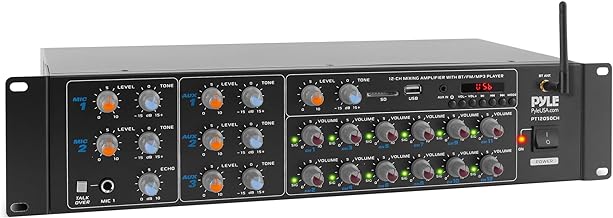
The Pyle PT12050CH.5 is a feature-rich alternative for buyers who value playback and input options, but its product name identifies it as a 12-channel amplifier, not a 16-channel model. It should not be treated as a like-for-like substitute when all 16 channels are required.
- Features Bluetooth streaming from compatible Bluetooth-enabled devices, as described in the listing.
- Provides USB, SD, and AUX inputs, plus two 1/4-inch microphone inputs.
- Has a digital LED display panel.
- The listing advertises 6000 watts maximum output; this figure is not presented as a per-channel rating in the supplied information.
Best for: A buyer seeking a multi-channel system with Bluetooth and several media or microphone connections, and who does not need 16 channels.
Consideration: The 12-channel designation is the key limitation for this search. Compare the actual channel count and power specifications with the speaker plan rather than relying on the advertised maximum-output figure alone.
Fosi Audio BT20A Stereo Amplifier

The Fosi Audio BT20A is a compact two-channel amplifier rather than a 16-channel distribution amp. It is included for shoppers who discover that a simple stereo setup, not multi-zone distribution, is what their room requires.
- Product features describe 100 watts by two maximum output power.
- Supports Bluetooth and is intended for passive speakers.
- Has bass and treble controls and a one-touch power switch.
- The listing describes use in spaces such as an office, bedroom, living room, garage, or patio.
Best for: A small, straightforward stereo system where two channels are sufficient and Bluetooth is useful. Its compact design and simple controls are relevant to buyers who do not need centralized multi-room amplification.
Consideration: This is not a substitute for a 16-channel amplifier. Choose it only when the system requires two amplified channels rather than several separately powered zones.
Rockville RCS180-6 70V Amplifier

The Rockville RCS180-6 is a six-zone, 70V commercial amplifier with several listed source options. It is not a 16-channel amplifier, but may fit a commercial installation that needs six zones and the stated 70V format.
- Provides 180 watts across six zones, with independent volume knobs, according to the product features.
- Supports Bluetooth, USB, SD card, RCA, optical, and three microphone inputs.
- Includes an FM tuner and optical input.
- The listing identifies it for settings such as restaurants, cafes, offices, or retail spaces.
Best for: Commercial users who need six zones, independent zone volume control, and multiple listed source connections.
Consideration: Its six-zone design does not meet a requirement for 16 amplifier channels. Check that the installation calls for a 70V amplifier before comparing it with conventional multi-channel models.
Buying Guide: How To Choose A 16-Channel Audio Amplifier
Do you need 16 channels or 16 zones?
Channels and zones are related but are not interchangeable terms. A 16-channel amplifier may be arranged to power eight stereo zones, with two channels serving each zone. A product may also use “zone” to describe a separately controlled listening area, so check the channel-to-zone arrangement before buying.
Write down the number of speaker pairs and listening areas in the system. If eight rooms each need stereo sound, a 16-channel, eight-zone design may suit the plan. If the system uses a different speaker layout, count the required amplifier channels rather than relying on the word “zone.”
How much power does each speaker need?
Compare the amplifier’s power rating with the speakers’ requirements and the intended listening level. The Soundavo listing states different output figures at 8-ohm and 4-ohm loads, so impedance matters when interpreting its specifications. Do not compare wattage figures without checking whether they refer to a channel, a bridged pair, or a maximum-output claim.
Bridging combines amplifier channels for a higher-power output under supported conditions. That may be useful for a particular zone, but it changes the number of channels available for other speakers. Verify the manufacturer’s instructions and speaker load requirements before planning bridged operation.
Will every room play the same source?
Some installations send one source to every room; others need different audio in different areas. The Soundavo’s listed independent zone inputs and two shared bus inputs are relevant when a system may use either approach. The JBL listing confirms an eight-zone layout but does not specify its input-routing details in the supplied product information.
Before choosing, identify the sources you plan to connect and whether each area must select its own source. Check the full product documentation for input types, routing controls, and how shared sources can be distributed.
Should you choose a 70V system?
A 70V amplifier is a different system choice from a conventional multi-channel amplifier. The Rockville is explicitly described as a 70V commercial model, while the Soundavo and JBL information focuses on multi-channel distribution and speaker-load ratings. Match the amplifier format to the speakers and wiring design already planned for the installation.
If you are replacing existing equipment, verify the system’s speaker type and wiring before purchasing. The 70V label alone does not establish that the amplifier is suitable for every commercial speaker installation.
Which inputs and controls matter?
List the sources you actually use, such as a media player, TV, phone, or microphone, and compare them with the amplifier’s stated connections. The products in this list vary: the Soundavo includes S/PDIF and analog inputs; the Pyle lists Bluetooth, USB, SD, AUX, and microphone inputs; and the Rockville lists several commercial source options.
Also consider how the system will be operated. Independent volume controls can matter when different rooms need different levels. Bluetooth and media-card playback may be useful in some setups, but they do not replace the need to confirm channel count, speaker compatibility, or source routing.
How should you compare product specifications?
- Confirm the actual number of amplifier channels, not just the number of speakers a listing says it can power.
- Check how many zones are supported and whether each zone is stereo or mono.
- Compare power ratings at the speaker impedance used in the installation.
- Look for supported input types and source-distribution options.
- Confirm whether the amplifier is designed for a conventional speaker load or a 70V system.
- Treat maximum-output claims cautiously when the listing does not provide a comparable per-channel rating.
For this selection, the Soundavo and JBL are the products whose supplied descriptions identify 16 channels and eight zones. The Pyle, Fosi, and Rockville models address different channel counts or system formats, so they are alternatives only when the original 16-channel requirement is flexible.
Frequently Asked Questions
What is a 16-channel audio amplifier used for?
A 16-channel amplifier provides 16 amplified output channels for a multi-speaker installation. Depending on the design, those channels can serve multiple stereo zones or other speaker arrangements.
Is a 16-channel amplifier the same as an eight-zone amplifier?
No. A model can have 16 amplifier channels arranged as eight stereo zones, but the terms describe different things. Confirm the product’s channel-to-zone layout.
Which listed products are actually 16-channel models?
The Soundavo MZ-1650S and JBL DA1650 are identified as 16-channel models in the supplied product information. The Pyle is described as 12-channel, the Fosi as two-channel, and the Rockville as six-zone 70V.
Can a two-channel amplifier replace a 16-channel model?
Not when the system needs 16 amplified channels. A two-channel amplifier such as the Fosi BT20A is relevant only when the installation needs a basic stereo output.
What does bridged output mean?
Bridging uses amplifier channels together to provide a higher-power output under supported conditions. It can reduce the channels available for other speakers, so check the product’s instructions and speaker requirements.
What should I verify before buying?
Confirm channel count, zone layout, speaker impedance, power requirements, input connections, and source-routing needs. For a 70V commercial setup, also verify that the amplifier and speaker system are designed for that format.